


Adaption, implementation and evaluation of collaborative service improvements in the testing and result communication process in primary care from patient and staff perspectives: a qualitative study
- PMID: 28854919
- PMCID: PMC5577659
- DOI: 10.1186/s12913-017-2566-8
Adaption, implementation and evaluation of collaborative service improvements in the testing and result communication process in primary care from patient and staff perspectives: a qualitative study
Abstract
Background: Increasing numbers of blood tests are being ordered in primary care settings and the swift and accurate communication of test results is central to providing high quality care. The process of testing and result communication is complex and reliant on the coordinated actions of care providers, external groups in laboratory and hospital settings, and patients. This fragmentation leaves it vulnerable to error and the need to improve an apparently fallible system is apparent. However, primary care is complex and does not necessarily adopt change in a linear and prescribed manner influenced by a range of factors relating to practice staff, patients and organisational factors. To account for these competing perspectives, we worked in conjunction with both staff and patients to develop and implement strategies intended to improve patient satisfaction and increase efficiency of existing processes.
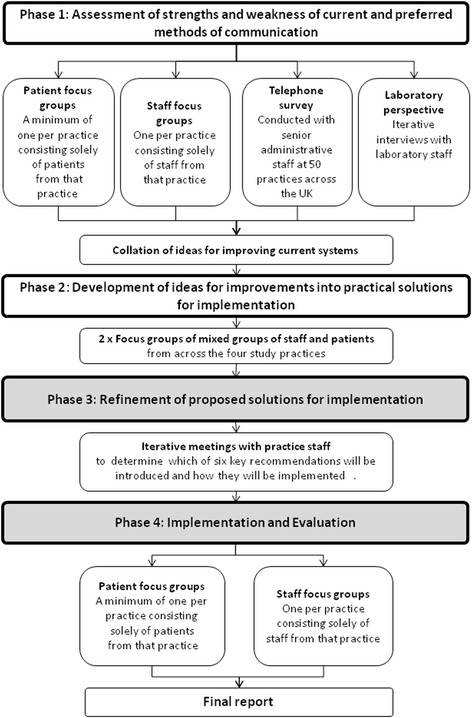
Methods: The study applied the principles of 'experience-based co-design' to identify key areas of weakness and source proposals for change from staff and patients. The study was undertaken within two primary practices situated in South Birmingham (UK) of contrasting size and socio-economic environment. Senior practice staff were involved in the refinement of the interventions for introduction. We conducted focus groups singly constituted of staff and patients at each practice to determine suitability, applicability and desirability alongside the practical implications of their introduction.
Results: At each practice four of the six proposals for change were implemented these were increased access to phlebotomy, improved receptionist training, proactive communication of results, and increased patient awareness of the tests ordered and the means of their communication. All were received favourably by both patients and staff. The remaining issues around the management of telephone calls and the introduction of electronic alerts for missing results were not addressed due to constraints of time and available resources.
Conclusions: Approaches to tackling the same area of weakness differed at practices and was determined by individual staff attitudes and by organisational and patient characteristics. The long-term impact of the changes requires further quantitative evaluation.
Keywords: Clinician-patient communication/relationship; Cllaborative/interdisciplinary care; Healthcare delivery/health services research.
Conflict of interest statement
Authors’ information
RJL is Director of the NIHR Collaboration for Leadership in Applied Health Research and Care (CLAHRC) - Birmingham and Black Country and SMG is a Theme Leader. RJM holds an NIHR Professorship and is supported by NIHR Oxford CLAHRC.
Ethics approval and consent to participate
This study was given favourable opinion by the National Research Committee of West Midlands - The Black Country and by the Birmingham and Black Country Comprehensive Local Research Network (REC reference number: 10/H1202/71). All patient and staff participants gave informed consent to participate in the study.
Competing interests
The authors declare they have no competing interests.
Publisher’s Note
Springer Nature remains neutral with regard to jurisdictional claims in published maps and institutional affiliations.
Figures
References
-
- Hickner J, Graham DG, Elder NC, Brandt E, Emsermann CB, Dovey S, et al. Testing process errors and their harms and consequences reported from family medicine practices: a study of the American Academy of family physicians National Research Network. Qual Saf Health Car. 2008;17:194–200. doi: 10.1136/qshc.2006.021915. - DOI - PubMed
-
- Elder NC, McEwen TR, Flach JM, Gallimore JJ. Creating safety in the testing process in primary care offices. In: Henriksen K, Battles JB, Keyes MA, Grady ML, editors. Advances in Patient Safety: New Directions and Alternative Approaches (Vol. 2: Culture and Redesign) Rockville, MD: Agency for Healthcare Research and Quality (US); 2008. - PubMed
MeSH terms
Grants and funding
LinkOut - more resources
Full Text Sources
Other Literature Sources
Medical
