


Diesel engine exhaust accelerates plaque formation in a mouse model of Alzheimer's disease
- PMID: 28854940
- PMCID: PMC5577845
- DOI: 10.1186/s12989-017-0213-5
Diesel engine exhaust accelerates plaque formation in a mouse model of Alzheimer's disease
Abstract
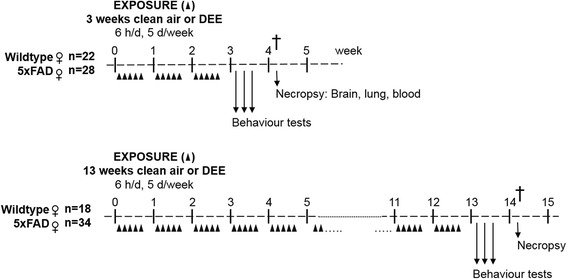
Background: Increasing evidence from toxicological and epidemiological studies indicates that the central nervous system is an important target for ambient air pollutants. We have investigated whether long-term inhalation exposure to diesel engine exhaust (DEE), a dominant contributor to particulate air pollution in urban environments, can aggravate Alzheimer's Disease (AD)-like effects in female 5X Familial AD (5XFAD) mice and their wild-type female littermates. Following 3 and 13 weeks exposures to diluted DEE (0.95 mg/m3, 6 h/day, 5 days/week) or clean air (controls) behaviour tests were performed and amyloid-β (Aβ) plaque formation, pulmonary histopathology and systemic inflammation were evaluated.
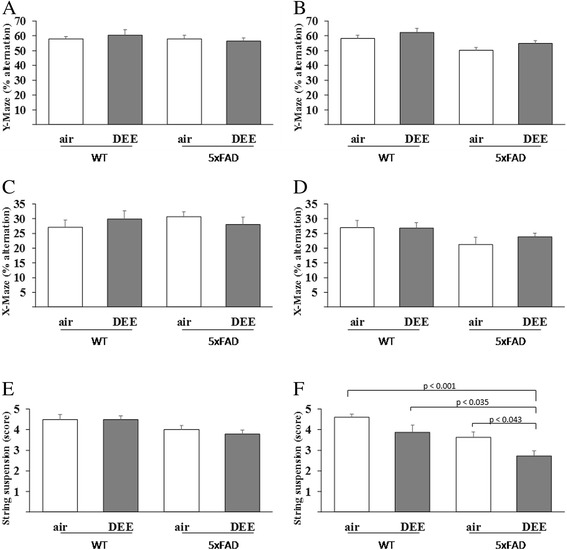
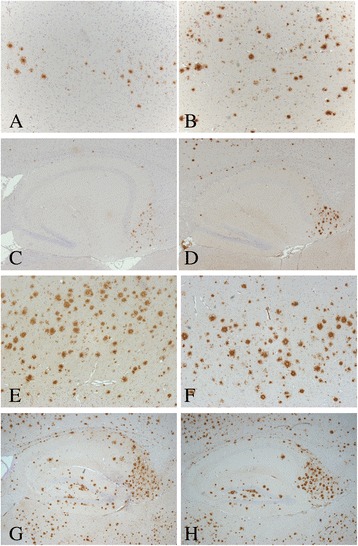
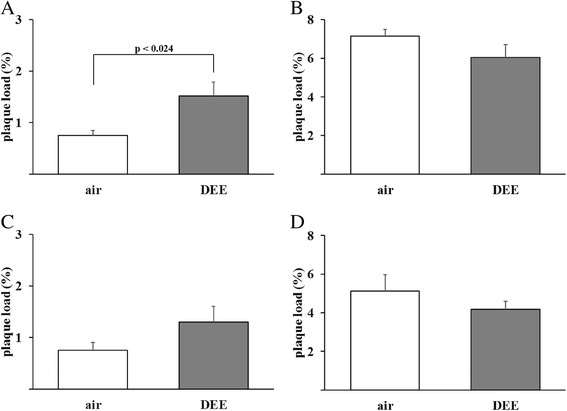
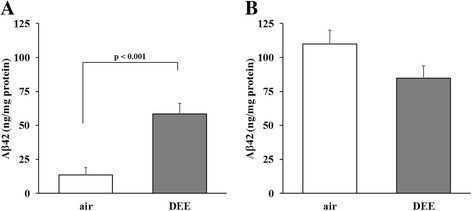
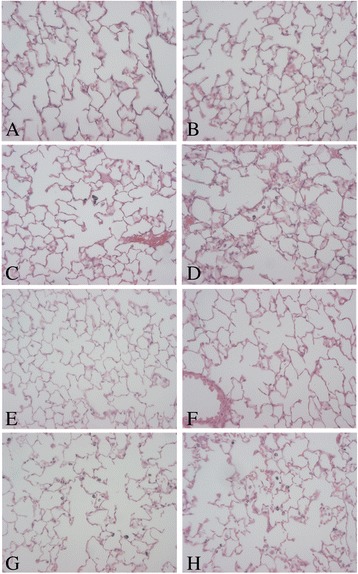
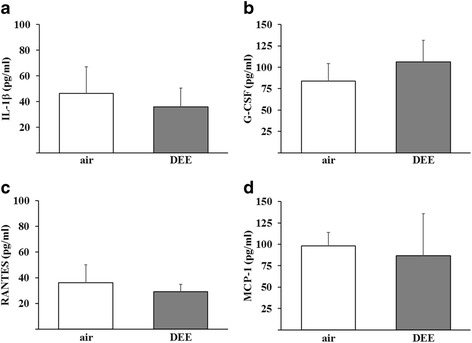
Results: In a string suspension task, assessing for grip strength and motor coordination, 13 weeks exposed 5XFAD mice performed significantly less than the 5XFAD controls. Spatial working memory deficits, assessed by Y-maze and X-maze tasks, were not observed in association with the DEE exposures. Brains of the 3 weeks DEE-exposed 5XFAD mice showed significantly higher cortical Aβ plaque load and higher whole brain homogenate Aβ42 levels than the clean air-exposed 5XFAD littermate controls. After the 13 weeks exposures, with increasing age and progression of the AD-phenotype of the 5XFAD mice, DEE-related differences in amyloid pathology were no longer present. Immunohistochemical evaluation of lungs of the mice revealed no obvious genetic background-related differences in tissue structure, and the DEE exposure did not cause histopathological changes in the mice of both backgrounds. Luminex analysis of plasma cytokines demonstrated absence of sustained systemic inflammation upon DEE exposure.
Conclusions: Inhalation exposure to DEE causes accelerated plaque formation and motor function impairment in 5XFAD transgenic mice. Our study provides further support that the brain is a relevant target for the effects of inhaled DEE and suggests that long-term exposure to this ubiquitous air pollution mixture may promote the development of Alzheimer's disease.
Keywords: 5XFAD mice; Alzheimer’s disease; Amyloid-β; Behaviour; Diesel engine exhaust; Inhalation; Particulate matter.
Conflict of interest statement
Ethics approval
The mice were handled according to guidelines of the Society for Laboratory Animals Science (GV-SOLAS), and the studies were approved by the Animal Ethics Committee (IUCAC) of the Dutch National Vaccine Institute (NVI, Bilthoven, Netherlands).
Consent for publication
Not applicable (no human data presented).
Competing interests
The authors declare that they have no competing interests.
Publisher’s Note
Springer Nature remains neutral with regard to jurisdictional claims in published maps and institutional affiliations.
Figures
Similar articles
-
Evaluation of neurological effects of cerium dioxide nanoparticles doped with different amounts of zirconium following inhalation exposure in mouse models of Alzheimer's and vascular disease.Neurochem Int. 2020 Sep;138:104755. doi: 10.1016/j.neuint.2020.104755. Epub 2020 May 15. Neurochem Int. 2020. PMID: 32422323 Free PMC article.
-
Effects of concentrated ambient particles and diesel engine exhaust on allergic airway disease in Brown Norway rats.Res Rep Health Eff Inst. 2009 Nov;(145):5-55. Res Rep Health Eff Inst. 2009. PMID: 20198910
-
Pulmonary and cardiovascular effects of traffic-related particulate matter: 4-week exposure of rats to roadside and diesel engine exhaust particles.Inhal Toxicol. 2010 Dec;22(14):1162-73. doi: 10.3109/08958378.2010.531062. Inhal Toxicol. 2010. PMID: 21126152
-
A systematic review of the health effects associated with the inhalation of particle-filtered and whole diesel exhaust.Inhal Toxicol. 2020 Jan;32(1):1-13. doi: 10.1080/08958378.2020.1725187. Epub 2020 Feb 26. Inhal Toxicol. 2020. PMID: 32100584 Free PMC article.
-
Controlled human exposures to diesel exhaust.Swiss Med Wkly. 2012 May 31;142:w13597. doi: 10.4414/smw.2012.13597. eCollection 2012. Swiss Med Wkly. 2012. PMID: 22653425 Review.
Cited by
-
Air Pollution-Related Neurotoxicity Across the Life Span.Annu Rev Pharmacol Toxicol. 2023 Jan 20;63:143-163. doi: 10.1146/annurev-pharmtox-051921-020812. Epub 2022 Aug 26. Annu Rev Pharmacol Toxicol. 2023. PMID: 36028225 Free PMC article. Review.
-
TUBE Project: Transport-Derived Ultrafines and the Brain Effects.Int J Environ Res Public Health. 2021 Dec 28;19(1):311. doi: 10.3390/ijerph19010311. Int J Environ Res Public Health. 2021. PMID: 35010571 Free PMC article.
-
The Air We Breathe: Air Pollution as a Prevalent Proinflammatory Stimulus Contributing to Neurodegeneration.Front Cell Neurosci. 2021 Jun 24;15:647643. doi: 10.3389/fncel.2021.647643. eCollection 2021. Front Cell Neurosci. 2021. PMID: 34248501 Free PMC article.
-
Coarse particulate matter (PM2.5-10) in Los Angeles Basin air induces expression of inflammation and cancer biomarkers in rat brains.Sci Rep. 2018 Apr 9;8(1):5708. doi: 10.1038/s41598-018-23885-3. Sci Rep. 2018. PMID: 29632393 Free PMC article.
-
Exposure to Environmental and Occupational Particulate Air Pollution as a Potential Contributor to Neurodegeneration and Diabetes: A Systematic Review of Epidemiological Research.Int J Environ Res Public Health. 2018 Aug 9;15(8):1704. doi: 10.3390/ijerph15081704. Int J Environ Res Public Health. 2018. PMID: 30096929 Free PMC article.
References
-
- Donaldson K, Mills N, MacNee W, Robinson S, Newby D. Role of inflammation in cardiopulmonary health effects of PM. Toxicol Appl Pharmacol. 2005;207(Suppl 2):26–32. - PubMed
-
- Guerra R, Vera-Aguilar E, Uribe-Ramirez M, Gookin G, Camacho J, Osornio-Vargas AR, et al. Exposure to inhaled particulate matter activates early markers of oxidative stress, inflammation and unfolded protein response in rat striatum. Toxicol Lett. 2013;222:146–154. doi: 10.1016/j.toxlet.2013.07.012. - DOI - PMC - PubMed
Publication types
MeSH terms
Substances
LinkOut - more resources
Full Text Sources
Other Literature Sources
Medical
