. 2017 Oct;27(10):1623-1633.
doi: 10.1101/gr.218149.116. Epub 2017 Aug 30.

Transposable elements are the primary source of novelty in primate gene regulation

Affiliations

Transposable elements are the primary source of novelty in primate gene regulation

Marco Trizzino et al. Genome Res. 2017 Oct.

Abstract

Gene regulation shapes the evolution of phenotypic diversity. We investigated the evolution of liver promoters and enhancers in six primate species using ChIP-seq (H3K27ac and H3K4me1) to profile cis-regulatory elements (CREs) and using RNA-seq to characterize gene expression in the same individuals. To quantify regulatory divergence, we compared CRE activity across species by testing differential ChIP-seq read depths directly measured for orthologous sequences. We show that the primate regulatory landscape is largely conserved across the lineage, with 63% of the tested human liver CREs showing similar activity across species. Conserved CRE function is associated with sequence conservation, proximity to coding genes, cell-type specificity, and transcription factor binding. Newly evolved CREs are enriched in immune response and neurodevelopmental functions. We further demonstrate that conserved CREs bind master regulators, suggesting that while CREs contribute to species adaptation to the environment, core functions remain intact. Newly evolved CREs are enriched in young transposable elements (TEs), including Long-Terminal-Repeats (LTRs) and SINE-VNTR-Alus (SVAs), that significantly affect gene expression. Conversely, only 16% of conserved CREs overlap TEs. We tested the cis-regulatory activity of 69 TE subfamilies by luciferase reporter assays, spanning all major TE classes, and showed that 95.6% of tested TEs can function as either transcriptional activators or repressors. In conclusion, we demonstrated the critical role of TEs in primate gene regulation and illustrated potential mechanisms underlying evolutionary divergence among the primate species through the noncoding genome.


Figures

Figure 1.
Figure 1.
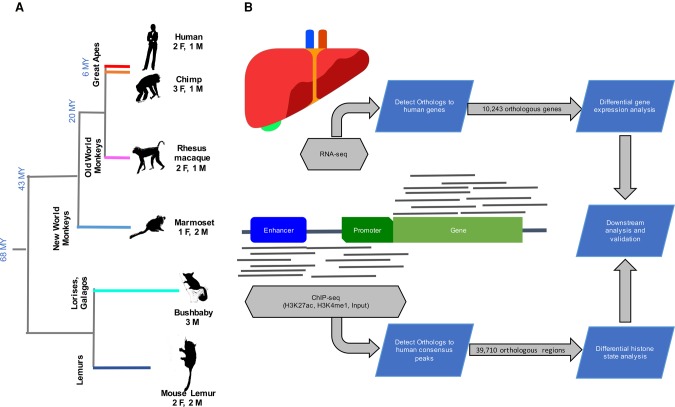
Experimental design and analytical pipeline. (A) Sampling included three to four specimens from six species representing all major primate clades. (B) ChIP-seq and RNA-seq profiles were produced from the liver samples. Differential histone modification and gene expression analyses were performed on the orthologous CREs and genes in each species, respectively.
Figure 2.
Figure 2.
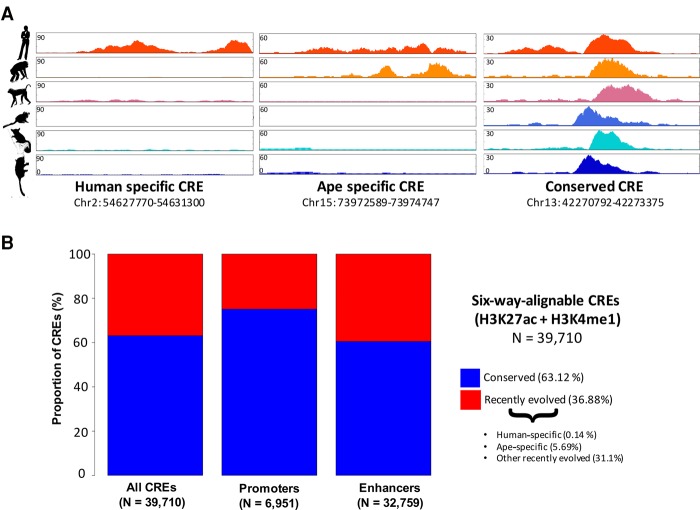
Primates CREs are evolutionarily conserved. (A) Examples of human-specific, ape-specific, and conserved CREs. (B) Fraction of conserved and recently evolved primate CREs, with breakdown of enhancers and promoters.
Figure 3.
Figure 3.
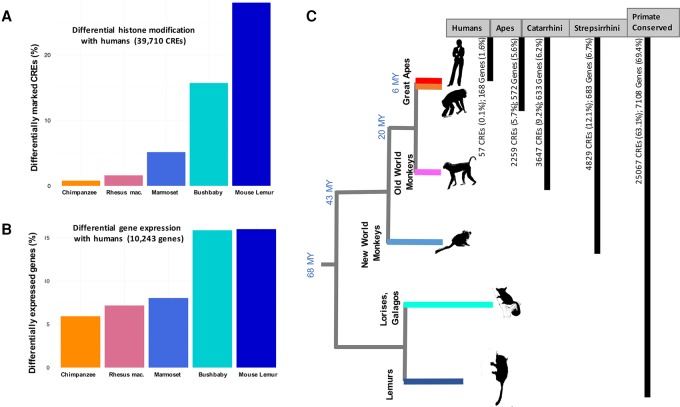
Differential histone mark and gene expression across species. (A) Human-centric pairwise comparisons for differential histone modification states on 39,710 orthologous CREs. (B) Human-centric pairwise comparisons for differential gene expression of 10,243 orthologous genes. (C) Number of lineage-specific CREs and genes across the primate phylogeny.
Figure 4.
Figure 4.
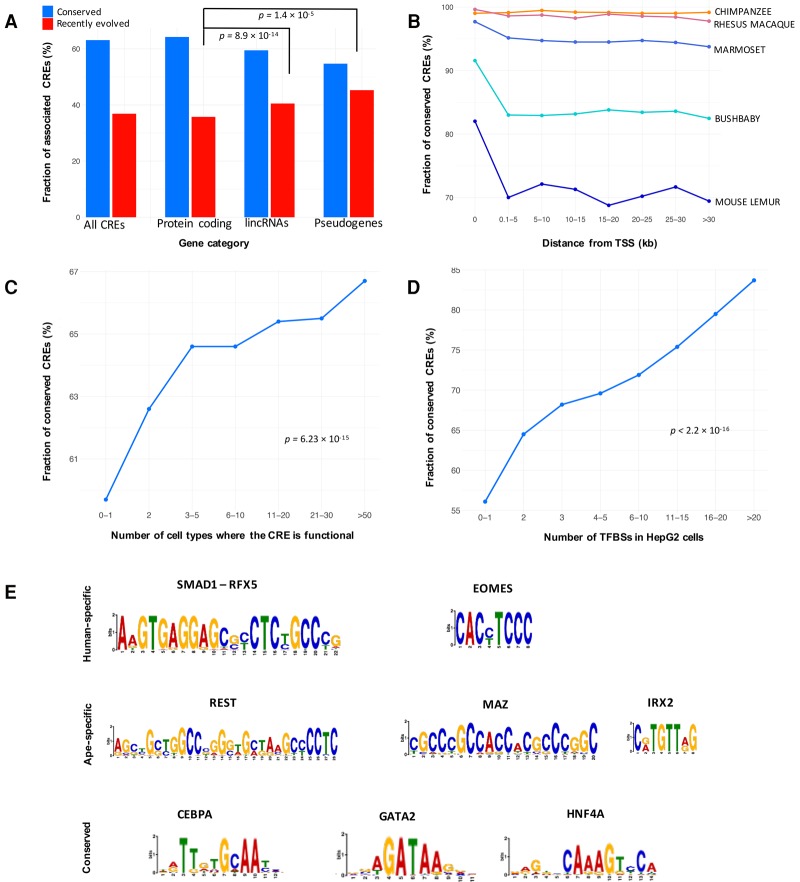
Genomic features associated with CRE conservation. (A) Fraction of conserved and recently evolved CREs associated with protein-coding genes, lincRNAs, and pseudogenes. (B) CRE conservation (y-axis) as a function of distance to the nearest gene start (quantiles on the x-axis). (C) CRE conservation (y-axis) as a function of cell-type specificity (quantiles on the x-axis) based on ENCODE data. (D) CRE conservation (y-axis) and number of ENCODE HepG2 TFBSs overlapping each CRE (quantiles on the x-axis). (E) Examples of enriched motifs in human-specific CREs, ape-specific CREs, and conserved CREs.
Figure 5.
Figure 5.
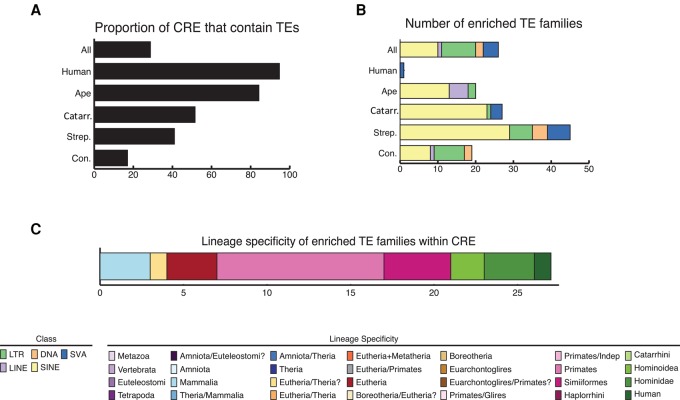
Newly evolved CREs are enriched in TEs. (A) Proportion of CREs that overlap TEs in the different primate lineages. (B) Number of enriched TE families within CREs in the different primate lineages. (C) Most enriched TE families in primates.
Figure 6.
Figure 6.
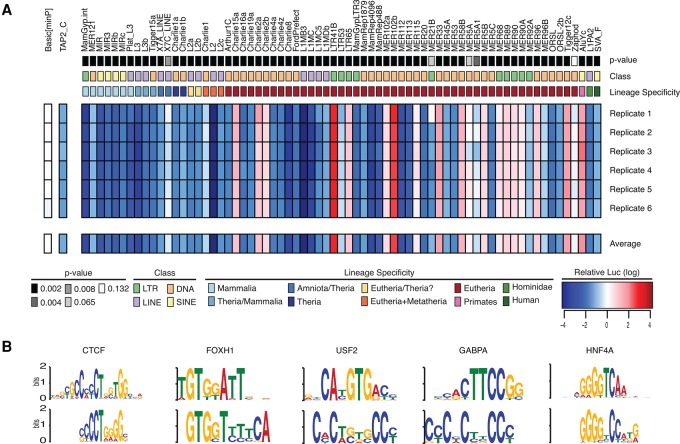
Regulatory ability of TE families found in poised and active regulatory elements in HepG2 cells. (A) The P-value (Wilcoxon rank-sum test), class, and lineage specificity for the 69 TE families tested in HepG2 cells for regulatory ability, the empty vector control (Basic[minP]), and the positive control (TAP2_C) are all shown above the six luciferase assay replicates conducted and the average regulatory ability found across the replicates. Red indicates luciferase expression higher than the empty vector control; blue indicates luciferase expression less than Basic[minP]. (B) Motifs enriched in the sequences of the 66 TE families that drive expression significantly different from background.

References

    1. Adachi N, Robinson M, Goolsbee A, Shubin NH. 2016. Regulatory evolution of Tbx5 and the origin of paired appendages. Proc Natl Acad Sci 113: 10115–10120. - PMC - PubMed
    1. Bailey TL, Boden M, Buske FA, Frith M, Grant CE, Clementi L, Ren J, Li WW, Noble WS. 2009. MEME SUITE: tools for motif discovery and searching. Nucleic Acids Res 37: W202–W208. - PMC - PubMed
    1. Ballester B, Medina-Rivera A, Schmidt D, Gonzàlez-Porta M, Carlucci M, Chen X, Chessman K, Faure AJ, Funnell AP, Goncalves A, et al. 2014. Multi-species, multi-transcription factor binding highlights conserved control of tissue-specific biological pathways. eLife 3: e02626. - PMC - PubMed
    1. Bejerano G, Lowe CB, Ahituv N, King B, Siepel A, Salama SR, Rubin EM, James Kent W, Haussler D. 2006. A distal enhancer and an ultraconserved exon are derived from a novel retroposon. Nature 441: 87–90. - PubMed
    1. Benjamini Y, Hochberg Y. 1995. Controlling the false discovery rate: a practical and powerful approach to multiple testing. J R Stat Soc B 57: 289–300.

Substances