


Developmental outcomes of cord blood transplantation for Krabbe disease: A 15-year study
- PMID: 28855403
- PMCID: PMC5649761
- DOI: 10.1212/WNL.0000000000004418
Developmental outcomes of cord blood transplantation for Krabbe disease: A 15-year study
Abstract
Objective: To describe long-term outcomes of children with early-infantile Krabbe disease who underwent hematopoietic stem cell transplantation (HSCT) in the first 7 weeks of life.
Methods: In this prospective longitudinal study, evaluations performed at baseline and follow-up included brain imaging, neurodiagnostic tests, and neurobehavioral evaluations.
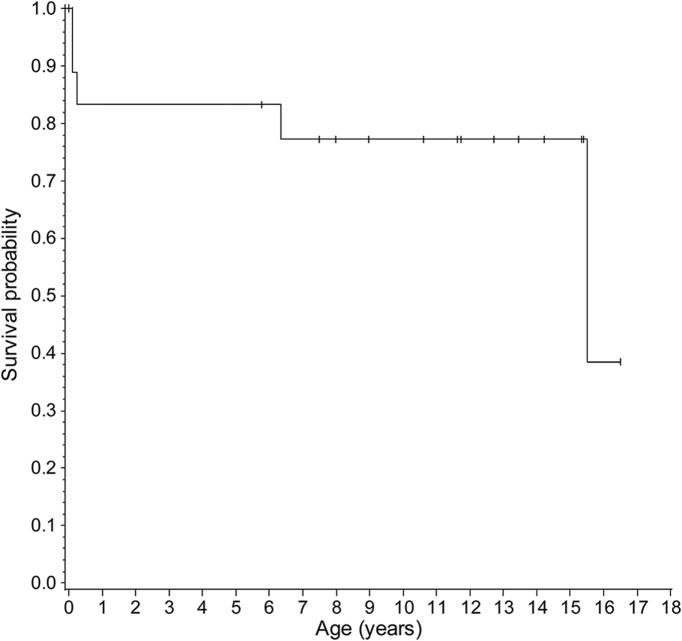
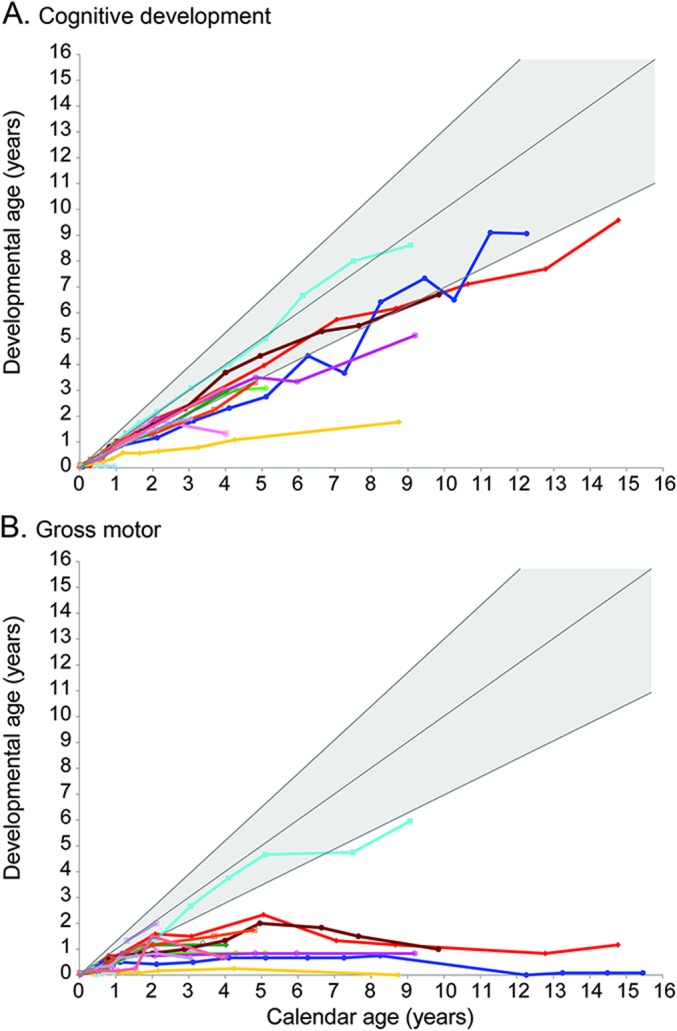
Results: Of the 18 patients in this study (11 girls, 7 boys; mean follow-up 9.5 years, range 4-15), 5 died (3 of peritransplant complications, 1 of a surgical complication unrelated to Krabbe disease, 1 of disease progression). One of the surviving patients has normal cognitive function and 10 continue to develop cognitive skills at a slightly slower rate than normal. All surviving patients continue to gain receptive language skills, with 7 falling within the normal range. Ten patients receive speech therapy, and 2 of these patients require augmentative communication devices. Gross motor development varies widely, but 3 patients can walk independently, and 7 walk with assistive devices. Spasticity ranges from mild to severe, and 12 patients wear orthotics. Fine motor skills are generally preserved. Brain myelination and atrophy stabilized in 8 patients, improved in 4 patients, and worsened in 1 patient. Nerve conduction velocities initially improved but continue to be abnormal in most patients.
Conclusions: The surviving patients function at a much higher level than untreated children or symptomatic children who underwent HSCT. These results show that early HSCT changes the natural history of this disease by improving both lifespan and functional abilities.
Classification of evidence: This study provides Class IV evidence that for children with early-infantile Krabbe disease, early HSCT improves lifespan and functional abilities.
© 2017 American Academy of Neurology.
Figures
Comment in
-
Stem cell transplantation in Krabbe disease: New truths discovered and opinions change.Neurology. 2017 Sep 26;89(13):1318-1319. doi: 10.1212/WNL.0000000000004427. Epub 2017 Aug 30. Neurology. 2017. PMID: 28855407 No abstract available.
References
-
- Wenger DA, Escolar ML, Luzi P, Rafi MA. Krabbe disease (globoid cell leukodystrophy). In: Valle D, Beaudet AL, Vogelstein B, et al., editors. Scriver's the Online Metabolic and Molecular Bases of Inherited Disease (OMMBID). New York: McGraw-Hill; 2013.
-
- Orsini JJ, Kay DM, Saavedra-Matiz CA, et al. Newborn screening for Krabbe disease in New York State: the first eight years' experience. Genet Med 2016;18:239–248. - PubMed
-
- Wenger DA, Rafi MA, Luzi P, Datto J, Costantino-Ceccarini E. Krabbe disease: genetic aspects and progress toward therapy. Mol Genet Metab 2000;70:1–9. - PubMed
-
- Escolar ML, Poe MD, Provenzale JM, et al. Transplantation of umbilical-cord blood in babies with infantile Krabbe's disease. N Engl J Med 2005;352:2069–2081. - PubMed
-
- Kaplan EL, Meier P. Nonparametric estimation from incomplete observations. J Am Statist Assn 1958;53:457–481.
MeSH terms
Grants and funding
LinkOut - more resources
Full Text Sources
Other Literature Sources
Medical
Research Materials
