High frequency of gastrointestinal manifestations in myotonic dystrophy type 1 and type 2
- PMID: 28855409
- PMCID: PMC5649763
- DOI: 10.1212/WNL.0000000000004420
High frequency of gastrointestinal manifestations in myotonic dystrophy type 1 and type 2
Abstract
Objective: To analyze gastrointestinal (GI) manifestations, their progression over time, and medications being used to treat GI symptoms in a large cohort of patients with myotonic dystrophy types 1 (DM1) and 2 (DM2).
Methods: We analyzed patient-reported data and medical records in a national registry cohort at baseline and 5 years.
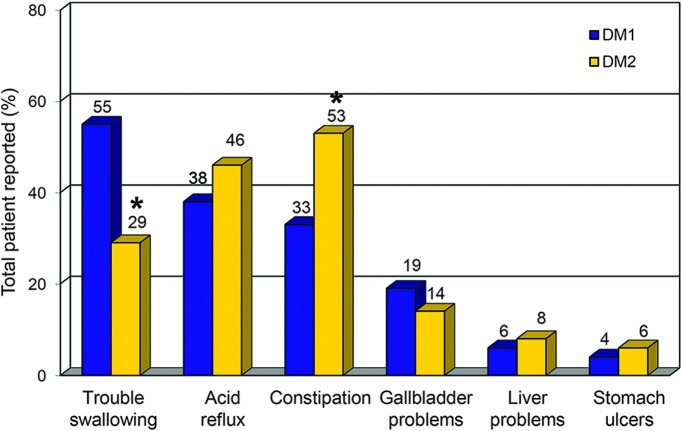
Results: At baseline, the majority of patients reported trouble swallowing in DM1 (55%; n = 499 of 913) and constipation in DM2 (53%; n = 96 of 180). Cholecystectomy occurred in 16.5% of patients with DM1 and 12.8% of patients with DM2, on average before 45 years of age. The use of medications indicated for gastroesophageal reflux disease was reported by 22.5% of DM1 and 18.9% of patients with DM2. Greater risk of a GI manifestation was associated with higher body mass index and longer disease duration in DM1 and female sex in DM2. At the 5-year follow-up, the most common new manifestations were trouble swallowing in patients with DM1 and constipation in patients with DM2.
Conclusions: GI manifestations were common in both DM1 and DM2, with a relatively high frequency of gallbladder removal in DM1 and DM2 occurring at a younger age compared to normative data in the literature. Studies are needed to determine the pathomechanism of how sex, weight gain, and duration of disease contribute to GI manifestations and how these manifestations affect quality of life and clinical care for patients with DM1 and DM2.
© 2017 American Academy of Neurology.
Figures
Comment in
-
Reader response: High frequency of gastrointestinal manifestations in myotonic dystrophy type 1 and type 2.Neurology. 2018 Apr 24;90(17):814. doi: 10.1212/WNL.0000000000005366. Neurology. 2018. PMID: 29686123 No abstract available.
-
Author response: High frequency of gastrointestinal manifestations in myotonic dystrophy type 1 and type 2.Neurology. 2018 Apr 24;90(17):814. doi: 10.1212/WNL.0000000000005370. Neurology. 2018. PMID: 29686124 No abstract available.
References
-
- Harper PS, Engelen BG, Eymard B, Wilcox DE. Myotonic Dystrophy: Present Management, Future Therapy. New York: Oxford University Press; 2004.
-
- Fu YH, Pizzuti A, Fenwick RG Jr, et al. An unstable triplet repeat in a gene related to myotonic muscular dystrophy. Science 1992;255:1256–1258. - PubMed
-
- Mahadevan M, Tsilfidis C, Sabourin L, et al. Myotonic dystrophy mutation: an unstable CTG repeat in the 3' untranslated region of the gene. Science 1992;255:1253–1255. - PubMed
-
- Brook JD, McCurrach ME, Harley HG, et al. Molecular basis of myotonic dystrophy: expansion of a trinucleotide (CTG) repeat at the 3' end of a transcript encoding a protein kinase family member. Cell 1992;68:799–808. - PubMed
-
- Liquori CL, Ricker K, Moseley ML, et al. Myotonic dystrophy type 2 caused by a CCTG expansion in intron 1 of ZNF9. Science 2001;293:864–867. - PubMed
MeSH terms
Grants and funding
LinkOut - more resources
Full Text Sources
Other Literature Sources