. 2017 Aug 30;8(1):390.
doi: 10.1038/s41467-017-00420-y.

Photoelectrochemical oxidation of organic substrates in organic media

Affiliations

Photoelectrochemical oxidation of organic substrates in organic media

Tengfei Li et al. Nat Commun. .

Abstract

There is a global effort to convert sunlight into fuels by photoelectrochemically splitting water to form hydrogen fuels, but the dioxygen byproduct bears little economic value. This raises the important question of whether higher value commodities can be produced instead of dioxygen. We report here photoelectrochemistry at a BiVO4 photoanode involving the oxidation of substrates in organic media. The use of MeCN instead of water enables a broader set of chemical transformations to be performed (e.g., alcohol oxidation and C-H activation/oxidation), while suppressing photocorrosion of BiVO4 that otherwise occurs readily in water, and sunlight reduces the electrical energy required to drive organic transformations by 60%. These collective results demonstrate the utility of using photoelectrochemical cells to mediate organic transformations that otherwise require expensive and toxic reagents or catalysts.Photoelectrochemical water splitting is a promising method for H2 fuel production, but the O2 by-product generated has little economic value. Here, Berlinguette and colleagues demonstrate that BiVO4 photoanodes immersed in organic media can instead perform valuable alcohol oxidation and C-H functionalization reactions.


Conflict of interest statement

The authors declare no competing financial interests.

Figures
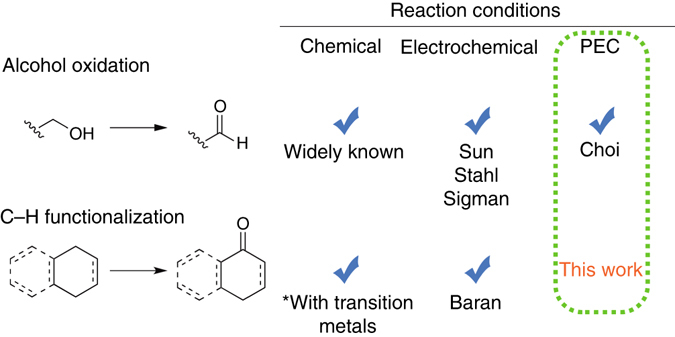
Fig. 1
Fig. 1
Summary of reaction conditions for alcohol oxidation and C-H functionalization. Three types of reaction conditions (chemical oxidation, EC oxidation at an electrode–, , and photoelectrochemical oxidation) that have been used for alcohol oxidation and C–H functionalization are shown. We report here C–H functionalization and oxidation by PEC
Fig. 2
Fig. 2
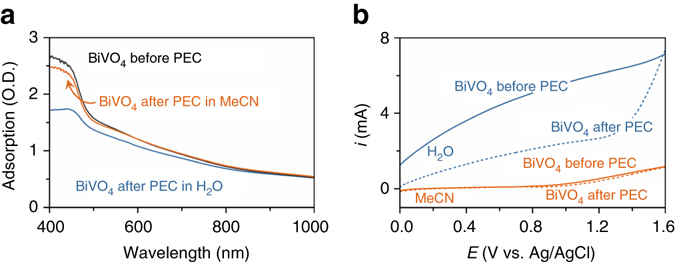
Demonstration of lower BiVO4 photocorrosion in MeCN than in H2O. a UV-Vis absorption spectra of BiVO4 photoanodes before (black) and after 96 h of PEC in H2O (blue) or MeCN (orange). b Photocurrents of BiVO4 photoanodes before (solid line) and after (dashed line) 96 h of PEC electrolysis in H2O (blue) or MeCN (orange)
Fig. 3
Fig. 3
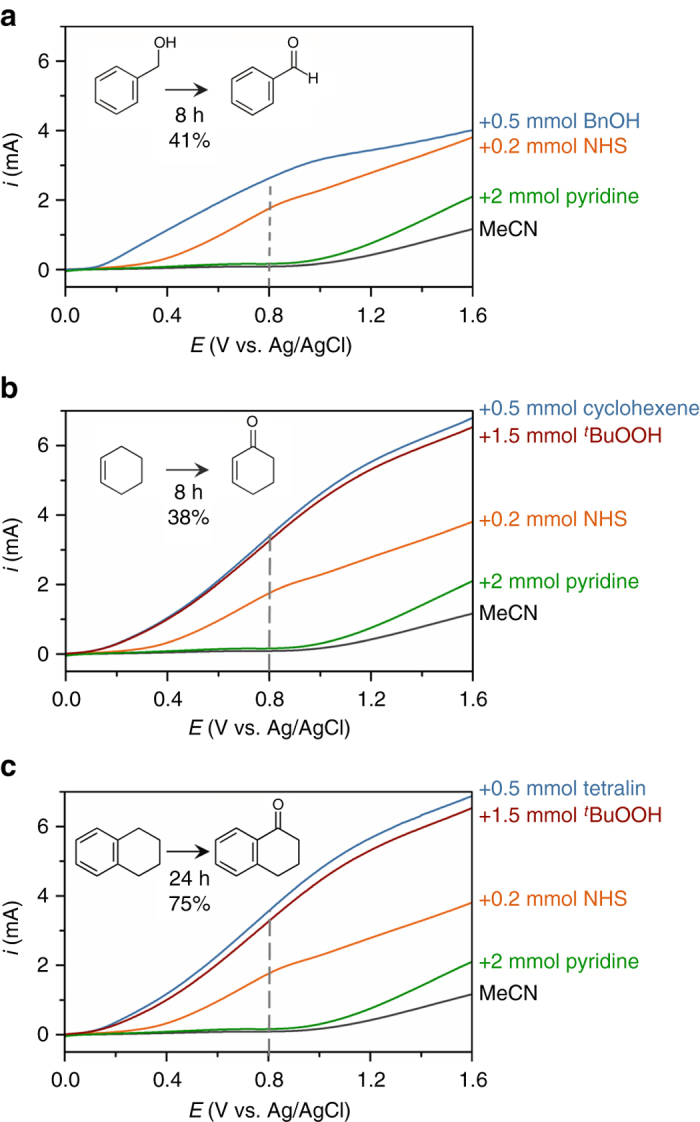
LSV curves of PEC organic oxidation profiles. Photocurrents correspond to PEC oxidations of a benzyl alcohol to benzaldehyde, b cyclohexene to cyclohexanone, and c tetralin to 1-tetralone using a BiVO4 photoanode immersed in 25 mL MeCN containing 0.1 M LiClO4 and subjected to AM1.5 G light (scan rate = 10 mV s−1). Photocurrent profiles correspond to the solvent and electrolyte solution (black) after the successive addition of 2 mmol pyridine (green), 0.2 mmol NHS (orange), 1.5 mmol of tBuOOH (red) and 0.5 mmol of the respective substrate (blue). The reaction yields determined by GC-MS are indicated. The dashed line indicates the NHS → NHS oxidation; this potential was used as the applied voltage, V app, for PEC electrolysis experiments
Fig. 4
Fig. 4
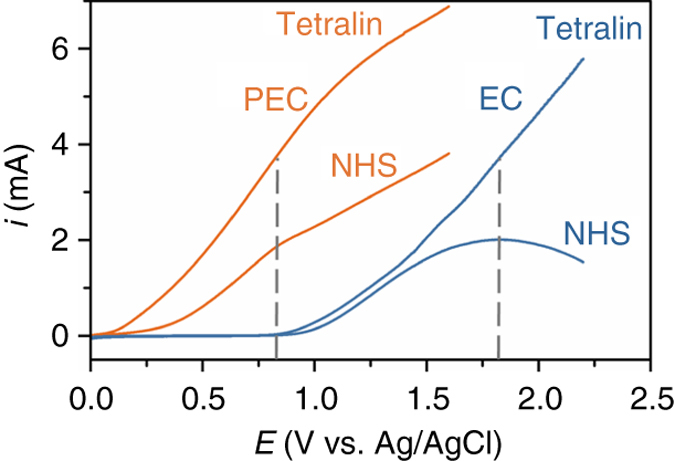
Contrasting the photoelectrochemical and EC oxidation processes. The NHS-mediated oxidation of tetralin in a PEC cell (orange) is cathodically shifted by 1 V compared to an EC cell (EC; blue). The (photo)currents measured after adding pyridine and NHS to MeCN are denoted NHS, while the (photo)currents measured after adding tBuOOH and tetralin are denoted tetralin. The shoulder at 0.8 V and peak at 1.8 V (dashed lines) are attributed to the oxidation of NHS to NHS under PEC and EC conditions, respectively

References

    1. Grätzel M. Photoelectrochemical cells. Nature. 2001;414:338–344. doi: 10.1038/35104607. - DOI - PubMed
    1. Lewis NS, Nocera DG. Powering the planet: chemical challenges in solar energy utilization. Proc. Natl Acad. Sci. USA. 2006;103:15729–15735. doi: 10.1073/pnas.0603395103. - DOI - PMC - PubMed
    1. Walter MG, et al. Solar water splitting cells. Chem. Rev. 2010;110:6446–6473. doi: 10.1021/cr1002326. - DOI - PubMed
    1. Sivula K. Metal oxide photoelectrodes for solar fuel production, surface traps, and catalysis. J. Phys. Chem. Lett. 2013;4:1624–1633. doi: 10.1021/jz4002983. - DOI - PubMed
    1. Hu K, et al. Kinetic pathway for interfacial electron transferfrom a semiconductor to a molecule. Nat. Chem. 2016;8:853–859. doi: 10.1038/nchem.2549. - DOI - PubMed

Publication types