. 2017 Aug 30;8(1):396.
doi: 10.1038/s41467-017-00407-9.

Developing a molecular picture of soil organic matter-mineral interactions by quantifying organo-mineral binding

Affiliations

Developing a molecular picture of soil organic matter-mineral interactions by quantifying organo-mineral binding

C J Newcomb et al. Nat Commun. .

Erratum in

Abstract

Long residence times of soil organic matter have been attributed to reactive mineral surface sites that sorb organic species and cause inaccessibility due to physical isolation and chemical stabilization at the organic-mineral interface. Instrumentation for probing this interface is limited. As a result, much of the micron- and molecular-scale knowledge about organic-mineral interactions remains largely qualitative. Here we report the use of force spectroscopy to directly measure the binding between organic ligands with known chemical functionalities and soil minerals in aqueous environments. By systematically studying the role of organic functional group chemistry with model minerals, we demonstrate that chemistry of both the organic ligand and mineral contribute to values of binding free energy and that changes in pH and ionic strength produce significant differences in binding energies. These direct measurements of molecular binding provide mechanistic insights into organo-mineral interactions, which could potentially inform land-carbon models that explicitly include mineral-bound C pools.Most molecular scale knowledge on soil organo-mineral interactions remains qualitative due to instrument limitations. Here, the authors use force spectroscopy to directly measure free binding energy between organic ligands and minerals and find that both chemistry and environmental conditions affect binding.


Conflict of interest statement

The authors declare no competing financial interests.

Figures
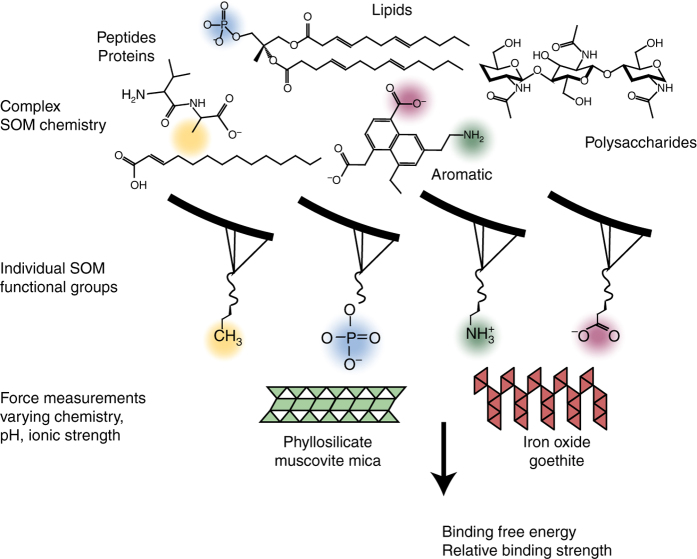
Fig. 1
Fig. 1
Schematic of the experimental setup. Common chemical functional groups from soil organic matter (SOM) were chosen to represent a model for interaction between organics and two model minerals: muscovite and goethite. Performing force measurements between these model organics and minerals enable us to quantitatively evaluate the binding energies
Fig. 2
Fig. 2
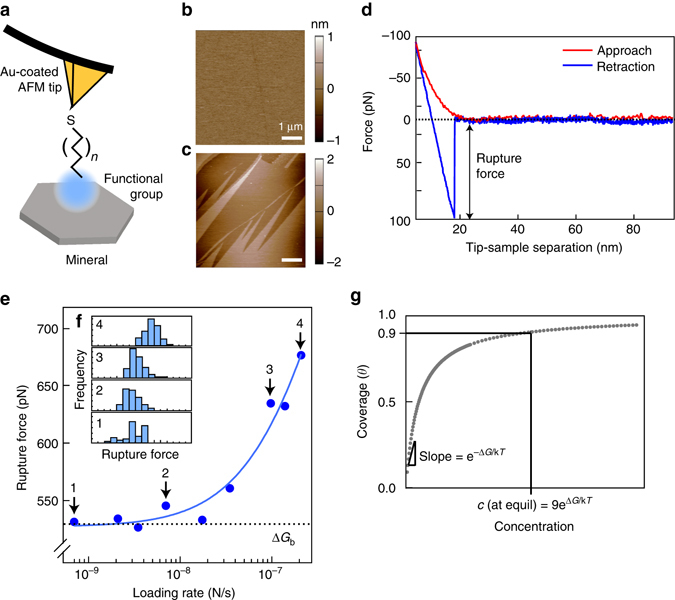
Dynamic force spectroscopy measurements at the organo–mineral interface. a Functional groups were covalently bound to gold-coated atomic force microscopy (AFM) tips and were used to probe mineral surfaces. Topographical AFM images of b the (001) surface of muscovite mica and c the (010) face of goethite (bottom) used in DFS experiments. Scale bars, 1 μm. d A representative force-distance curve and e a plot of mean rupture force versus loading rate showing increasing rupture force with increasing loading rate. The solid line represents a fit to the data using a theoretical model that accounts for both equilibrium and kinetic regimes of adsorption and forced desorption (See Eqs. 1–3, Methods section). Histograms (f, inset) of the force curves from individual points (1)–(4) show the trend of increasing rupture force with increasing loading rate. g To relate values of ΔG to typical measurements seen in adsorption experiments such as surface coverage, their relationship at equilibrium is shown in a model desorption isotherm. In the example, at a surface coverage of 90%, the value of ΔG is related through a simple exponential
Fig. 3
Fig. 3
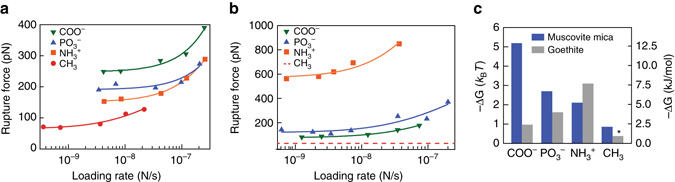
Chemistry of model soil organic matter affects binding strengths to different minerals. Experiments were performed at pH 6 in 10 mM NaCl. a, b Mean rupture forces for interactions between self-assembled monolayers with various functional groups and a muscovite mica or b goethite. c Experimentally derived values for the binding free energy (ΔG b) from fitted dynamic force spectroscopy data. Values for fitting parameters can be found in Supplementary Table 1. Asterisk: The value for the methyl group interacting with goethite is approximate, as the force was close to the detection limit of the experiment
Fig. 4
Fig. 4
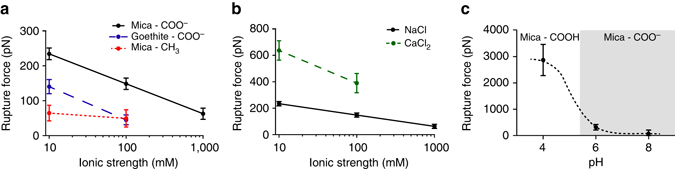
Values for the strength of binding as a function of local environmental conditions. Organic–mineral interactions are affected by ionic strength, ion composition, and pH. a Ionic strength was varied using NaCl electrolyte at pH = 6. Interactions between COO and either mica or goethite were investigated. The CH3 functional group was used as a control interaction on mica. b The effects of monovalent (NaCl) and divalent (CaCl2) cations were compared using the carboxylic acid functional group and mica at pH 6 at varying ionic strengths. c The effect of binding between carboxylic acid and mica was probed as a function of pH in 10 mM NaCl solution. For each condition, experiments were performed with the same AFM tip for reproducibility. Rupture forces were measured at loading rates of 3.5 × 10−9 N/s. Values are represented as mean ± 1 standard deviation

References

    1. Lehmann J, Kleber M. The contentious nature of soil organic matter. Nature. 2015;528:60–68. doi: 10.1038/nature16045. - DOI - PubMed
    1. Schmidt MWI, et al. Persistence of soil organic matter as an ecosystem property. Nature. 2011;478:49–56. doi: 10.1038/nature10386. - DOI - PubMed
    1. Kleber M, Sollins P, Sutton R. A conceptual model of organo-mineral interactions in soils: self-assembly of organic molecular fragments into zonal structures on mineral surfaces. Biogeochemistry. 2007;85:9–24. doi: 10.1007/s10533-007-9103-5. - DOI
    1. Kleber M, et al. Mineral-organic associations: formation, properties, and relevance in soil environments. Adv. Agron. 2015;130:1–140. doi: 10.1016/bs.agron.2014.10.005. - DOI
    1. Doetterl S, et al. Soil carbon storage controlled by interactions between geochemistry and climate. Nat. Geosci. 2015;8:780–783. doi: 10.1038/ngeo2516. - DOI

Publication types