


Mitogenome Sequencing in the Genus Camelus Reveals Evidence for Purifying Selection and Long-term Divergence between Wild and Domestic Bactrian Camels
- PMID: 28855525
- PMCID: PMC5577142
- DOI: 10.1038/s41598-017-08995-8
Mitogenome Sequencing in the Genus Camelus Reveals Evidence for Purifying Selection and Long-term Divergence between Wild and Domestic Bactrian Camels
Abstract
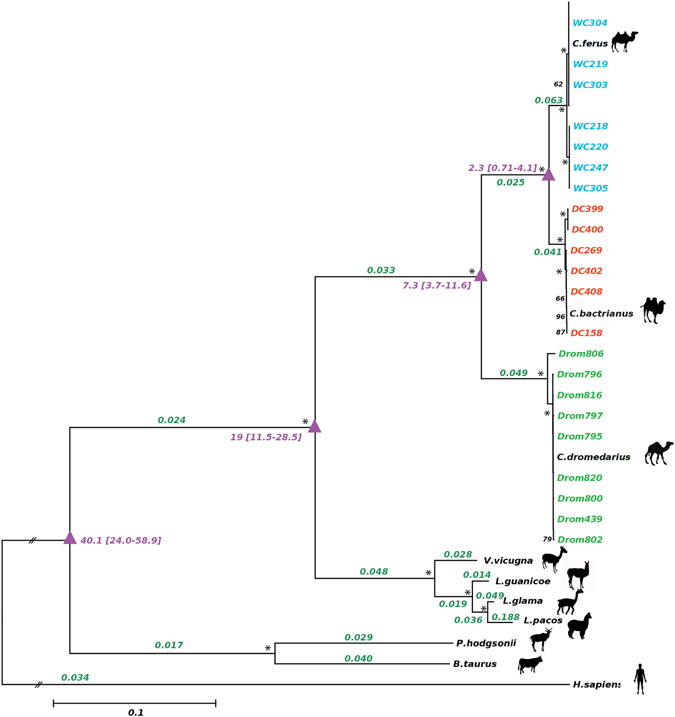
The genus Camelus is an interesting model to study adaptive evolution in the mitochondrial genome, as the three extant Old World camel species inhabit hot and low-altitude as well as cold and high-altitude deserts. We sequenced 24 camel mitogenomes and combined them with three previously published sequences to study the role of natural selection under different environmental pressure, and to advance our understanding of the evolutionary history of the genus Camelus. We confirmed the heterogeneity of divergence across different components of the electron transport system. Lineage-specific analysis of mitochondrial protein evolution revealed a significant effect of purifying selection in the concatenated protein-coding genes in domestic Bactrian camels. The estimated dN/dS < 1 in the concatenated protein-coding genes suggested purifying selection as driving force for shaping mitogenome diversity in camels. Additional analyses of the functional divergence in amino acid changes between species-specific lineages indicated fixed substitutions in various genes, with radical effects on the physicochemical properties of the protein products. The evolutionary time estimates revealed a divergence between domestic and wild Bactrian camels around 1.1 [0.58-1.8] million years ago (mya). This has major implications for the conservation and management of the critically endangered wild species, Camelus ferus.
Conflict of interest statement
The authors declare that they have no competing interests.
Figures
References
-
- Bourzat D, Wilson RT. Research on the dromedary in Africa. Scientific and Technical Review. 1987;6:383–389. - PubMed
-
- Wardeh MF. Classification of the Dromedary Camels. Journal Camel Science. 2004;1:1–7.
-
- Faye, B. & Konuspayeva, G. The Encounter between Bactrian and Dromedary Camels in Central Asia. In: Knoll, E.-M. and Burger, P. editors. Camels in Asia and North Africa. Vienna: Interdisciplinary perspectives on their significance in past and present. Austrian Academy of Sciences Press, Wien (Austria). p. 27–33 (photos p. 248–250) (2012).
-
- Grubb, P. Order Artiodactyla. In: Wilson, D. E., Reeder, D. M. editors. Mammal species of the world: a taxonomic and geographic reference. Baltimore: Johns Hopkins University Press. p. 637–722 (2005).
-
- Potts D. Camel hybridization and the role of Camelus bactrianus in the Ancient Near East. Journal of the Economic and Social History of the Orient. 2004;47:143–165. doi: 10.1163/1568520041262314. - DOI
Publication types
MeSH terms
Substances
Grants and funding
LinkOut - more resources
Full Text Sources
Other Literature Sources
