. 2017 Aug 30;7(1):9990.
doi: 10.1038/s41598-017-11045-y.

Interferences between breathing, experimental dyspnoea and bodily self-consciousness

Affiliations

Interferences between breathing, experimental dyspnoea and bodily self-consciousness

Etienne Allard et al. Sci Rep. .

Abstract

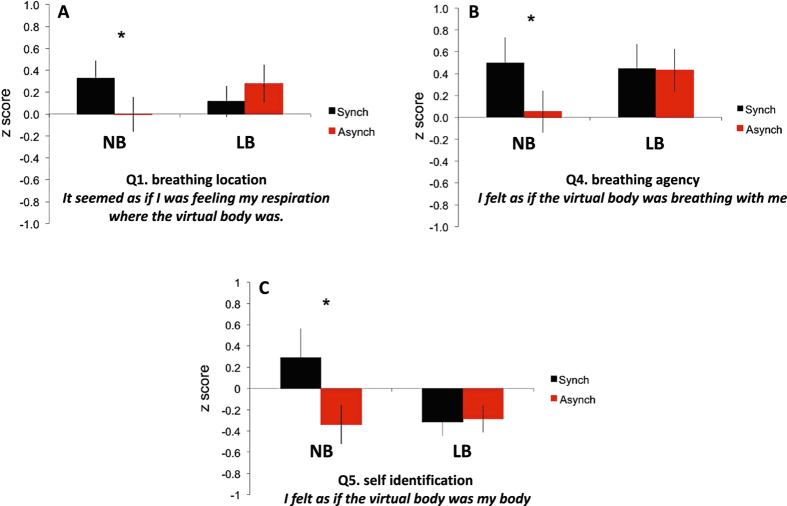
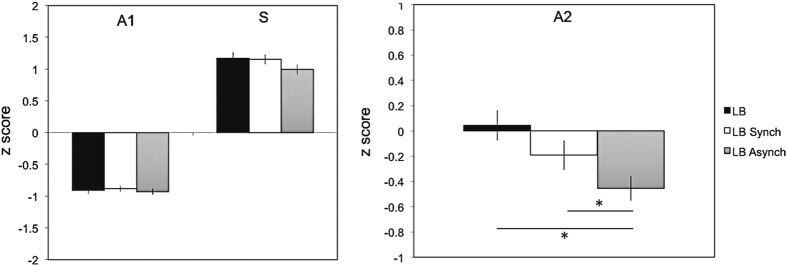
Dyspnoea, a subjective experience of breathing discomfort, is a most distressing symptom. It implicates complex cortical networks that partially overlap with those underlying bodily self-consciousness, the experience that the body is one's own within a given location (self-identification and self-location, respectively). Breathing as an interoceptive signal contributes to bodily self-consciousness: we predicted that inducing experimental dyspnoea would modify or disrupt this contribution. We also predicted that manipulating bodily self-consciousness with respiratory-visual stimulation would possibly attenuate dyspnoea. Twenty-five healthy volunteers were exposed to synchronous and asynchronous respiratory-visual illumination of an avatar during normal breathing and mechanically loaded breathing that elicited dyspnoea. During normal breathing, synchronous respiratory-visual stimulation induced illusory self-identification with the avatar and an illusory location of the subjects' breathing towards the avatar. This did not occur when respiratory-visual stimulation was performed during dyspnoea-inducing loaded breathing. In this condition, the affective impact of dyspnoea was attenuated by respiratory-visual stimulation, particularly when asynchronous. This study replicates and reinforces previous studies about the integration of interoceptive and exteroceptive signals in the construction of bodily self-consciousness. It confirms the existence of interferences between experimental dyspnoea and cognitive functions. It suggests that respiratory-visual stimulation should be tested as a non-pharmacological approach of dyspnoea treatment.


Conflict of interest statement

The authors declare that they have no competing interests.

Figures
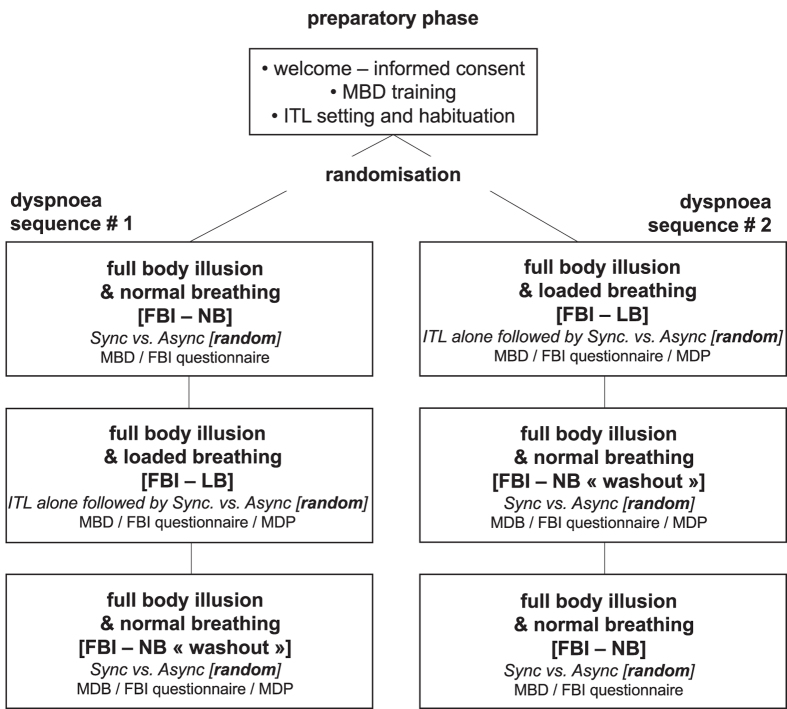
Figure 1
Figure 1
Flow chart of the experimental sequence. ITL, Inspiratory Threshold Loading; FBI, full body illusion; NB, Normal Breathing; LB, Loaded Breathing; Sync, synchronous respiratory-visual stimulation; Async, asynchronous respiratory-visual stimulation; MBD, mental ball drop task; MDP, Multidimensional Dyspnea Profile. The participants were randomised to participate either in “dyspnoea sequence 1” or in “dyspnoea sequence 2”. For each induction of full body illusion, the order of synchronous and asynchronous illumination was randomised.
Figure 2
Figure 2
Effects of inspiratory threshold loading on Bodily Self-Consciousness. Mean questionnaire ratings, transformed in z-scores, for normal breathing (NB) and loaded breathing (LB), during synchronous and asynchronous respiratory-visual illumination. The error bars denote the standard error of the mean (SEM).
Figure 3
Figure 3
Effects of inspiratory threshold loading without and with respiratory-visual synchronous and asynchronous stimulation on the components of dyspnoea as explored by the Multidimensional Dyspnea Profile. LB, Loaded Breathing alone; LB Sync, Loaded Breathing Synchronous respiratory-visual illumination; LB Async, Loaded Breathing Asynchronous respiratory-visual stimulation; A1, immediate unpleasantness of dyspnoea; S, sensory dimension of dyspnoea; A2, affective component of dyspnoea (see “Methods” for details); the error bars denote the standard error of the mean (SEM); the * symbol denotes p < 0.05.

References

    1. Davenport PW, Vovk A. Cortical and subcortical central neural pathways in respiratory sensations. Respir Physiol Neurobiol. 2009;167:72–86. doi: 10.1016/j.resp.2008.10.001. - DOI - PubMed
    1. Mainland J, Sobel N. The sniff is part of the olfactory percept. Chem Senses. 2006;31:181–196. doi: 10.1093/chemse/bjj012. - DOI - PubMed
    1. Adler D, et al. Diaphragm pacing restores olfaction in tetraplegia. Eur Respir J. 2009;34:365–370. doi: 10.1183/09031936.00177708. - DOI - PubMed
    1. Adler D, Herbelin B, Similowski T, Blanke O. Breathing and sense of self: visuo-respiratory conflicts alter body self-consciousness. Respir Physiol Neurobiol. 2014;203:68–74. doi: 10.1016/j.resp.2014.08.003. - DOI - PubMed
    1. Aspell JE, et al. Turning body and self inside out: visualized heartbeats alter bodily self-consciousness and tactile perception. Psychol Sci. 2013;24:2445–2453. doi: 10.1177/0956797613498395. - DOI - PubMed

Publication types