


Review
doi: 10.1038/nrn.2017.92.
Epub 2017 Aug 17.
Polyglutamine spinocerebellar ataxias - from genes to potential treatments
Affiliations
- PMID: 28855740
- PMCID: PMC6420820
- DOI: 10.1038/nrn.2017.92
Item in Clipboard
Review
Polyglutamine spinocerebellar ataxias - from genes to potential treatments
Nat Rev Neurosci.
2017 Oct.
Abstract
The dominantly inherited spinocerebellar ataxias (SCAs) are a large and diverse group of neurodegenerative diseases. The most prevalent SCAs (SCA1, SCA2, SCA3, SCA6 and SCA7) are caused by expansion of a glutamine-encoding CAG repeat in the affected gene. These SCAs represent a substantial portion of the polyglutamine neurodegenerative disorders and provide insight into this class of diseases as a whole. Recent years have seen considerable progress in deciphering the clinical, pathological, physiological and molecular aspects of the polyglutamine SCAs, with these advances establishing a solid base from which to pursue potential therapeutic approaches.
Figures
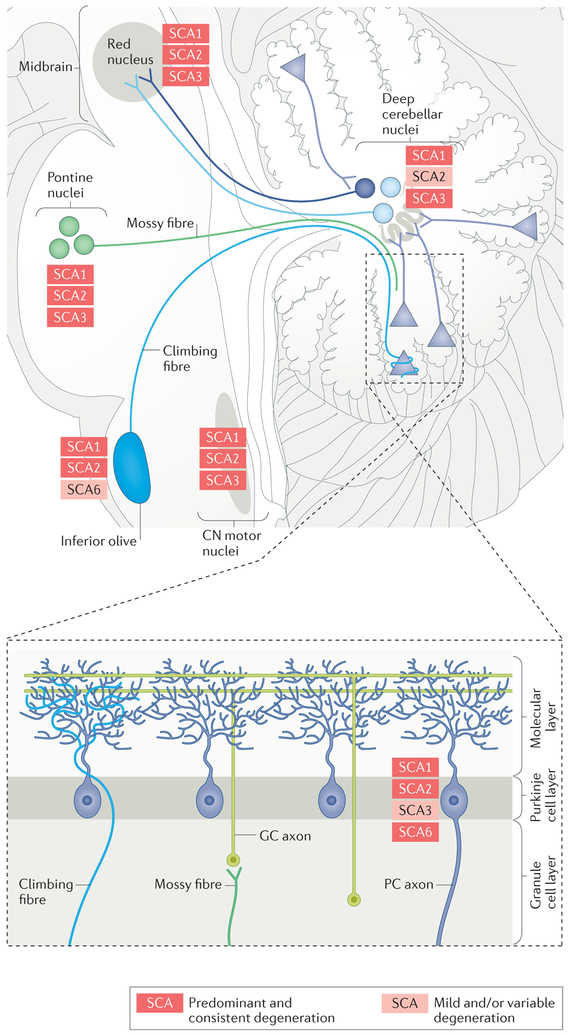
The different spinocerebellar ataxias (SCAs) have similar but not identical patterns of pathological involvement, shown here for SCA1, SCA2, SCA3 and SCA6. The figure shows the areas that are consistently affected in the different SCAs (red), as well as those that are mildly or variably affected in the different SCAs (pink). The areas and cell types in the cerebellar circuitry that are affected include the cerebellar cortex (particularly Purkinje cells (PCs), the cell bodies of which are depicted by triangles here), the inferior olive and its climbing fibres, the pontine nuclei and their mossy fibres, the deep cerebellar nuclei, the red nucleus and the cranial nerve (CN) motor nuclei. GC, cerebellar granule cell.
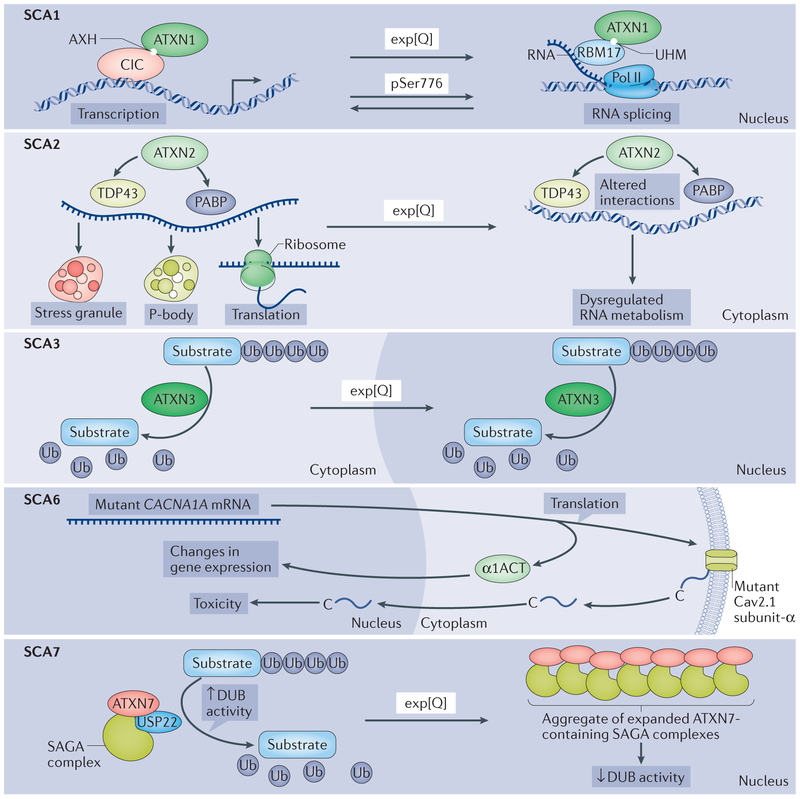
Each panel illustrates the cellular processes affected by the polyglutamine (polyQ) proteins in spinocerebellar ataxia 1 (SCA1), SCA2, SCA3, SCA6 and SCA7. In all of the SCAs depicted, except SCA3, the cerebellar Purkinje cells are prominently affected, whereas in SCA3, the Purkinje cells are more mildly affected. Top panel (SCA1): in the ataxin 1 (ATXN1) protein, it is believed that the AXTN1 HBP1 (AXH) domain and the U2AF homology (UHM) domain are interaction motifs for the transcriptional regulator capicua (CIC) and the RNA splicing factor RBM17, respectively, and a shift in these interactions is critical for mutant, polyglutamine-expanded ATXN1 to cause disease in Purkinje cells. PolyQ expansion is depicted by ‘exp[Q]’ in all panels. Phosphorylation of Ser776 in ATXN1 (pSer 776) also shifts the balance between these interactions. Second panel (SCA2): ATXN2 is known to interact directly or indirectly with numerous proteins implicated in RNA metabolism, as well as RNA itself, to regulate translation, stress granule formation and P-body formation. Of particular interest are the interactions of ATXN2 with polyadenylate-binding protein (PABP) and TAR DNA-binding protein 43 (TDP43), each of which also binds directly to RNA. One hypothesis is that the polyQ tract length in ATXN2 impairs interactions with PABP and TDP43 and thereby contributes to SCA2 pathogenesis, as well as the risk for ALS (not shown). Third panel (SCA3): as a deubiguitinase (DUB), ATXN3 binds and cleaves polyubiguitin chains and has been implicated in a variety of ubiguitin (Ub)-dependent protein quality control pathways. Although expanded ATXN3 retains DUB activity in vitro, changes in polyQ-repeat length may alter its function in the complex cellular environment, with deleterious consequences. As with many polyQ disease proteins, mutant ATXN3 becomes concentrated in the nucleus. Fourth panel (SCA6): the CACNA1A gene encodes a bicistronic mRNA that, on translation, yields the following two proteins: the membrane-localized α1A subunit of the Cav2.1 channel and the transcription factor α1ACT. Expansion of the polyQ-encoding repeat in CACNA1A leads to toxicity through altered α1ACT-mediated regulation of transcription, as well as through nuclear translocation of a peptide cleaved from the carboxyl terminus of the mutant Cav2.1 channel subunit. Fifth panel(SCA7): ATXN7 is a component of the SPT-ADA-GCN5 acetyltransferase (SAGA) complex. SAGA regulates transcription through its dual histone-modifying enzymes, the histone acetyltransferase GCN5 and the DUB ubiguitin C-terminal hydrolase 22 (USP22). PolyQ-expanded ATXN7 forms insoluble complexes that are thought to sequester other components of the DUB module such that the SAGA complex can no longer remove ubiquitin from its substrates. Pol II, polymerase II.
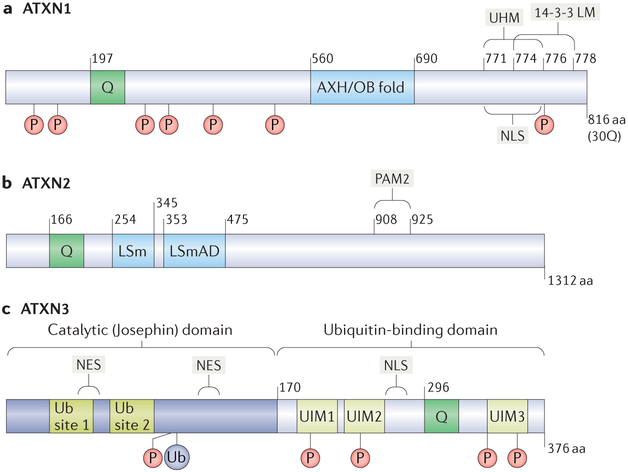
Functional motifs are diagrammed for each polyglutamine (polyQ) spinocerebellar ataxia (SCA)-associated ataxin (ATXN) protein. The diagrams also show the polyQ regions (denoted as ‘Q’), as well as the phosphorylation sites (denoted as ‘P’) and ubiquitylation sites (denoted as ‘Ub’ to represent ubiquitin). a | ATXN1 with a 30Q polyQ region is shown. The ATXN1 HBP1 (AXH) domain and the U2AF homology motif (UHM) of ATXN1 are interaction motifs for capicua (CIC) and RBM17, respectively; the AXH domain itself forms an oligonucleotide/oligosaccharide-binding (OB) fold. ATXN1 also features a nuclear-localization signal (NLS) near the carboxyl terminus of the protein that facilitates its localization to the nucleus and a phosphorylation-dependent binding motif for the chaperone 14-3-3 (14-3-3 LM). b | ATXN2 interacts directly or indirectly with numerous proteins implicated in RNA metabolism. Its poly(A)-binding protein (PABP)-interacting motif PAM2 enables ATXN2 to interact with PABP and TAR DNA-binding protein 43 (TDP43). ATXN2 also features a like-Sm(LSm) motif and an LSm-associated domain (LSmAD). c | The deubiquitinase (DUB) ATXN3 has an N-terminal catalytic (Josephin) domain, which contains two Ub-binding sites and two nuclear export sites (NES), and a C-terminal Ub-binding domain bearing three Ub-interacting motifs (UIMs) and an NLS.
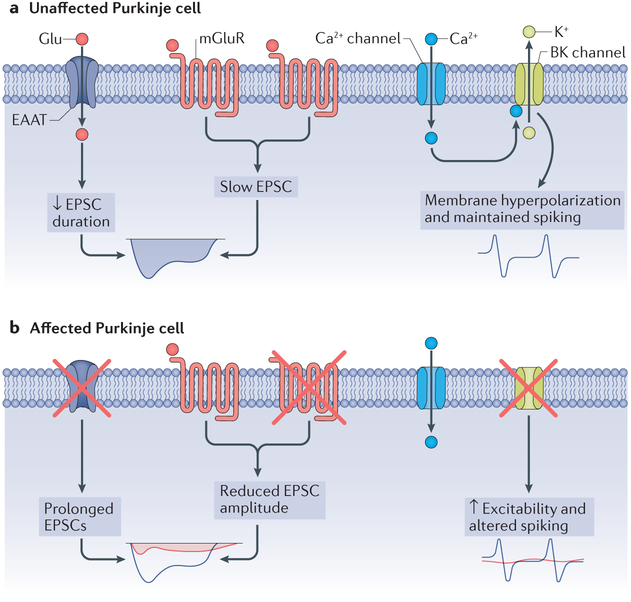
Concurrent with the motor dysfunction that occurs in the spinocerebellar ataxias (SCAs), and before the onset of substantial cellular morphological alterations, the expression levels and functions of ion channels and receptors are altered in SCA. a | Expression and function of ion channels in an unaffected Purkinje cell. The function of excitatory amino acid transporters (EAATs), which carry glutamate, and metabotropic glutamate receptors (mGluRs) yield slow excitatory postsynaptic currents (EPSCs), whereas normal large-conductance calcium-activated potassium (BK) channel function keeps the cell membrane hyperpolarized, maintaining spiking, b | The reduction in mGluRs and EAATs results in reductions in the amplitude of slow EPSCs (normal currents are shown in blue, and the currents in SCA are shown in red). The reduction in glutamate transporters prolongs the effect of glutamate at the synapse and also prolongs the mGluR-mediated slow EPSCs (red). In addition to alterations in synaptic signalling, the intrinsic excitability of the neuron is altered secondary to a loss of potassium channels. A reduction in BK channel expression and function results in unopposed calcium entry through voltage-gated calcium channels, with impairments in Purkinje neuron spiking (normal spiking indicated in blue; altered spiking indicated in red).
References
-
- Durr A Autosomal dominant cerebellar ataxias: polyglutamine expansions and beyond. Lancet Neurol. 9, 885–894 (2010). - PubMed
-
- Klockgether T et al. The natural history of degenerative ataxia: a retrospective study in 466 patients. Brain 121,589–600 (1998). - PubMed
-
- Globas C et al. Early symptoms in spinocerebellar ataxia type 1, 2, 3, and 6. Mov. Disord. 23, 2232–2238 (2008). - PubMed
Publication types
MeSH terms
Substances
Grants and funding
LinkOut - more resources
Full Text Sources
Other Literature Sources
Medical
Research Materials
