


Review
doi: 10.1038/nrn.2017.100.
Epub 2017 Aug 31.
The impact of cytoskeletal organization on the local regulation of neuronal transport
Affiliations
- PMID: 28855741
- PMCID: PMC6400490
- DOI: 10.1038/nrn.2017.100
Item in Clipboard
Review
The impact of cytoskeletal organization on the local regulation of neuronal transport
Nat Rev Neurosci.
2017 Oct.
Abstract
Neurons are akin to modern cities in that both are dependent on robust transport mechanisms. Like the best mass transit systems, trafficking in neurons must be tailored to respond to local requirements. Neurons depend on both high-speed, long-distance transport and localized dynamics to correctly deliver cargoes and to tune synaptic responses. Here, we focus on the mechanisms that provide localized regulation of the transport machinery, including the cytoskeleton and molecular motors, to yield compartment-specific trafficking in the axon initial segment, axon terminal, dendrites and spines. The synthesis of these mechanisms provides a sophisticated and responsive transit system for the cell.
Figures
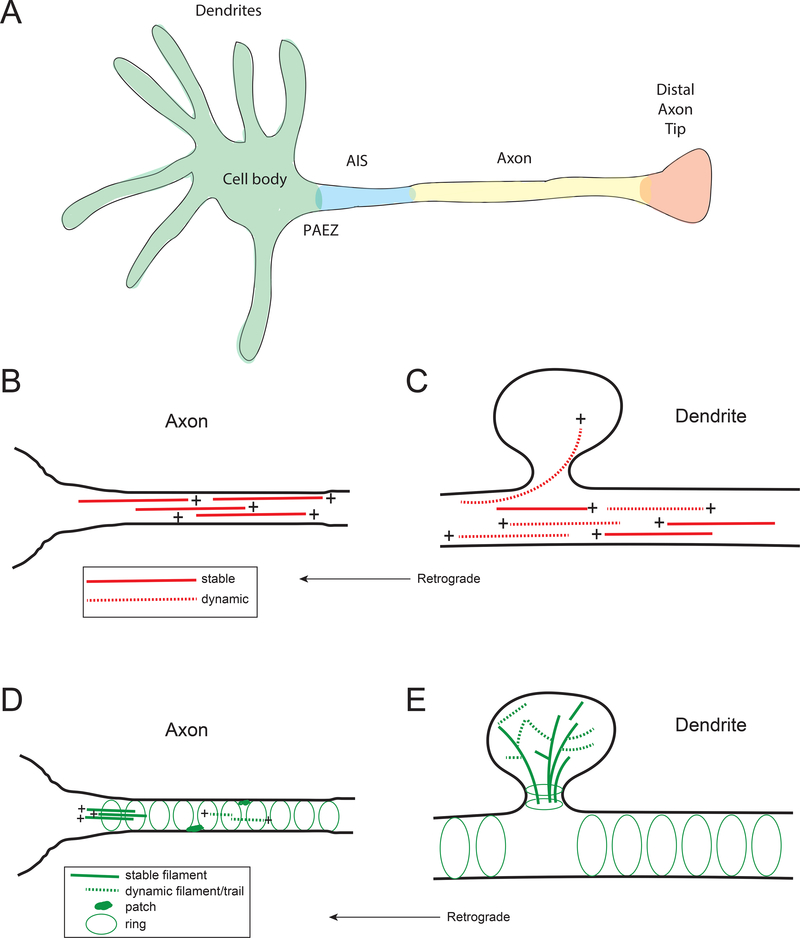
(A) Functionally and/or structurally distinct compartments are found in many types of neurons. These compartments include the cell body, dendrites, pre-axonal exclusion zone (PAEZ), axon initial segment (AIS), axon shaft, and distal axon terminal. (B) Super-resolution microscopy has shown actin filaments in periodic rings organized by interactions with ankyrin G and βIV spectrin at the AIS. Actin rings are also found along the axon shaft, in association with ankyrin B and βII spectrin ,,,. Other actin structures identified in axons include stable actin patches and dynamic actin trails ,. (C) Dendritic spines are highly enriched in a dense network of both stable and dynamic F-actin. Actin rings are also present in dendrites . (D) Microtubules in the axon are almost uniformly plus-end out and tiled into overlapping arrays . In C. elegans
, the number of microtubules in an axon decreases with increasing distance from the soma; a similar organization may occur in mammalian neurons. Microtubules in the proximal and mid-axon are characterized by post-translational modifications known to accumulate on stable microtubules. (E) Microtubules along dendritic shafts are organized with mixed polarity in mammalian neurons, while a more uniform plus end-out distribution is found in distal dendrites . Dynamic microtubules can invade dendritic spines ,, possibly depositing motor or cargo in the process.
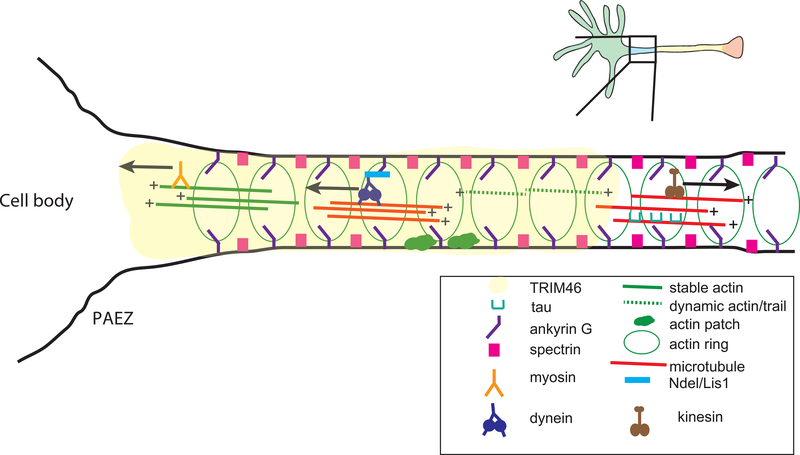
A cytoskeletal hallmark of the AIS is the periodic arrangement of proteins including ankyrin G, spectrin, and actin. Bundled microtubules oriented plus-end outward are required for axodendritic cargo sorting at the AIS. While kinesin motors carry cargo into the axon, dynein and myosins assist with re-routing of somatodendritic cargos as needed. Axon-specific MAPs (e.g. TRIM46, tau) and motor adaptors (e.g. NDEL) contribute to cargo sorting at the AIS or pre-axonal exclusion zone (PAEZ).
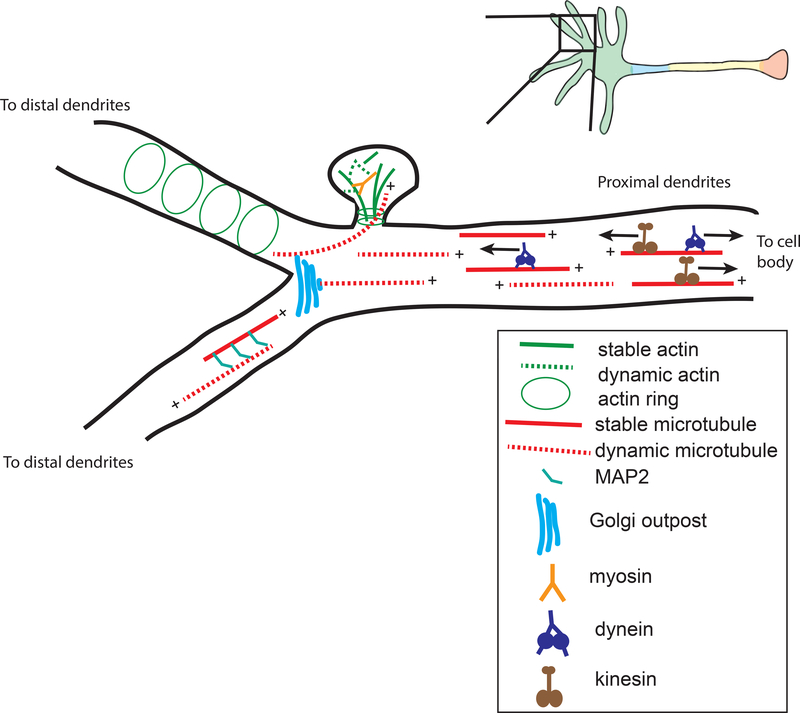
The dendritic shaft is enriched in microtubules, while dendritic spines are actin-rich; both stable and dynamic microtubule and actin filaments are present. Actin rings are found in the shaft and spine neck, and may provide structural support. Due to the mixed polarity of dendritic microtubules, both dynein and kinesins regulate the transport of retrograde and anterograde cargo, while myosins mediate trafficking into and out of spines. Microtubules may be transported into dendrites by motors or nucleated at Golgi outposts, and are enriched in MAPs such as MAP2. In this compartment, long-range transport must be balanced against the dynamics of the underlying microtubule tracks and overall dendritic morphology.
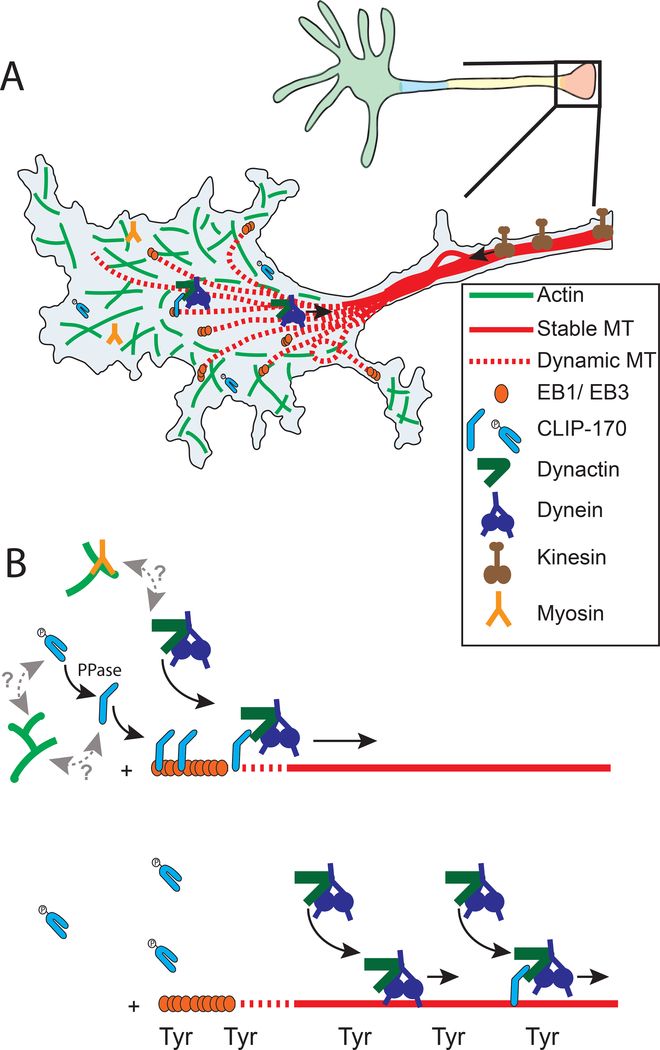
(A) The cytoskeleton of the distal axon terminal is characterized by a dense actin network and sparse microtubule array. Although the morphology of a neuronal growth cone is depicted here, these features are also found in mature axon terminals. This contrasts with the dense, tiled array of more stable microtubules found in the mid-axon. Anterograde cargos are delivered by kinesin motors, primarily from the kinesin-1, −2, and −3 families. Actin and myosin coordinate the delivery, retention and release of pre-synaptic cargo. Retrograde cargo transport is driven by the dynein-dynactin complex. (B) Multiple mechanisms regulate the loading of retrograde cargo onto microtubule plus-ends. These regulatory proteins include +TIPs such as EB3, CLIP-170, DCTN1, and Lis1. Initiation is tuned by the phosphorylation state of CLIP-170 (top), which assumes an open conformation when dephosphorylated, and then binds to the plus-tips of microtubules, to enhance the recruitment of the dynein-dynactin complex. The local enrichment of tyrosinated microtubules (bottom), also enhances the recruitment of the dynein-dynactin complex to initiate retrograde transport.
References
Publication types
MeSH terms
Substances
Grants and funding
LinkOut - more resources
Full Text Sources
Other Literature Sources
