


Polo-like kinase 3, hypoxic responses, and tumorigenesis
- PMID: 28857653
- PMCID: PMC5731420
- DOI: 10.1080/15384101.2017.1373224
Polo-like kinase 3, hypoxic responses, and tumorigenesis
Abstract
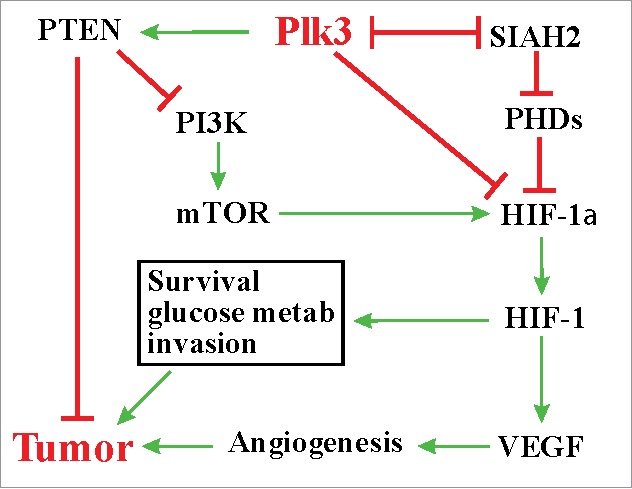
The cellular hypoxic response contributes to cell transformation and tumor progression. Hypoxia-inducible factor 1 (HIF-1) is a key transcription factor that mediates transcription of genes whose products are essential for cellular adaptation to hypoxia. The activity of HIF-1 is largely regulated by the abundance of its alpha subunit (HIF-1α), which is primarily regulated by an oxygen-dependent and ubiquitin/proteasome-mediated degradation process. The HIF-1α protein level is also regulated by protein kinases through phosphorylation. Polo-like kinase 3 (Plk3) is a serine/threonine protein kinase with a tumor suppressive function. Plk3 phosphorylates and destabilizes HIF-1α. Plk3 also phosphorylates and stabilizes PTEN, a known regulator of HIF-1α stability via the PI3K pathway. Our latest study showed that the Plk3 protein is suppressed by hypoxia or nickel treatment via the ubiquitin/proteasome system. We discovered that Seven in Absentia Homologue 2 (SIAH2) is the E3 ubiquitin ligase of Plk3 and that Plk3 in turn destabilizes SIAH2. Given the role of SIAH2 in promoting stability of HIF-1α, our work reveals a novel mutual regulatory mechanism between Plk3 and SIAH2, which may function to fine-tune the cellular hypoxic response. Here we discuss the role of Plk3 in the hypoxic response and tumorigenesis in light of these latest findings.
Keywords: Carcinogenesis; HIF-1α; PTEN; Plk3; SIAH2; hypoxia; nickel; tumor angiogenesis.
Figures
References
Publication types
MeSH terms
Substances
Grants and funding
LinkOut - more resources
Full Text Sources
Other Literature Sources
Research Materials
