


Stepwise resection of the posterior ligamentous complex for stability of a thoracolumbar compression fracture: An in vitro biomechanical investigation
- PMID: 28858098
- PMCID: PMC5585492
- DOI: 10.1097/MD.0000000000007873
Stepwise resection of the posterior ligamentous complex for stability of a thoracolumbar compression fracture: An in vitro biomechanical investigation
Abstract
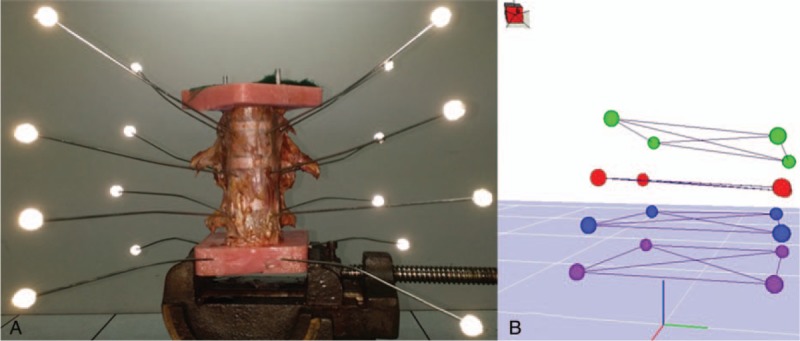
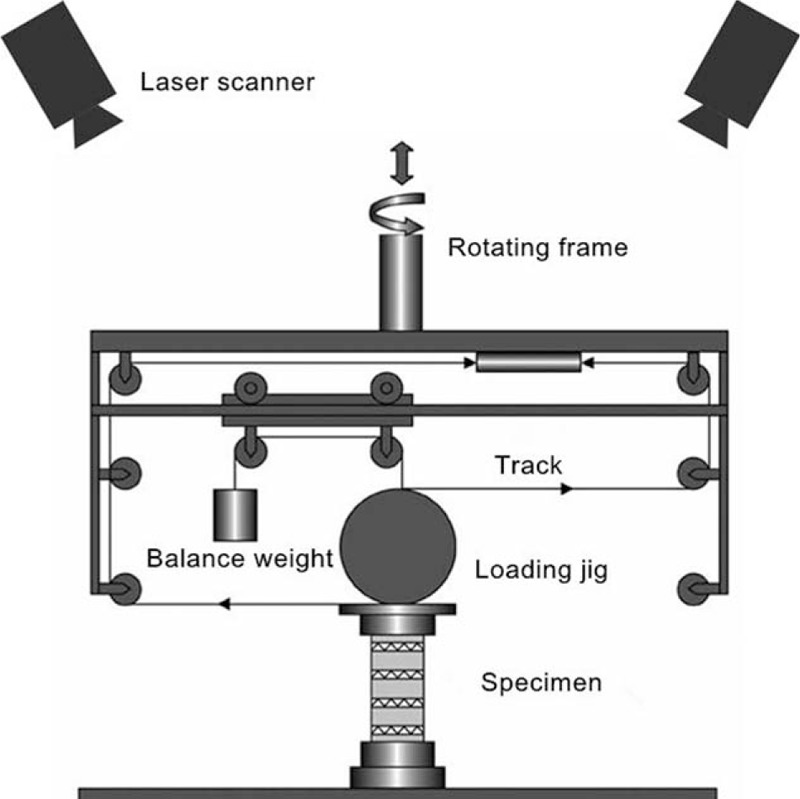
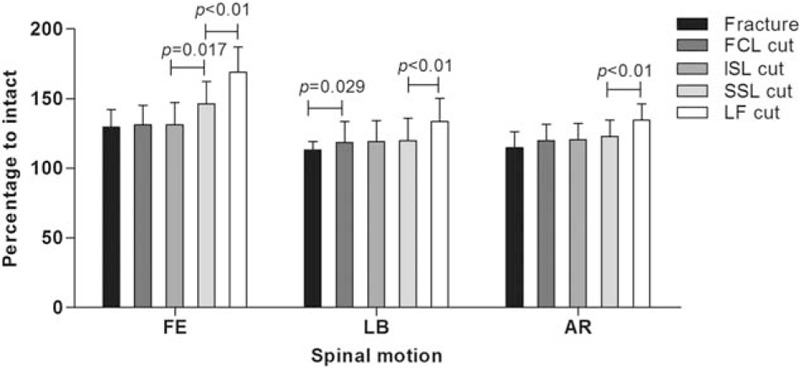
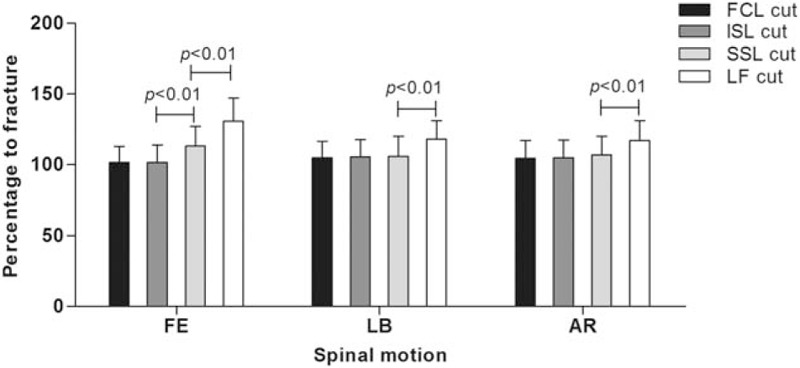
To quantify the mechanical contribution of posterior ligamentous structures to the stability of thoracolumbar compression fractures.Twelve fresh human T11-L3 spinal specimens were harvested in this study. The 1/3 L1 vertebral body was resected in a wedged shape. After the preinjury had been created, the specimens were subjected to flexion-compression to create a fracture model. Resection of the ligaments was performed in a sequential manner from the bilateral facet capsule ligament (FCL), interspinous ligament, and supraspinous ligament (SSL) to the ligamentum flavum at the T12-L1 level. Then, for the intact specimen, fracture model, and ligament disruption steps, the range of motion (ROM) and neutral zone (NZ) of T12-L1 and L1-L2 were collected for each simulated movement.Sequential transection of the posterior ligamentous complex (PLC), ROM, and NZ were increased in all movements at the T12-L1 segment. In the flexion-extension (FE), the ROM and NZ demonstrated significant increases after the fracture model and resection of SSL and LF. In lateral bending (LB), the ROM increased after the fracture and removal of the LF, while the NZ showed a slight increase. In axial rotation, the fracture model and removal of the LF resulted in a significant increase in the ROM, and the NZ showed a slight change after step reduction. For the L1-L2 segment, resection of the FCL led to an increased ROM in LB.With rupture of SSL or LF, the stability of the segment decreased significantly compared with the intact and fracture model, particularly in FE motion, the function of the PLC was considered to be incompetent.
Conflict of interest statement
The authors have no conflicts of interest to disclose.
Figures
References
-
- Behrsin JF, Briggs CA. Ligaments of the lumbar spine: a review. Surg Radiol Anat 1988;10:211–9. - PubMed
-
- McAfee PC, Yuan HA, Fredrickson BE, et al. The value of computed tomography in thoracolumbar fractures. An analysis of one hundred consecutive cases and a new classification. J Bone Joint Surg Am 1983;65:461–73. - PubMed
-
- Oner FC, van Gils AP, Faber JA, et al. Some complications of common treatment schemes of thoracolumbar spine fractures can be predicted with magnetic resonance imaging: prospective study of 53 patients with 71 fractures. Spine 2002;27:629–36. - PubMed
-
- Panjabi MM, Hoffman H, Kato Y, et al. Superiority of incremental trauma approach in experimental burst fracture studies. Clin Biomech 2000;15:73–8. - PubMed
Publication types
MeSH terms
LinkOut - more resources
Full Text Sources
Other Literature Sources
Medical
