


Trends in Deaths Involving Heroin and Synthetic Opioids Excluding Methadone, and Law Enforcement Drug Product Reports, by Census Region - United States, 2006-2015
- PMID: 28859052
- PMCID: PMC5657786
- DOI: 10.15585/mmwr.mm6634a2
Trends in Deaths Involving Heroin and Synthetic Opioids Excluding Methadone, and Law Enforcement Drug Product Reports, by Census Region - United States, 2006-2015
Abstract
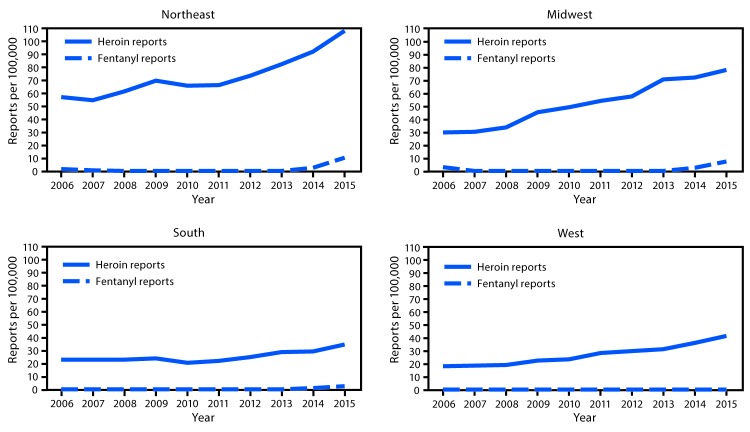
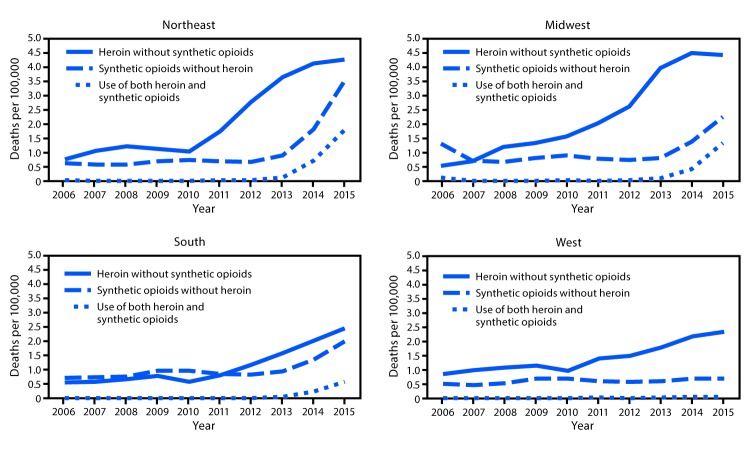
Opioid overdose deaths quadrupled from 8,050 in 1999 to 33,091 in 2015 and accounted for 63% of drug overdose deaths in the United States in 2015. During 2010-2015, heroin overdose deaths quadrupled from 3,036 to 12,989 (1). Sharp increases in the supply of heroin and illicitly manufactured fentanyl (IMF) are likely contributing to increased deaths (2-6). CDC examined trends in unintentional and undetermined deaths involving heroin or synthetic opioids excluding methadone (i.e., synthetic opioids)* by the four U.S. Census regions during 2006-2015. Drug exhibits (i.e., drug products) obtained by law enforcement and reported to the Drug Enforcement Administration's (DEA's) National Forensic Laboratory Information System (NFLIS) that tested positive for heroin or fentanyl (i.e., drug reports) also were examined. All U.S. Census regions experienced substantial increases in deaths involving heroin from 2006 to 2015. Since 2010, the South and West experienced increases in heroin drug reports, whereas the Northeast and Midwest experienced steady increases during 2006-2015.† In the Northeast, Midwest, and South, deaths involving synthetic opioids and fentanyl drug reports increased considerably after 2013. These broad changes in the U.S. illicit drug market highlight the urgent need to track illicit drugs and enhance public health interventions targeting persons using or at high risk for using heroin or IMF.
Conflict of interest statement
Figures
References
-
- Drug Enforcement Administration. 2016 national drug threat assessment summary. Washington, DC: US Department of Justice, Drug Enforcement Administration; 2016. https://www.dea.gov/resource-center/2016%20NDTA%20Summary.pdf
-
- Drug Enforcement Administration. Counterfeit prescription pills containing fentanyls: a global threat. DEA intelligence brief. Washington, DC: US Department of Justice, Drug Enforcement Administration; 2016. https://www.dea.gov/docs/Counterfeit%20Prescription%20Pills.pdf
MeSH terms
Substances
LinkOut - more resources
Full Text Sources
Other Literature Sources
