


Projections of primary liver cancer to 2030 in 30 countries worldwide
- PMID: 28859220
- PMCID: PMC5832532
- DOI: 10.1002/hep.29498
Projections of primary liver cancer to 2030 in 30 countries worldwide
Abstract
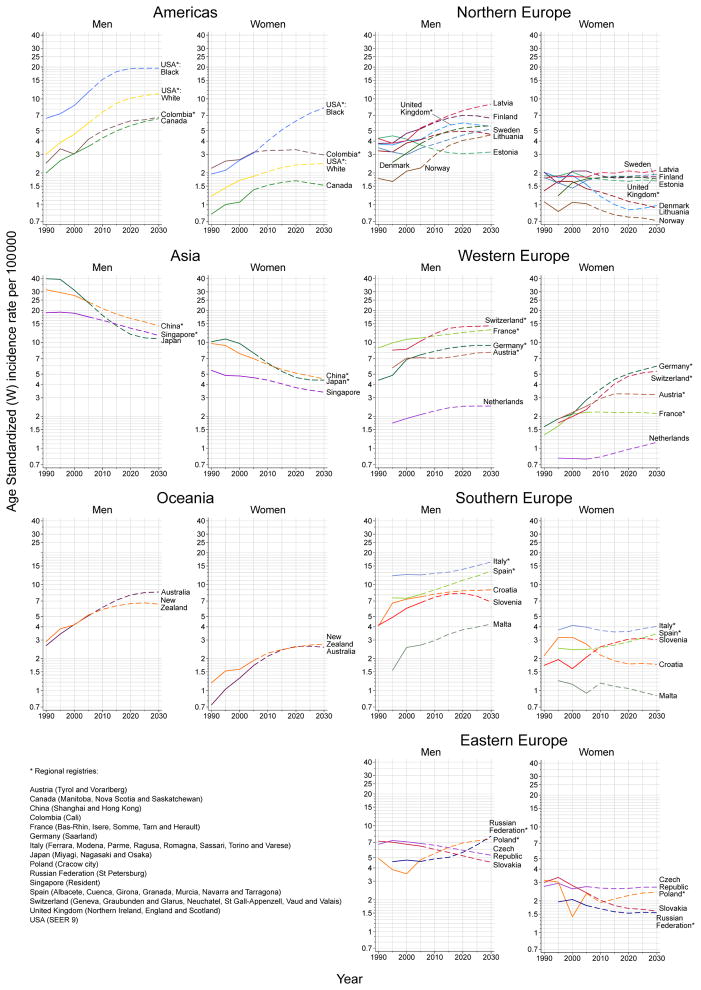
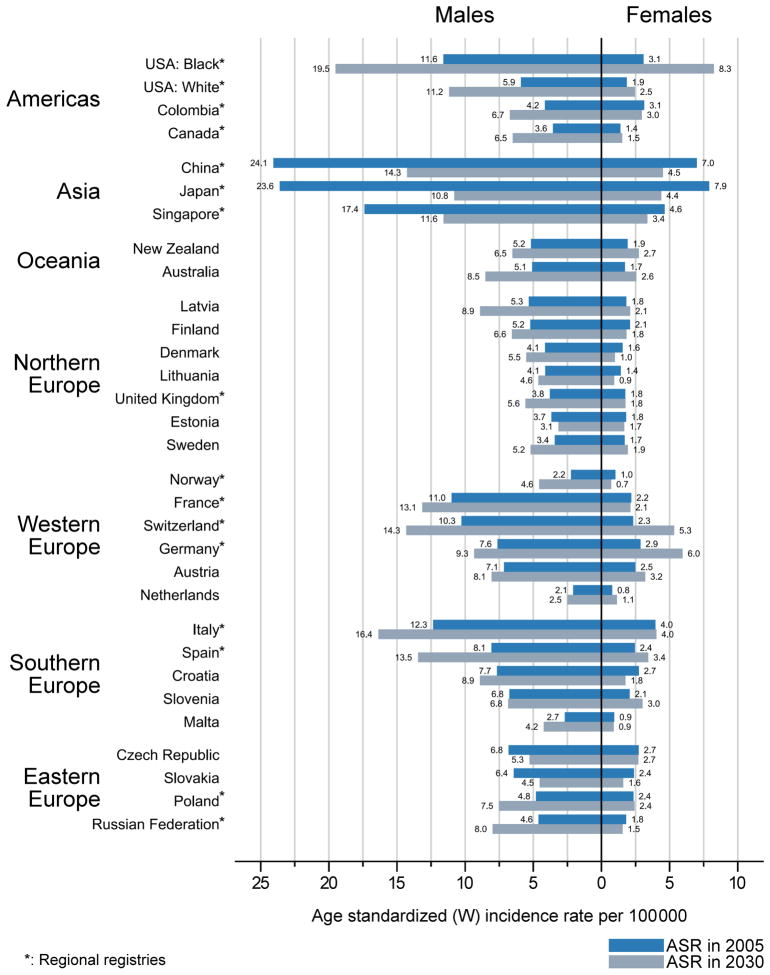
Primary liver cancer (PLC) is the sixth most common cancer worldwide and the second most common cause of cancer death. Future predictions can inform health planners and raise awareness of the need for cancer control action. We predicted the future burden of PLC in 30 countries around 2030. Incident cases of PLC (International Classification of Diseases, Tenth Revision, C22) were obtained from 30 countries for 1993-2007. We projected new PLC cases to 2030 using age-period-cohort models (NORDPRED software). Age-standardized incidence rates per 100,000 person-years were calculated by country and sex. Increases in new cases and rates of PLC are projected in both sexes. The largest increases in rates are, among men, in Norway (2.9% per annum), US whites (2.6%), and Canada (2.4%) and, among women, in the United States (blacks 4.0%), Switzerland (3.4%), and Germany (3.0%). The projected declines are in China, Japan, Singapore, and parts of Europe (e.g., Estonia, Czech Republic, Slovakia). A 35% increase in the number of new cases annually is expected compared to 2005. This increasing burden reflects both increasing rates (and the underlying prevalence of risk factors) and demographic changes. Japan is the only country with a predicted decline in the net number of cases and annual rates by 2030. Conclusion: Our reporting of a projected increase in PLC incidence to 2030 in 30 countries serves as a baseline for anticipated declines in the longer term through the control of hepatitis B virus and hepatitis C virus infections by vaccination and treatment; however, the prospect that rising levels of obesity and its metabolic complications may lead to an increased risk of PLC that potentially offsets these gains is a concern. (Hepatology 2018;67:600-611).
© 2017 by the American Association for the Study of Liver Diseases.
Conflict of interest statement
Figures
References
-
- Ferlay J, Soerjomataram I, Ervik M, Dikshit R, Eser S, Mathers C, Rebelo M, et al. Cancer Incidence and Mortality Worldwide: IARC CancerBase No.11. Lyon, France: IARC; 2012.
-
- International Agency for Research on Cancer (IARC) World Cancer Report 2014. Lyon, France: 2014.
-
- Chimed T, Sandagdorj T, Znaor A, Laversanne M, Tseveen B, Genden P, Bray F. Cancer incidence and cancer control in Mongolia: Results from the National Cancer Registry 2008–12. Int J Cancer. 2017;140:302–309. - PubMed
-
- El-Serag HB, Rudolph KL. Hepatocellular carcinoma: epidemiology and molecular carcinogenesis. Gastroenterol. 2007;132:2557–2576. - PubMed
Publication types
MeSH terms
Grants and funding
LinkOut - more resources
Full Text Sources
Other Literature Sources
Medical
