


What impact does nursing care left undone have on patient outcomes? Review of the literature
- PMID: 28859254
- PMCID: PMC6001747
- DOI: 10.1111/jocn.14058
What impact does nursing care left undone have on patient outcomes? Review of the literature
Abstract
Aims and objectives: Systematic review of the impact of missed nursing care on outcomes in adults, on acute hospital wards and in nursing homes.
Background: A considerable body of evidence supports the hypothesis that lower levels of registered nurses on duty increase the likelihood of patients dying on hospital wards, and the risk of many aspects of care being either delayed or left undone (missed). However, the direct consequence of missed care remains unclear.
Design: Systematic review.
Methods: We searched Medline (via Ovid), CINAHL (EBSCOhost) and Scopus for studies examining the association of missed nursing care and at least one patient outcome. Studies regarding registered nurses, healthcare assistants/support workers/nurses' aides were retained. Only adult settings were included. Because of the nature of the review, qualitative studies, editorials, letters and commentaries were excluded. PRISMA guidelines were followed in reporting the review.
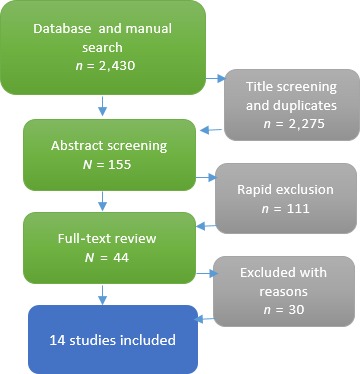
Results: Fourteen studies reported associations between missed care and patient outcomes. Some studies were secondary analyses of a large parent study. Most of the studies used nurse or patient reports to capture outcomes, with some using administrative data. Four studies found significantly decreased patient satisfaction associated with missed care. Seven studies reported associations with one or more patient outcomes including medication errors, urinary tract infections, patient falls, pressure ulcers, critical incidents, quality of care and patient readmissions. Three studies investigated whether there was a link between missed care and mortality and from these results no clear associations emerged.
Conclusions: The review shows the modest evidence base of studies exploring missed care and patient outcomes generated mostly from nurse and patient self-reported data. To support the assertion that nurse staffing levels and skill mix are associated with adverse outcomes as a result of missed care, more research that uses objective staffing and outcome measures is required.
Relevance to clinical practice: Although nurses may exercise judgements in rationing care in the face of pressure, there are nonetheless adverse consequences for patients (ranging from poor experience of care to increased risk of infection, readmissions and complications due to critical incidents from undetected physiological deterioration). Hospitals should pay attention to nurses' reports of missed care and consider routine monitoring as a quality and safety indicator.
Keywords: care left undone; missed care; nurse staff; patient outcomes; safe staffing levels; unfinished care.
© 2017 The Authors. Journal of Clinical Nursing Published by John Wiley & Sons Ltd.
Figures
References
-
- Ambrosi, E. , De Togni, S. , Guarnier, A. , Barelli, P. , Zambiasi, P. , Allegrini, E. , … Palese, A. (2016). In‐hospital elderly mortality and associated factors in 12 Italian acute medical units: Findings from an exploratory longitudinal study. Aging Clinical and Experimental Research, 29(3), 1–11. https://doi.org/10.1007/s40520-016-0576-8 - DOI - PubMed
-
- Ausserhofer, D. , Schubert, M. , Desmedt, M. , Blegen, M. A. , De Geest, S. , & Schwendimann, R. (2013). The association of patient safety climate and nurse‐related organizational factors with selected patient outcomes: A cross‐sectional survey. International Journal of Nursing Studies, 50(2), 240–252. https://doi.org/10.1016/j.ijnurstu.2012.04.007 - DOI - PubMed
-
- Ausserhofer, D. , Zander, B. , Busse, R. , Schubert, M. , De Geest, S. , Rafferty, A. M. , … Consortium, R. C. (2014). Prevalence, patterns and predictors of nursing care left undone in European hospitals: Results from the multicountry cross‐sectional RN4CAST study. BMJ Quality and Safety, 23(2), 126–135. https://doi.org/10.1136/bmjqs-2013-002318 - DOI - PubMed
-
- Ball, J. E. , Murrells, T. , Rafferty, A. M. , Morrow, E. , & Griffiths, P. (2014). ‘Care left undone’ during nursing shifts: Associations with workload and perceived quality of care. BMJ Quality and Safety, 23(2), 116–125. https://doi.org/10.1136/bmjqs-2012-001767 - DOI - PMC - PubMed
-
- Bruyneel, L. , Li, B. , Ausserhofer, D. , Lesaffre, E. , Dumitrescu, I. , Smith, H. L. , … Sermeus, W. (2015). Organization of hospital nursing, provision of nursing care, and patient experiences with care in Europe. Medical Care Research and Review, 72(6), 643–664. https://doi.org/10.1177/1077558715589188 - DOI - PMC - PubMed
Publication types
MeSH terms
Grants and funding
LinkOut - more resources
Full Text Sources
Other Literature Sources
