


The Ecology of Exercise: Mechanisms Underlying Individual Variation in Behavior, Activity, and Performance: An Introduction to Symposium
- PMID: 28859409
- PMCID: PMC5886314
- DOI: 10.1093/icb/icx083
The Ecology of Exercise: Mechanisms Underlying Individual Variation in Behavior, Activity, and Performance: An Introduction to Symposium
Abstract
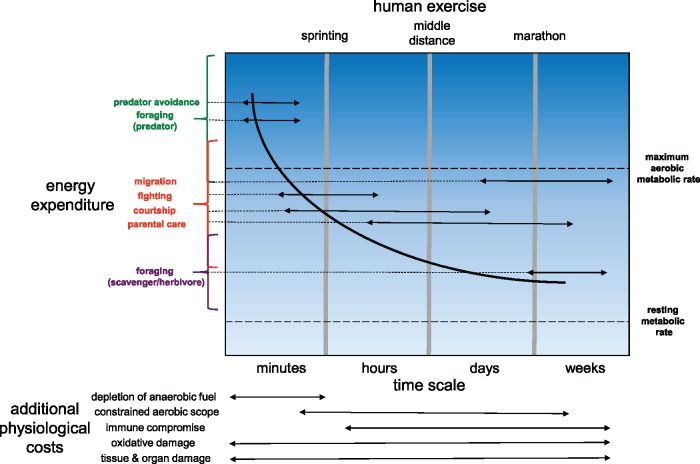
Wild animals often engage in intense physical activity while performing tasks vital for their survival and reproduction associated with foraging, avoiding predators, fighting, providing parental care, and migrating. In this theme issue we consider how viewing these tasks as "exercise"-analogous to that performed by human athletes-may help provide insight into the mechanisms underlying individual variation in these types of behaviors and the importance of physical activity in an ecological context. In this article and throughout this issue, we focus on four key questions relevant to the study of behavioral ecology that may be addressed by studying wild animal behavior from the perspective of exercise physiology: (1) How hard do individual animals work in response to ecological (or evolutionary) demands?; (2) Do lab-based studies of activity provide good models for understanding activity in free-living animals and individual variation in traits?; (3) Can animals work too hard during "routine" activities?; and (4) Can paradigms of "exercise" and "training" be applied to free-living animals? Attempts to address these issues are currently being facilitated by rapid technological developments associated with physiological measurements and the remote tracking of wild animals, to provide mechanistic insights into the behavior of free-ranging animals at spatial and temporal scales that were previously impossible. We further suggest that viewing the behaviors of non-human animals in terms of the physical exercise performed will allow us to fully take advantage of these technological advances, draw from knowledge and conceptual frameworks already in use by human exercise physiologists, and identify key traits that constrain performance and generate variation in performance among individuals. It is our hope that, by highlighting mechanisms of behavior and performance, the articles in this issue will spur on further synergies between physiologists and ecologists, to take advantage of emerging cross-disciplinary perspectives and technologies.
© The Author 2017. Published by Oxford University Press on behalf of the Society for Integrative and Comparative Biology.
Figures
References
-
- Baktoft H, Jacobsen L, Skov C, Koed A, Jepsen N, Berg S, Boel M, Aarestrup K, Svendsen JC.. 2016. Phenotypic variation in metabolism and morphology correlating with animal swimming activity in the wild: relevance for the OCLTT (oxygen-and capacity-limitation of thermal tolerance), allocation and performance models. Conserv Physiol 4 (doi:10.1093/conphys/cov055). - PMC - PubMed
-
- Beltrami FG, Froyd C, Mauger AR, Metcalfe AJ, Marino F, Noakes TD.. 2012. Conventional testing methods produce submaximal values of maximum oxygen consumption. Br J Sports Med 46:23–9. - PubMed
-
- Bennett AF, Houck LD.. 1983. The energetic cost of courtship and aggression in a plethodontid salamander. Ecology 64:979–83.
Publication types
MeSH terms
LinkOut - more resources
Full Text Sources
Other Literature Sources
Medical
Miscellaneous
