Review
. 2017 Sep;20(5):476-494.
doi: 10.1080/10253890.2017.1369523. Epub 2017 Aug 31.

Hypothalamic-pituitary-adrenal and hypothalamic-pituitary-gonadal axes: sex differences in regulation of stress responsivity

Affiliations
Review

Hypothalamic-pituitary-adrenal and hypothalamic-pituitary-gonadal axes: sex differences in regulation of stress responsivity

Mario G Oyola et al. Stress. 2017 Sep.

Abstract

Gonadal hormones play a key role in the establishment, activation, and regulation of the hypothalamic-pituitary-adrenal (HPA) axis. By influencing the response and sensitivity to releasing factors, neurotransmitters, and hormones, gonadal steroids help orchestrate the gain of the HPA axis to fine-tune the levels of stress hormones in the general circulation. From early life to adulthood, gonadal steroids can differentially affect the HPA axis, resulting in sex differences in the responsivity of this axis. The HPA axis influences many physiological functions making an organism's response to changes in the environment appropriate for its reproductive status. Although the acute HPA response to stressors is a beneficial response, constant activation of this circuitry by chronic or traumatic stressful episodes may lead to a dysregulation of the HPA axis and cause pathology. Compared to males, female mice and rats show a more robust HPA axis response, as a result of circulating estradiol levels which elevate stress hormone levels during non-threatening situations, and during and after stressors. Fluctuating levels of gonadal steroids in females across the estrous cycle are a major factor contributing to sex differences in the robustness of HPA activity in females compared to males. Moreover, gonadal steroids may also contribute to epigenetic and organizational influences on the HPA axis even before puberty. Correspondingly, crosstalk between the hypothalamic-pituitary-gonadal (HPG) and HPA axes could lead to abnormalities of stress responses. In humans, a dysregulated stress response is one of the most common symptoms seen across many neuropsychiatric disorders, and as a result, such interactions may exacerbate peripheral pathologies. In this review, we discuss the HPA and HPG axes and review how gonadal steroids interact with the HPA axis to regulate the stress circuitry during all stages in life.

Keywords: Hypothalamic–pituitary–adrenal axis; estrogen; gonadal steroids; hypothalamic–pituitary–gonadal axis; progesterone; sex differences; stress circuitry; testosterone.


Conflict of interest statement

Disclosure statement

The authors report no conflicts of interest.

Figures
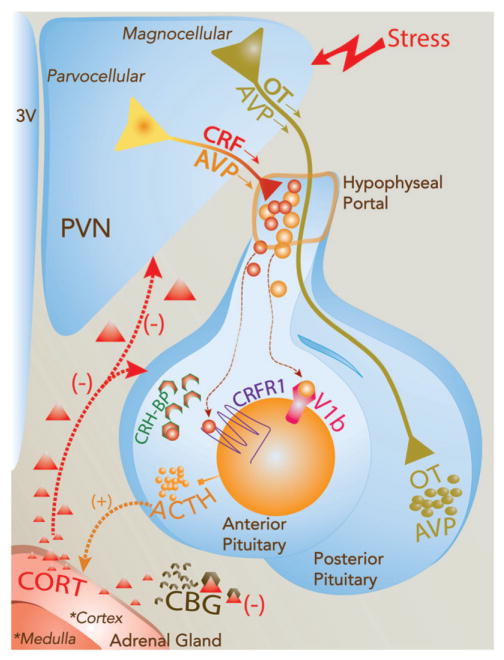
Figure 1
Figure 1
Schematic diagram of the HPA axis and factors controlling the neuro-endocrine response to stress. Stress signals are relayed to the paraventricular nucleus of the hypothalamus (PVN) where oxytocin (OT), vasopressin (AVP), and corticotropin-releasing hormone (CRH) neurons reside. These neurons are recruited to trigger the HPA axis response. First, a subset of hypophysiotropic PVN neurons releases CRH and AVP into the hypophysial portal vasculature. These neuropeptides are transported to the anterior pituitary to act on corticotropes through their binding to CRHR1 and V1b receptors thereby stimulating the synthesis and release of adrenocorticotropic hormone (ACTH) into the general circulation. CRH activity on corticotropes is also regulated by the CRH-binding protein, which impedes its interaction with CRHR1. OT and AVP also control CRH actions at the pituitary level. In the adrenal cortex, the binding of circulating ACTH to the melanocortin type 2 receptor (MC2R) stimulates the synthesis and secretion of corticosterone (CORT) into the general circulation. Circulating CORT can then modulate behavioral and physiological responses to stress. CORT is also capable of inhibiting HPA axis activation (negative feedback) by acting in brain regions including the PVN, pituitary, hippocampus, and other limbic areas. The activity of circulating CORT is in part regulated by the CORT binding globulin (CBG). In contrast, axons of OT and AVP in the magnocellular division of the PVN project to the posterior pituitary, where they release OT and AVP to the general circulation to regulate the physiological response to stressors, osmoregulation, and reproductive function.
Figure 2
Figure 2
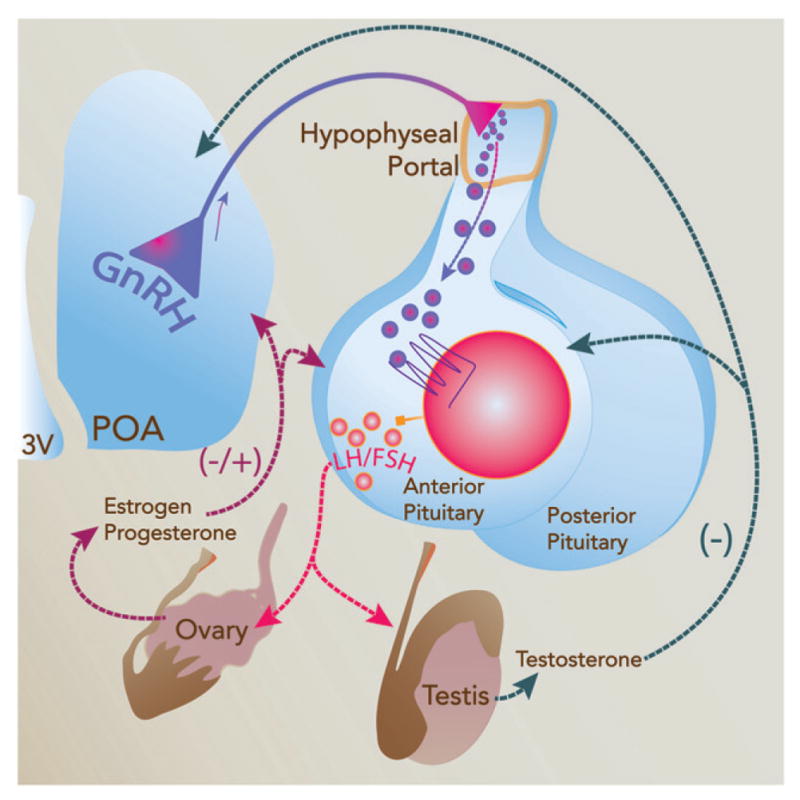
Schematic diagram showing the hypothalamic–pituitary–gonadal (HPG) axis and factors involved in its regulation. Hypophysiotropic neurons in the rodent hypothalamus secrete gonadotropin-releasing hormone (GnRH) into the hypothalamo-hypophyseal portal vasculature at the median eminence, where it is carried to the anterior pituitary. Once in the anterior pituitary, GnRH stimulates gonadotroph cells to synthesize and secrete luteinizing hormone (LH) and follicular stimulating hormone (FSH). LH and FSH act on the ovary and testis to regulate steroidogenesis and gametogenesis. Once released, steroid hormones signal through the anterior pituitary and steroid-sensitive hypothalamic neurons to feedback upon the HPG axis to regulate its activity and to other brain areas thereby controlling reproductive behaviors and functions, including HPA axis activity.
Figure 3
Figure 3
Schematic diagram demonstrating the reciprocal interaction between the HPA and HPG axes. Panel A: Hormones of the HPG axis are involved in the regulation of the HPA axis at different levels, as delineated by dotted lines. Both axes are influenced by upstream regulatory centers. In the case of the HPA axis, most of these centers release GABA either directly into the PVN or in its immediate periphery. In the case of the HPG axis, upstream centers release kisspeptin to regulate GnRH activity. Panel B: Hormones from the HPA axis are involved in the regulation of the HPG axis at different levels, as delineated by dotted lines. Abbreviations: PVN: paraventricular nucleus of the hypothalamus; AVP: arginine vasopressin; CRH: corticotropin releasing hormone; ACTH: adrenocorticotropic hormone; CORT: corticosterone; POA: pre-optic area; OVLT: organum vasculosum lamina terminalis; GnRH: gonadotropin releasing hormone; LH: luteinizing hormone; FSH: follicle stimulating hormone; E: estrogen; P: progesterone; T: testosterone; DHT: dihydrotestosterone.

References

    1. Adachi S, Yamada S, Takatsu Y, Matsui H, Kinoshita M, Takase K, … Maeda K. Involvement of anteroventral periventricular meta-stin/kisspeptin neurons in estrogen positive feedback action on luteinizing hormone release in female rats. Journal of Reproduction and Development. 2007;53:367–378. - PubMed
    1. Akana SF, Cascio CS, Du JZ, Levin N, Dallman MF. Reset of feedback in the adrenocortical system: An apparent shift in sensitivity of adrenocorticotropin to inhibition by corticosterone between morning and evening. Endocrinology. 1986;119:2325–2332. doi: 10.1210/endo-119-5-2325. - DOI - PubMed
    1. Amateau SK, McCarthy MM. Induction of PGE2 by estradiol mediates developmental masculinization of sex behavior. Nature Neuroscience. 2004;7:643–650. doi: 10.1038/nn1254. - DOI - PubMed
    1. Arevalo MA, Azcoitia I, Garcia-Segura LM. The neuroprotective actions of oestradiol and oestrogen receptors. Nature Reviews. Neuroscience. 2015;16:17–29. doi: 10.1038/nrn3856. - DOI - PubMed
    1. Arnold AP. Genetically triggered sexual differentiation of brain and behavior. Hormones and Behavior. 1996;30:495–505. doi: 10.1006/hbeh.1996.0053. - DOI - PubMed

Substances