


Protraction of neuropathic pain by morphine is mediated by spinal damage associated molecular patterns (DAMPs) in male rats
- PMID: 28860068
- PMCID: PMC5832500
- DOI: 10.1016/j.bbi.2017.08.018
Protraction of neuropathic pain by morphine is mediated by spinal damage associated molecular patterns (DAMPs) in male rats
Abstract
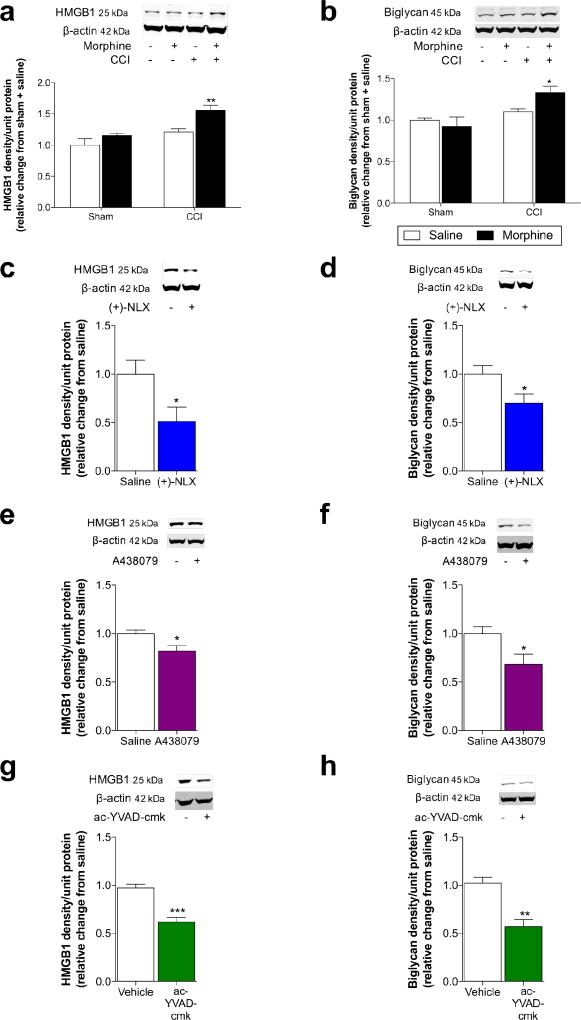
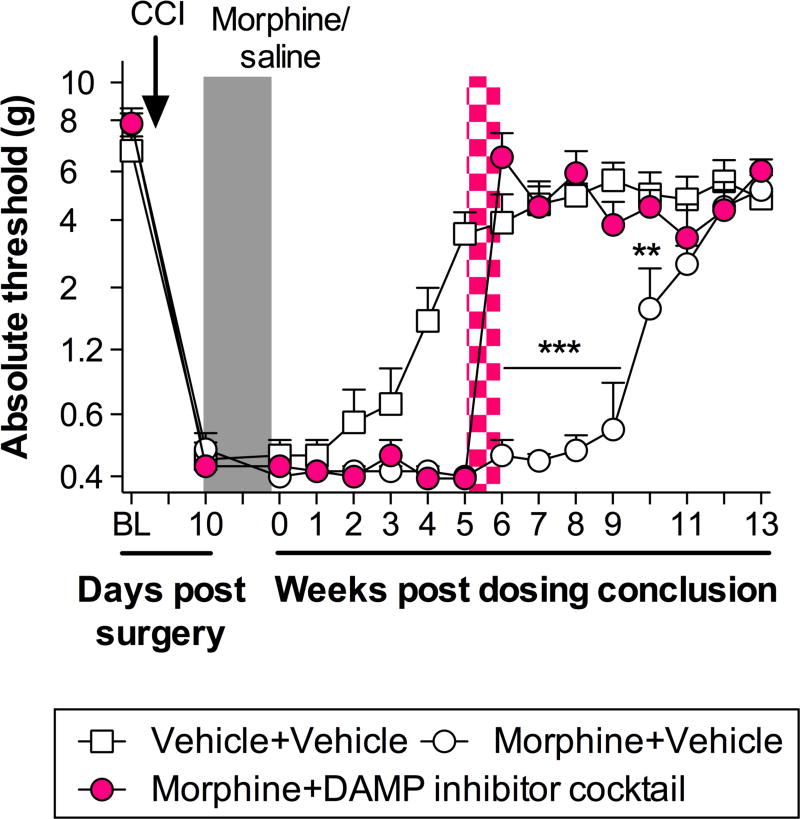
We have recently reported that a short course of morphine, starting 10days after sciatic chronic constriction injury (CCI), prolonged the duration of mechanical allodynia for months after morphine ceased. Maintenance of this morphine-induced persistent sensitization was dependent on spinal NOD-like receptor protein 3 (NLRP3) inflammasomes-protein complexes that proteolytically activate interleukin-1β (IL-1β) via caspase-1. However, it is still unclear how NLRP3 inflammasome signaling is maintained long after morphine is cleared. Here, we demonstrate that spinal levels of the damage associated molecular patterns (DAMPs) high mobility group box 1 (HMGB1) and biglycan are elevated during morphine-induced persistent sensitization in male rats; that is, 5weeks after cessation of morphine dosing. We also show that HMGB1 and biglycan levels are at least partly dependent on the initial activation of caspase-1, as well as Toll like receptor 4 (TLR4) and the purinergic receptor P2X7R-receptors responsible for priming and activation of NLRP3 inflammasomes. Finally, pharmacological attenuation of the DAMPs HMGB1, biglycan, heat shock protein 90 and fibronectin persistently reversed morphine-prolonged allodynia. We conclude that after peripheral nerve injury, morphine treatment results in persistent DAMP release via TLR4, P2X7R and caspase-1, which are involved in formation/activation of NLRP3 inflammasomes. These DAMPs are responsible for maintaining persistent allodynia, which may be due to engagement of a positive feedback loop, in which NLRP3 inflammasomes are persistently activated by DAMPs signaling at TLR4 and P2X7R.
Keywords: Danger signals; Glia; Opioid-induced hyperalgesia; Priming.
Copyright © 2017 Elsevier Inc. All rights reserved.
Figures
References
-
- Bennett GJ, Xie YK. A peripheral mononeuropathy in rat that produces disorders of pain sensation like those seen in man. Pain. 1988;33:87–107. - PubMed
-
- Chacur M, Milligan ED, Gazda LS, Armstrong C, Wang H, Tracey KJ, Maier SF, Watkins LR. A new model of sciatic inflammatory neuritis (SIN): induction of unilateral and bilateral mechanical allodynia following acute unilateral peri-sciatic immune activation in rats. Pain. 2001;94:231–244. - PubMed
-
- Chaplan SR, Bach FW, Pogrel JW, Chung JM, Yaksh TL. Quantitative assessment of tactile allodynia in the rat paw. J. Neurosci. Methods. 1994;53:55–63. - PubMed
Publication types
MeSH terms
Substances
Grants and funding
LinkOut - more resources
Full Text Sources
Other Literature Sources
Medical
