. 2017 Aug 31;7(1):10102.
doi: 10.1038/s41598-017-10012-x.

Structural and Functional View of Polypharmacology

Affiliations

Structural and Functional View of Polypharmacology

Aurelio Moya-García et al. Sci Rep. .

Abstract

Protein domains mediate drug-protein interactions and this principle can guide the design of multi-target drugs i.e. polypharmacology. In this study, we associate multi-target drugs with CATH functional families through the overrepresentation of targets of those drugs in CATH functional families. Thus, we identify CATH functional families that are currently enriched in drugs (druggable CATH functional families) and we use the network properties of these druggable protein families to analyse their association with drug side effects. Analysis of selected druggable CATH functional families, enriched in drug targets, show that relatives exhibit highly conserved drug binding sites. Furthermore, relatives within druggable CATH functional families occupy central positions in a human protein functional network, cluster together forming network neighbourhoods and are less likely to be within proteins associated with drug side effects. Our results demonstrate that CATH functional families can be used to identify drug-target interactions, opening a new research direction in target identification.


Conflict of interest statement

The authors declare that they have no competing interests.

Figures
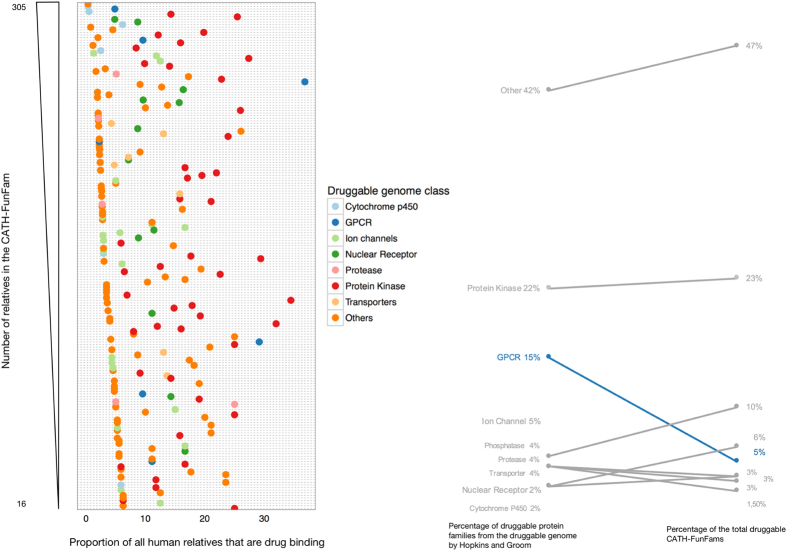
Figure 1
Figure 1
Proportion of drug-binding proteins in CATH-FunFams and the druggable genome. (A) Proportion of drug-binding proteins in 195 selected CATH-FunFams. FunFams were selected for having at least one drug-binding protein amongst their relatives and containing more than 2% of drug targets. (B) Slopegraph comparing the previous distribution of druggable protein families (i.e. the druggable genome) by Hopkins and Groom and our distribution of druggable CATH-FunFams.
Figure 2
Figure 2
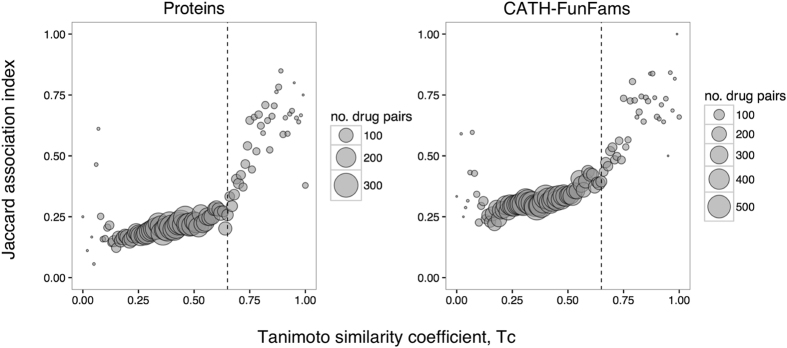
Correlation of the interactions profiles of a drug pair with their molecular similarity. Each circle is the average Jaccard index at a given bin of Tc similarity (bin size 0.01). The size of the circles is proportional to the number of drug pairs in the corresponding Tc bin. The vertical dashed line indicates the drug similarity threshold, Tc = 0.65 (see Supplementary Fig. S2).
Figure 3
Figure 3
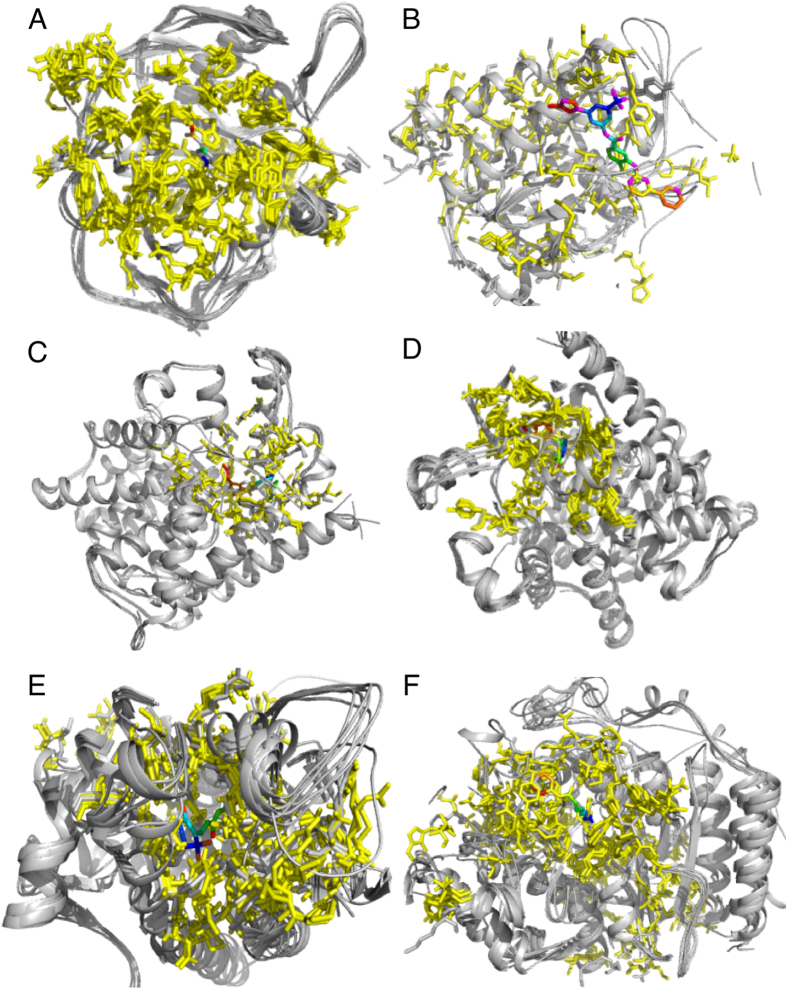
Conservation of the binding site within CATH-FunFams. Structural alignment of the CATH-Funfams associated with: (A) acetazolamide (CATH ID: 3.10.200.10-FF1430), (B) nilotinib (CATH ID: 1.10.510.10-FF78758), (C) Sildenafil (CATH ID: 1.10.510.10-FF78946), (D) tadalafil (CATH ID: 1.10.1300.10-FF1260), (E) Tretinoin (CATH ID: 1.10.565.10-FF5060) and (F) vorinostat (CATH ID: 3.40.800.20-FF2855) and the drug-target complexes of these drugs. In each case, the protein domain is grey, except the ligand binding residues, which have been coloured yellow. The drug molecules are coloured in rainbow.
Figure 4
Figure 4
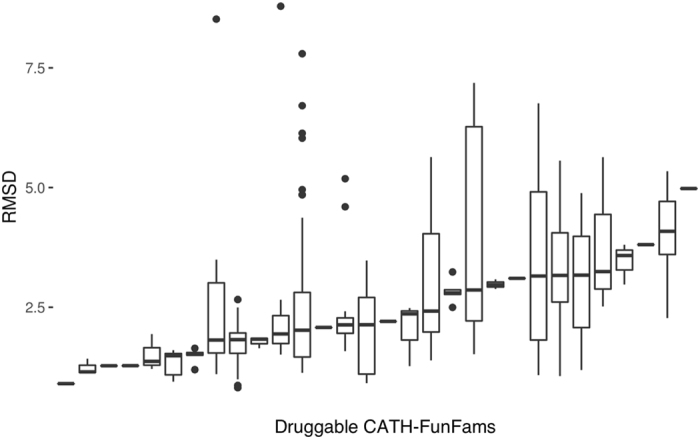
Normalised RMSD of druggable CATH-FunFams. Boxplots of the structural conservation within druggable CATH-FunFams. The RMSD is normalised by the number of residues in each structural alignment.
Figure 5
Figure 5
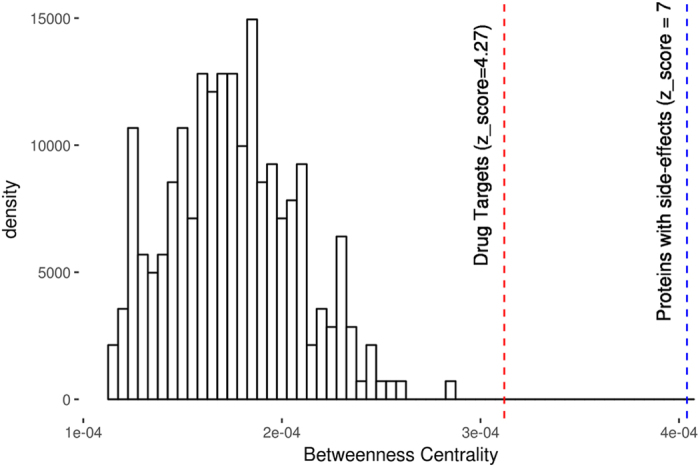
Betweenness centrality of drug targets. The mean betweenness centrality of drug targets (red line) and proteins associated with side effects in IntSide (blue line), in the protein functional network, is compared with the distribution of the mean betweenness centralities of random protein sets.
Figure 6
Figure 6
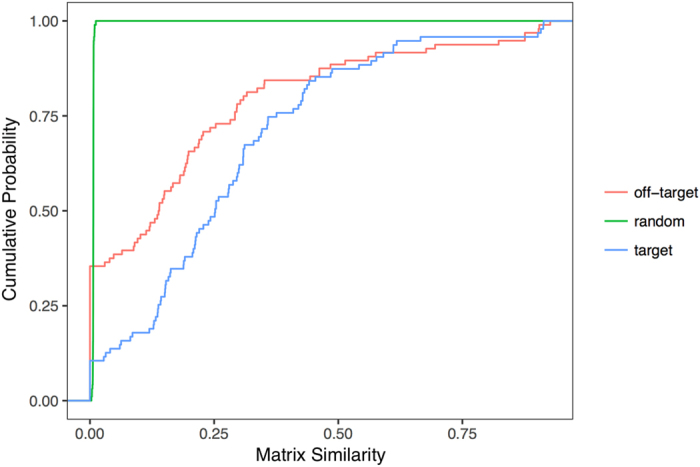
Drug neighbourhoods in the protein functional network. Cumulative distribution function of the matrix similarity of drug targets (blue line), off-targets (red line) and random sets of proteins (green line).
Figure 7
Figure 7
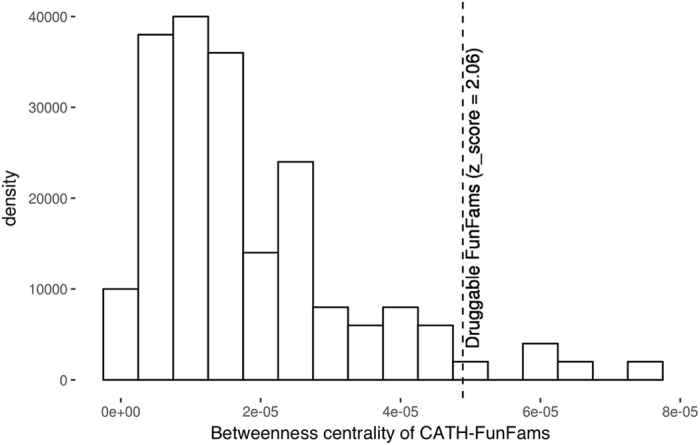
Betweenness centrality of druggable CATH functional families. The mean betweenness centrality of CATH-FunFams (dashed line) is compared with the distribution of the median betweenness centralities of random sets of non-druggable CATH-FunFams in the protein functional network.

References

    1. Berg EL. Systems biology in drug discovery and development. Drug Discov Today. 2014;19:113–125. doi: 10.1016/j.drudis.2013.10.003. - DOI - PubMed
    1. Anighoro, A., Bajorath, J. & Rastelli, G. Polypharmacology: Challenges and Opportunities in Drug Discovery. J Med Chem, doi:10.1021/jm5006463 (2014). - PubMed
    1. Moya-García AA, Morilla I, Ranea JAG. Oncogenic Signalling Networks and Polypharmacology as Paradigms to Cope with Cancer Heterogeneity. Current Proteomics. 2014;11:1–8. doi: 10.2174/157016461101140709105405. - DOI
    1. Roth BL, Sheffler DJ, Kroeze WK. Magic shotguns versus magic bullets: selectively non-selective drugs for mood disorders and schizophrenia. Nat Rev Drug Discov. 2004;3:353–359. doi: 10.1038/nrd1346. - DOI - PubMed
    1. Mestres J, Gregori-Puigjané E, Valverde S, Solé RV. Data completeness–the Achilles heel of drug-target networks. Nat Biotechnol. 2008;26:983–984. doi: 10.1038/nbt0908-983. - DOI - PubMed

Publication types