. 2017 Aug 31;7(1):10156.
doi: 10.1038/s41598-017-10698-z.

Heterologous expression of the N-acetylglucosaminyltransferase I dictates a reinvestigation of the N-glycosylation pathway in Chlamydomonas reinhardtii

Affiliations

Heterologous expression of the N-acetylglucosaminyltransferase I dictates a reinvestigation of the N-glycosylation pathway in Chlamydomonas reinhardtii

Gaëtan Vanier et al. Sci Rep. .

Abstract

Eukaryotic N-glycosylation pathways are dependent of N-acetylglucosaminyltransferase I (GnTI), a key glycosyltransferase opening the door to the formation of complex-type N-glycans by transferring a N-acetylglucosamine residue onto the Man5GlcNAc2 intermediate. In contrast, glycans N-linked to Chlamydomonas reinhardtii proteins arise from a GnTI-independent Golgi processing of oligomannosides giving rise to Man5GlcNAc2 substituted eventually with one or two xylose(s). Here, complementation of C. reinhardtii with heterologous GnTI was investigated by expression of GnTI cDNAs originated from Arabidopsis and the diatom Phaeodactylum tricornutum. No modification of the N-glycans was observed in the GnTI transformed cells. Consequently, the structure of the Man5GlcNAc2 synthesized by C. reinhardtii was reinvestigated. Mass spectrometry analyses combined with enzyme sequencing showed that C. reinhardtii proteins carry linear Man5GlcNAc2 instead of the branched structure usually found in eukaryotes. Moreover, characterization of the lipid-linked oligosaccharide precursor demonstrated that C. reinhardtii exhibit a Glc3Man5GlcNAc2 dolichol pyrophosphate precursor. We propose that this precursor is then trimmed into a linear Man5GlcNAc2 that is not substrate for GnTI. Furthermore, cells expressing GnTI exhibited an altered phenotype with large vacuoles, increase of ROS production and accumulation of starch granules, suggesting the activation of stress responses likely due to the perturbation of the Golgi apparatus.


Conflict of interest statement

The authors declare that they have no competing interests.

Figures
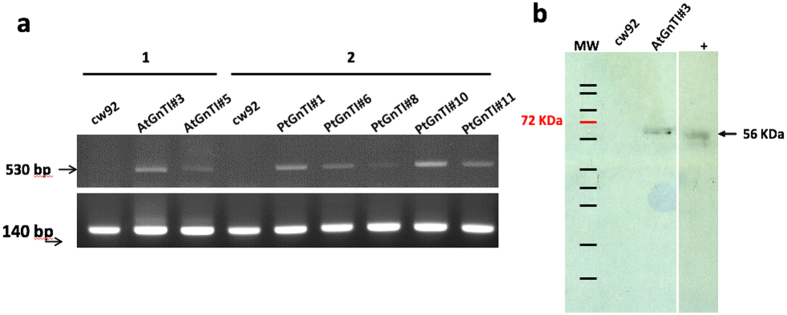
Figure 1
Figure 1
(a) RT-PCR analysis of GnTI transcription level in cw92 cells, cell lines transformed with AtGnTI-V5 (lines AtGnTI#3 and AtGnTI#5) or PtGnTI-V5 (lines PtGnTI#1, PtGnTI#6, PtGnTI#8, PtGnTI#10 and PtGnTI#11) using AtGnTI (1) or PtGnTI (2) specific primers. Actin (lower panel) was used as an RT-PCR control. (b) Immunodetection of recombinant GnTI in the microsomal fraction isolated from cw92 cells and AtGnTI#3 lines respectively. The immunodetection was performed using an anti-V5 antibody as a primary antibody. A protein extract from CHO cells expressing PtGnTI-V5 (+) was used as a positive control. Full images of the agarose gel and the Western blot are presented in Figs S1 and S2.
Figure 2
Figure 2
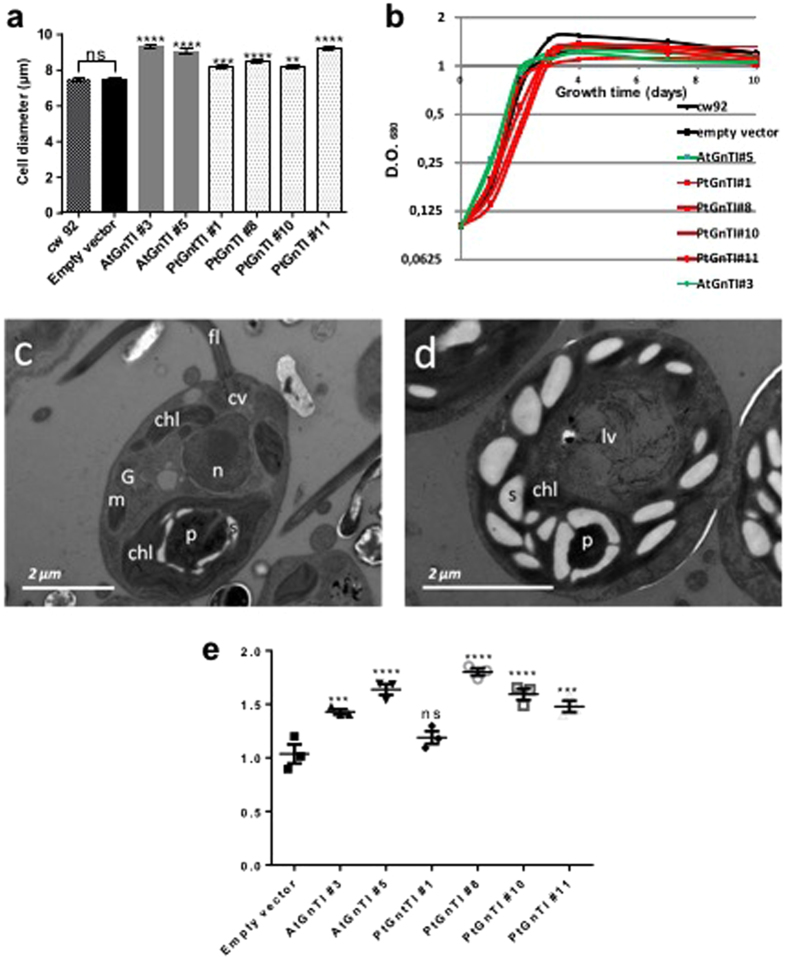
(a) Measurement of the cell diameters of C. reinhardtii cells expressing AtGnTI or PtGnTI as compared to the cw92 cells and cells transformed with an empty vector (Kruskal-Wallis test with n > 200 and p-value fixed at 0.05; stars indicate the significant level of the test). (b) Growth rate of cw92 and transformed cell lines grown in TAP medium. (c,d) Ultrastructure of cw92 cells (c) and transformed cell line AtGnTI#3 (d) by Transmission Electron Microscopy (TEM). chl: chloroplast, fl: flagella, G: Golgi apparatus, m: mitochondrion, n: nucleus, P: pyrenoid, s: starch granules, cv: contractile vacuoles, lv: large vesicles. (e) ROS levels in transformed cell lines determined through the oxidation measurement of CMH spin probe by electron paramagnetic resonance spectroscopy. The ROS level (arbitrary units/12 × 104 cells hour−1) in each transformed cell line was normalized against ROS level measured in cw92 cells. After normalization, a statistical test was performed between GnTI expressing cell lines and cells transformed with the empty vector using Ordinary One-Way ANOVA with n = 3 and p-value fixed at 0.05.
Figure 3
Figure 3
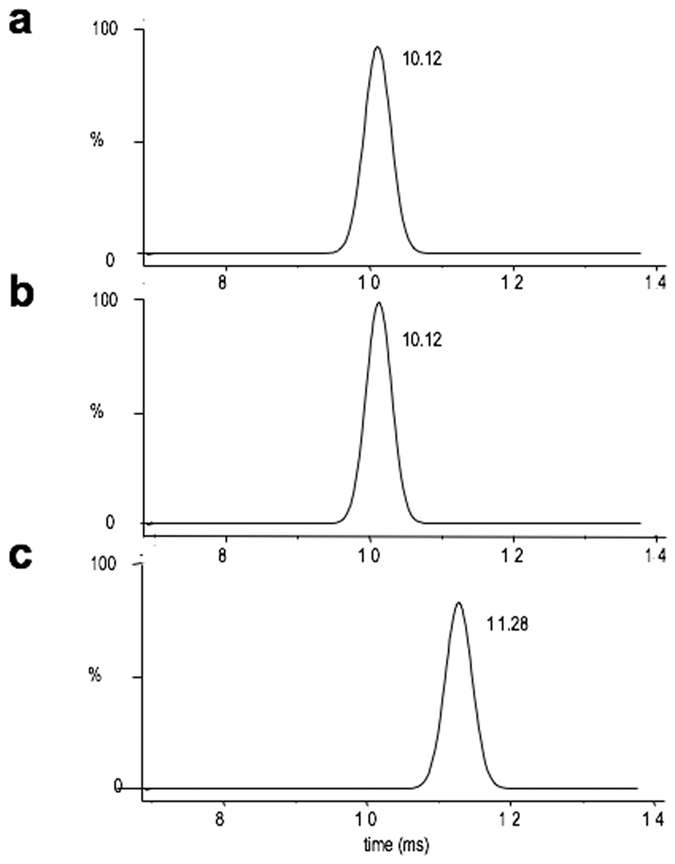
(ac) Ion mobility spectra of Man5GlcNAc2-2AB derivatives prepared from two independent preparations of C. reinhardtii proteins (a,b) and bovine ribonuclease B (c) (M + Na+ adducts).
Figure 4
Figure 4
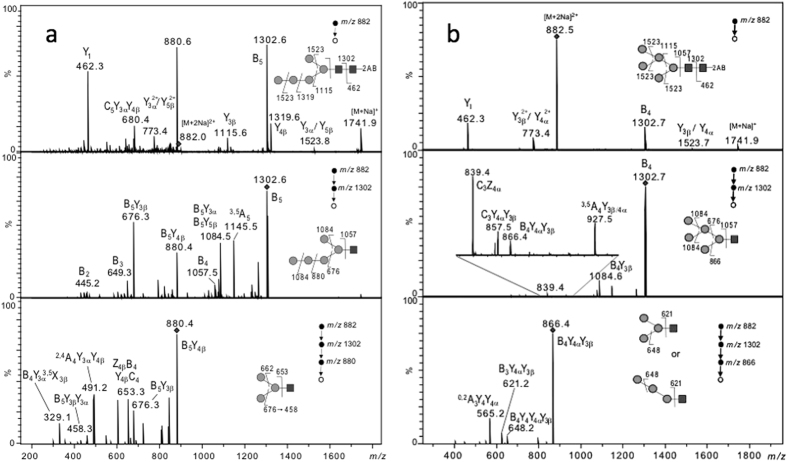
ESI-MSn spectra with n = 2 (upper panel), n = 3 (middle panel) and n = 4 (lower panel) of permethylated Man5GlcNAc2-2AB derivative (m/z 882 corresponding to [M + 2Na]2+ precursor ion) isolated from PtGnTI C. reinhardtii proteins (a) and from Ribonuclease B (b) On each panel, the precursor ion selected for the fragmentation analysis is shown with a diamond and its fragmentation pattern is proposed according to one of the possible structures. 2AB: 2-aminobenzamide; Black square: GlcNAc; grey circle: Man.
Figure 5
Figure 5
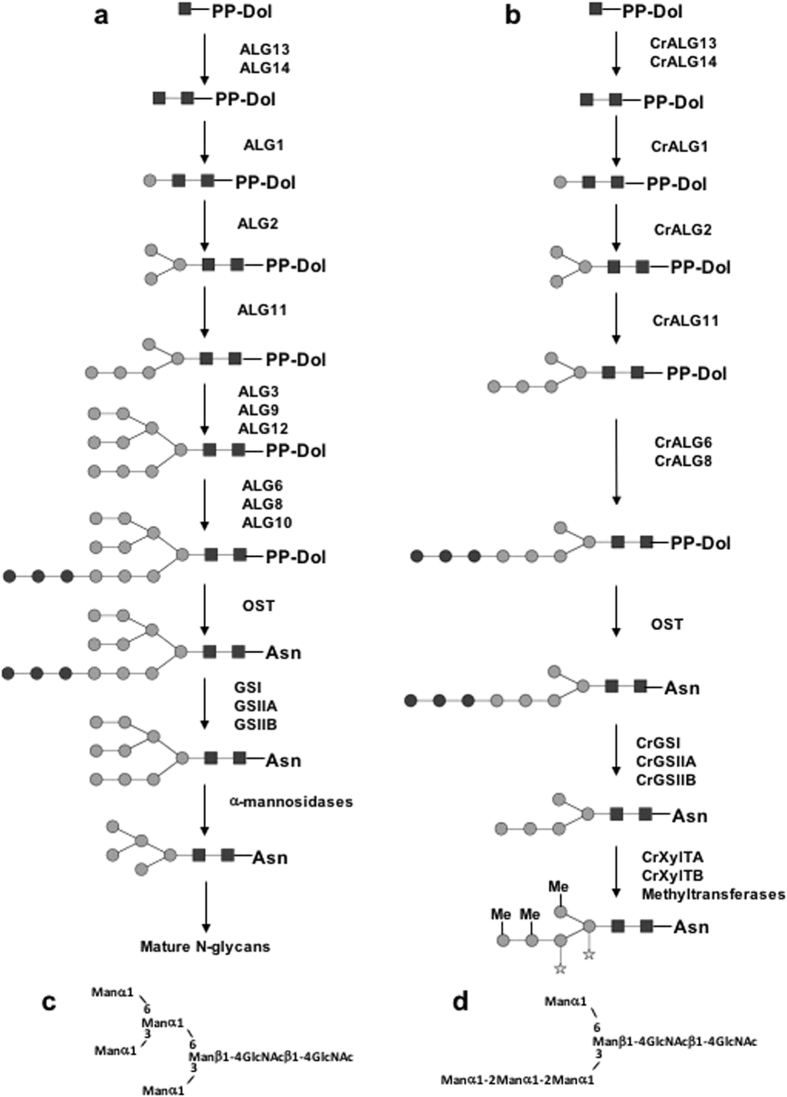
N-glycan biosynthesis in land plants and mammals (a) and proposed pathway in C. reinhardtii (b). Asn: asparagine residue of the N-glycosylation site (Asn-X-S/T/C). PP-Dol: dolichol pyrophosphate; Black square: GlcNAc; grey circle: Man; Star: xylose and Me: methyl substituent. Detailed structure of Man5GlcNAc2 in land plants and mammals (c) and in C. reinhardtii (d).
Figure 6
Figure 6
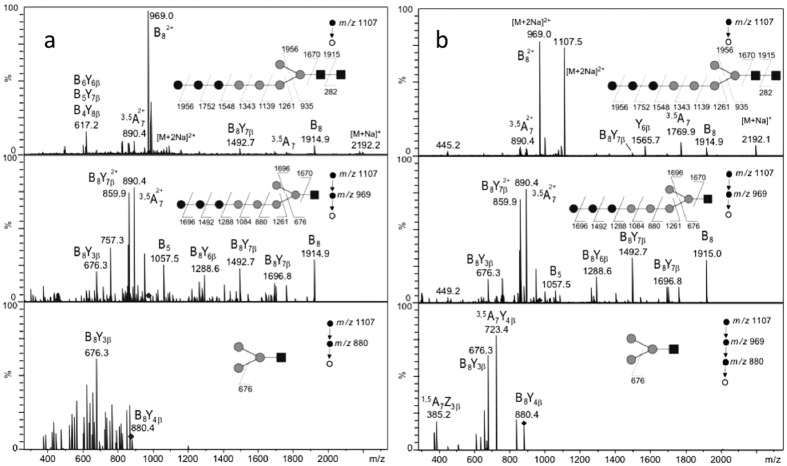
ESI-MSn spectra with n = 2 (upper panel), n = 3 (middle panel + lower panel (a)) and n = 4 (lower panel (b)) of permethylated LLO derivative (m/z 1107 corresponding to [M + 2Na]2+ precursor ion) from lipid-linked oligosaccharides of cw92 C. reinhardtii cells (a) and the YG170 yeast mutant cells (b). On each panel, the precursor ion selected for the fragmentation analysis is shown with a diamond and its fragmentation pattern is proposed. Black square: GlcNAc; grey circle: Man; black circle: Glc.

References

    1. Austen BM, Marshall RD. Acid dissociation constants of glycopeptides. Biochem. J. 1977;163:31–38. doi: 10.1042/bj1630031. - DOI - PMC - PubMed
    1. Gavel Y, von Heijne G. Sequence differences between glycosylated and non-glycosylated Asn-X-Thr/Ser acceptor sites: implications for protein engineering. Protein Eng. 1990;3:433–442. doi: 10.1093/protein/3.5.433. - DOI - PMC - PubMed
    1. Gil G-C, Velander WH, Van Cott KE. N-glycosylation microheterogeneity and site occupancy of an Asn-X-Cys sequon in plasma-derived and recombinant protein C. PROTEOMICS. 2009;9:2555–2567. doi: 10.1002/pmic.200800775. - DOI - PMC - PubMed
    1. Matsui T, et al. N-glycosylation at noncanonical Asn-X-Cys sequences in plant cells. Glycobiology. 2011;21:994–999. doi: 10.1093/glycob/cwq198. - DOI - PubMed
    1. Helenius J, et al. Translocation of lipid-linked oligosaccharides across the ER membrane requires Rft1 protein. Nature. 2002;415:447–450. doi: 10.1038/415447a. - DOI - PubMed

Publication types

MeSH terms

Substances

LinkOut - more resources