


Efficacy and safety of apatinib treatment for advanced esophageal squamous cell carcinoma
- PMID: 28860804
- PMCID: PMC5558584
- DOI: 10.2147/OTT.S132756
Efficacy and safety of apatinib treatment for advanced esophageal squamous cell carcinoma
Abstract
Objective: No standard chemotherapy is available for patients with advanced esophageal squamous cell carcinoma (ESCC) who have failed prior first-line chemotherapy. The aim of this study was to evaluate the efficacy and safety of apatinib, an oral VEGFR-2 inhibitor, as salvage treatment for advanced ESCC.
Patients and methods: After apatinib dosing, the efficacy and toxicity were evaluated in 62 patients with pretreated advanced ESCC from 2014 to 2016 at Zhejiang Cancer Hospital. In addition, survival analysis was performed by the Kaplan-Meier method.
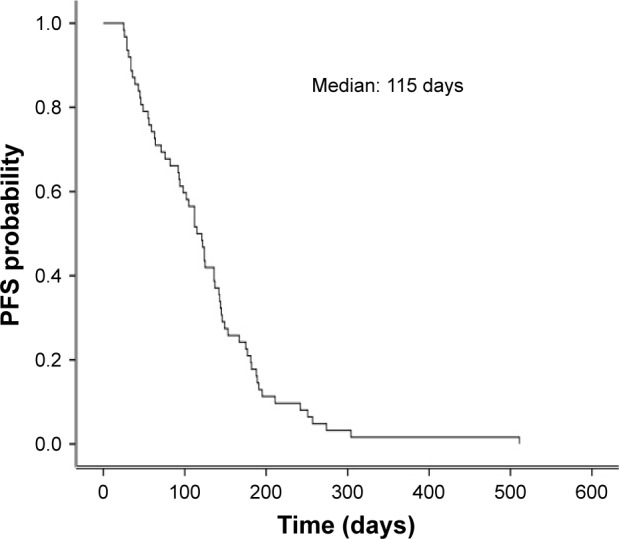
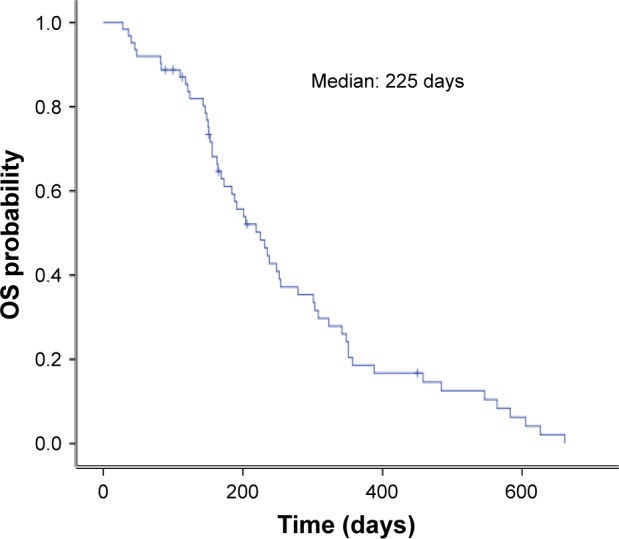
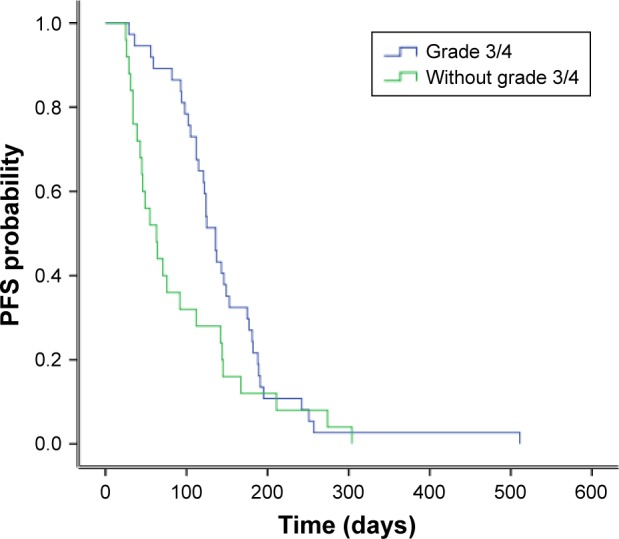
Results: Among the 62 patients, 15 achieved partial response while 31 had stable disease with a response rate of 24.2% and a disease control rate of 74.2%. Median progression-free survival (PFS) and overall survival were 115 and 209 days, respectively. Grade 3/4 toxicities (59.7%) were acceptable. Patients with grade 3/4 toxicities showed a longer PFS than those without (136 vs 63 days, P=0.044).
Conclusion: Apatinib is efficacious as second- or further-line treatment for advanced ESCC.
Keywords: apatinib; esophageal squamous cell carcinoma; toxicity; vascular endothelial growth factor.
Conflict of interest statement
Disclosure The authors report no conflicts of interest in this work.
Figures
References
-
- Low DE. Evolution in surgical management of esophageal cancer. Dig Dis. 2013;31(1):21–29. - PubMed
LinkOut - more resources
Full Text Sources
Other Literature Sources
