. 2017 Jun:7:395-402.
doi: 10.1038/nclimate3303. Epub 2017 May 31.

Forest disturbances under climate change

Affiliations

Forest disturbances under climate change

Rupert Seidl et al. Nat Clim Chang. 2017 Jun.

Abstract

Forest disturbances are sensitive to climate. However, our understanding of disturbance dynamics in response to climatic changes remains incomplete, particularly regarding large-scale patterns, interaction effects and dampening feedbacks. Here we provide a global synthesis of climate change effects on important abiotic (fire, drought, wind, snow and ice) and biotic (insects and pathogens) disturbance agents. Warmer and drier conditions particularly facilitate fire, drought and insect disturbances, while warmer and wetter conditions increase disturbances from wind and pathogens. Widespread interactions between agents are likely to amplify disturbances, while indirect climate effects such as vegetation changes can dampen long-term disturbance sensitivities to climate. Future changes in disturbance are likely to be most pronounced in coniferous forests and the boreal biome. We conclude that both ecosystems and society should be prepared for an increasingly disturbed future of forests.


Conflict of interest statement

Competing financial interests The authors declare no competing financial interests.

Figures
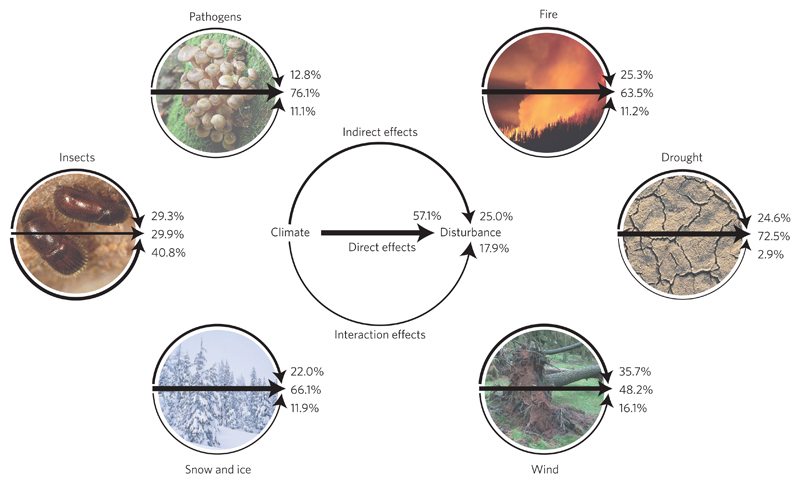
Figure 1
Figure 1. Distribution of evidence for direct, indirect and interaction effects of climate change on forest disturbance agents in the reviewed literature.
For every agent, arrow widths and percentages indicate the relative prominence of the respective effect as expressed by the number of observations extracted from the analysed literature supporting it. The central panel displays the aggregate result over all disturbance agents. Direct effects are unmediated impacts of climate on disturbance processes, while indirect effects describe a climate influence on disturbances through effects on vegetation and other ecosystem processes. Interaction effects refer to the focal agent being influenced by other disturbance agents. Image credits: David R. Frazier Photolibrary/Alamy Stock Photo (fire); PhotoDisc/Getty Images/Don Farrell (drought); Chris Warham/Alamy Stock Photo (wind); Royalty-Free/Corbis (snow and ice); Nigel Cattlin/Alamy Stock Photo (insects); and Naturepix/Alamy Stock Photo (pathogens).
Figure 2
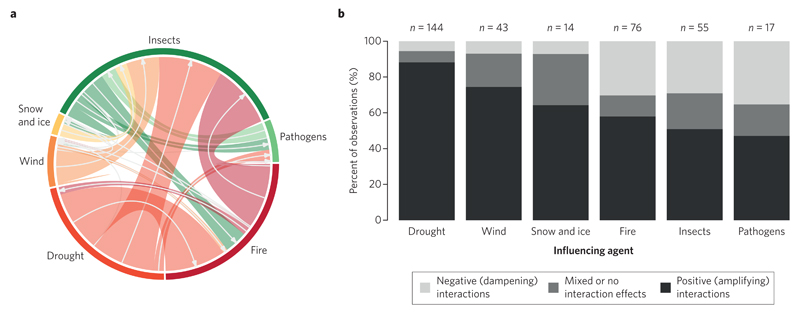
Figure 2. Interactions between forest disturbance agents.
a, The sector size in the outer circle indicates the distribution of interactions over agents, while the flows through the centre of the circle illustrate the relative importance of interactions between individual agents (as measured by the number of observations reporting on the respective interaction). Arrows point from the influencing agent to the agent being influenced by the interaction. b, Sign of the interaction effect induced by the influencing agent on the influenced agent. n, number of observations.
Figure 3
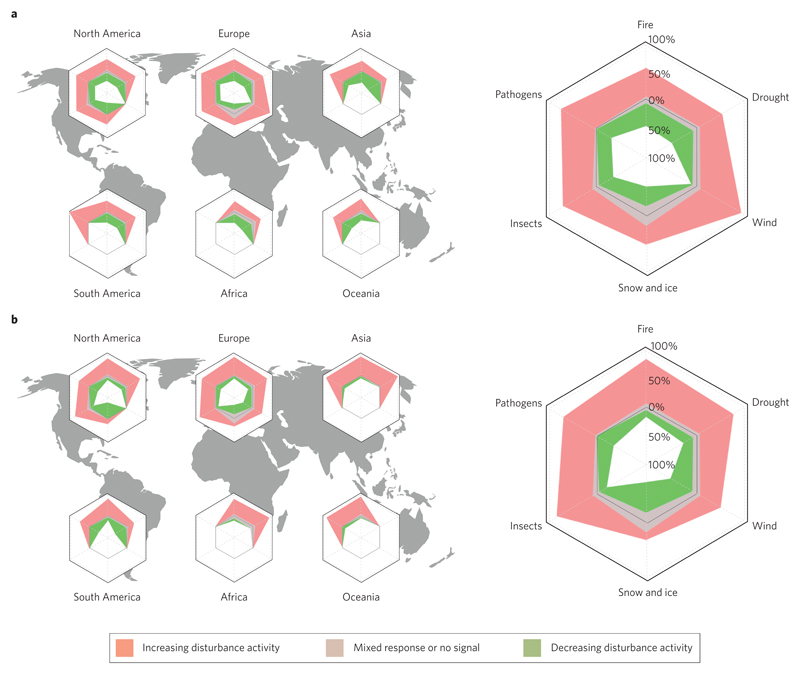
Figure 3. Global disturbance response to changing temperature and water availability.
a,b, Radar surfaces indicate the distribution of evidence (% of observations) for increasing or decreasing disturbance activity under warmer and wetter (a) as well as warmer and drier (b) climate conditions. The large radar plots to the right summarize the responses over all continents. Disturbance agents with less than four observations were omitted in the analysis. Only direct and indirect climate effects are considered here. More details on the qualitative modelling applied can be found in the Supplementary Information.

References

    1. Turner MG. Disturbance and landscape dynamics in a changing world. Ecology. 2010;91:2833–2849. - PubMed
    1. Frelich LE. Forest Dynamics and Disturbance Regimes: Studies from Temperate Evergreen–Deciduous Forests. Cambridge Univ. Press; 2002.
    1. White PS, Pickett STA. In: The Ecology of Natural Disturbance and Patch Dynamics. Pickett STA, White PS, editors. Academic Press; 1985. pp. 3–13.
    1. Turner MG, Tinker DB, Romme WH, Kashian DM, Litton CM. Landscape patterns of sapling density, leaf area, and aboveground net primary production in postfire lodgepole pine forests, Yellowstone National Park (USA) Ecosystems. 2004;7:751–775.
    1. Beudert B, et al. Bark beetles increase biodiversity while maintaining drinking water quality. Conserv Lett. 2015;8:272–281.