


Genome-wide DNA methylation analysis in blood cells from patients with Werner syndrome
- PMID: 28861129
- PMCID: PMC5577832
- DOI: 10.1186/s13148-017-0389-4
Genome-wide DNA methylation analysis in blood cells from patients with Werner syndrome
Abstract
Background: Werner syndrome is a progeroid disorder characterized by premature age-related phenotypes. Although it is well established that autosomal recessive mutations in the WRN gene is responsible for Werner syndrome, the molecular alterations that lead to disease phenotype remain still unidentified.
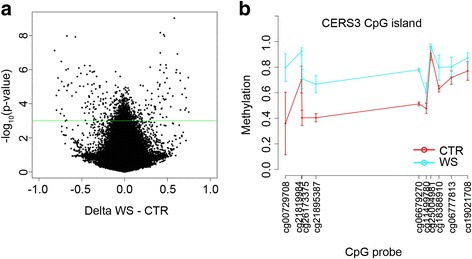
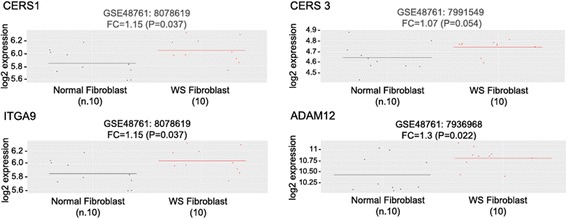
Results: To address whether epigenetic changes can be associated with Werner syndrome phenotype, we analysed genome-wide DNA methylation profile using the Infinium MethylationEPIC BeadChip in the whole blood from three patients affected by Werner syndrome compared with three age- and sex-matched healthy controls. Hypermethylated probes were enriched in glycosphingolipid biosynthesis, FoxO signalling and insulin signalling pathways, while hypomethylated probes were enriched in PI3K-Akt signalling and focal adhesion pathways. Twenty-two out of 47 of the differentially methylated genes belonging to the enriched pathways resulted differentially expressed in a publicly available dataset on Werner syndrome fibroblasts. Interestingly, differentially methylated regions identified CERS1 and CERS3, two members of the ceramide synthase family. Moreover, we found differentially methylated probes within ITGA9 and ADAM12 genes, whose methylation is altered in systemic sclerosis, and within the PRDM8 gene, whose methylation is affected in dyskeratosis congenita and Down syndrome.
Conclusions: DNA methylation changes in the peripheral blood from Werner syndrome patients provide new insight in the pathogenesis of the disease, highlighting in some cases a functional correlation of gene expression and methylation status.
Keywords: DNA methylation; Systemic sclerosis; Werner syndrome.
Conflict of interest statement
Ethics approval and consent to participate
Subjects were enrolled in the study “Early diagnosis of scleroderma and identification of predictor factors of disease development”. All participants signed the informed consent forms. The study was approved by the Ethic Committee of ASL RM/B, Prot.054/CE-RMB.
Consent for publication
Consent for publication was obtained from the patient.
Competing interests
The authors declare that they have no competing interests.
Publisher’s Note
Springer Nature remains neutral with regard to jurisdictional claims in published maps and institutional affiliations.
Figures
References
MeSH terms
Substances
LinkOut - more resources
Full Text Sources
Other Literature Sources
Molecular Biology Databases
Miscellaneous
