Comparison of the Effect of Continuous Femoral Nerve Block and Adductor Canal Block after Primary Total Knee Arthroplasty
- PMID: 28861197
- PMCID: PMC5567025
- DOI: 10.4055/cios.2017.9.3.303
Comparison of the Effect of Continuous Femoral Nerve Block and Adductor Canal Block after Primary Total Knee Arthroplasty
Abstract
Background: This study aimed to compare the effects of femoral nerve block and adductor canal block on postoperative pain, quadriceps strength, and walking ability after primary total knee arthroplasty.
Methods: Between November 2014 and February 2015, 60 patients underwent primary total knee arthroplasty. Thirty patients received femoral nerve block and the other 30 received adductor canal block for postoperative pain control. Before spinal anesthesia, the patients received nerve block via a catheter (20 mL 0.75% ropivacaine was administered initially, followed by intermittent bolus injection of 10 mL 0.2% ropivacaine every 6 hours for 3 days). The catheters were maintained in the exact location of nerve block in 24 patients in the femoral nerve block group and in 19 patients in the adductor canal block group. Data collection was carried out from these 43 patients. To evaluate postoperative pain control, the numerical rating scale scores at rest and 45° flexion of the knee were recorded. To evaluate quadriceps strength, manual muscle testing was performed. Walking ability was assessed using the Timed Up and Go test. We also evaluated analgesic consumption and complications of peripheral nerve block.
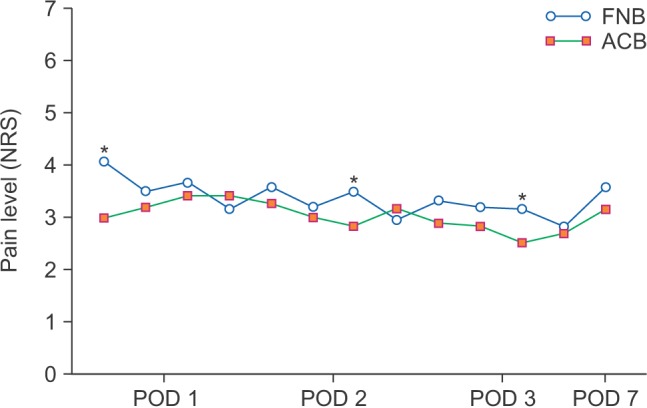
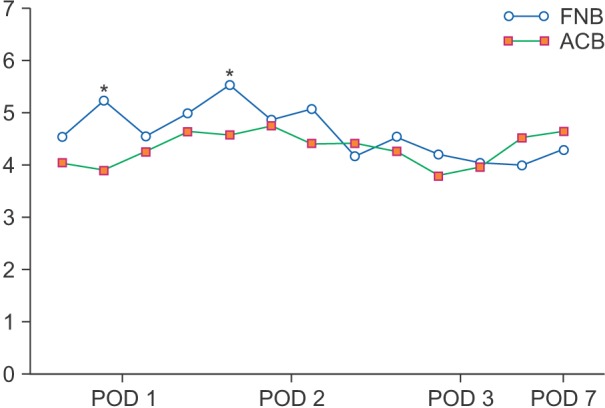
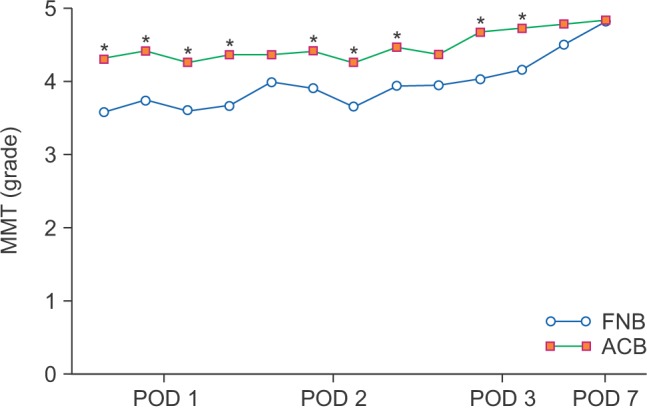
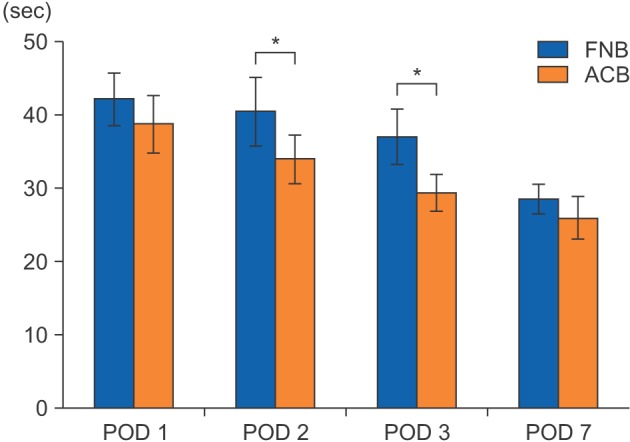
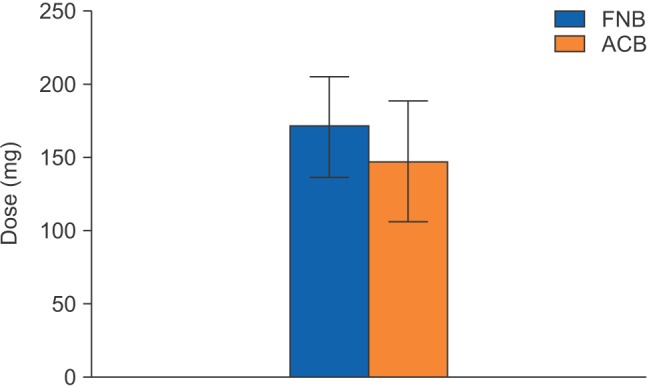
Results: No significant intergroup difference was observed in the numerical rating scale scores at rest and 45° flexion of the knee on postoperative days 1, 2, 3, and 7. The adductor canal block group had significantly greater quadriceps strength than did the femoral nerve block group, as assessed by manual muscle testing on postoperative days 1, 2, and 3. The 2 groups showed no difference in walking ability on postoperative day 1, but on postoperative days 2, 3, walking ability was significantly better in the adductor canal block group than in the femoral nerve block group. No significant intergroup difference was observed in analgesic consumption.
Conclusions: The groups showed no difference in postoperative pain control. Adductor canal block was superior to femoral nerve block in preserving quadriceps strength and walking ability. However, adductor canal block was inferior to femoral nerve block in maintaining the exact location of the catheter.
Keywords: Adductor canal block; Femoral nerve block; Postoperative pain; Total knee arthroplasty.
Conflict of interest statement
CONFLICT OF INTEREST: No potential conflict of interest relevant to this article was reported.
Figures
References
-
- Bonica JJ, Loeser JD, Chapman CR, Fordyce WE. The management of pain. 2nd ed. Philadelphia, PA: Lea and Febiger; 1990. pp. 461–480.
-
- Strassels SA, Chen C, Carr DB. Postoperative analgesia: economics, resource use, and patient satisfaction in an urban teaching hospital. Anesth Analg. 2002;94(1):130–137. - PubMed
-
- Jeong MS, Song EK, Seon JK, Byun JW, Lee KJ, Jung YW. Effectiveness of pain relief for femoral nerve block in multimodal pain control protocols in total knee arthroplasty. J Korean Orthop Assoc. 2011;46(3):237–243.
-
- Paul JE, Arya A, Hurlburt L, et al. Femoral nerve block improves analgesia outcomes after total knee arthroplasty: a meta-analysis of randomized controlled trials. Anesthesiology. 2010;113(5):1144–1162. - PubMed
-
- Choy WS, Lee SK, Kim KJ, Kam BS, Yang DS, Bae KW. Two continuous femoral nerve block strategies after TKA. Knee Surg Sports Traumatol Arthrosc. 2011;19(11):1901–1908. - PubMed
Publication types
MeSH terms
Substances
LinkOut - more resources
Full Text Sources
Other Literature Sources
Medical