


A Cross-Sectional Survey of Medical Cannabis Users: Patterns of Use and Perceived Efficacy
- PMID: 28861489
- PMCID: PMC5549439
- DOI: 10.1089/can.2016.0007
A Cross-Sectional Survey of Medical Cannabis Users: Patterns of Use and Perceived Efficacy
Abstract
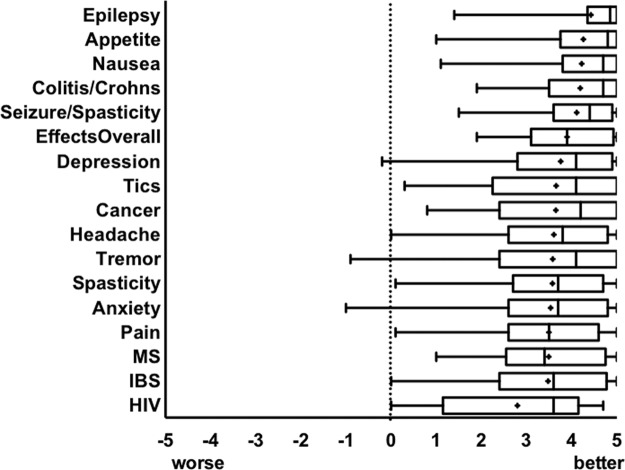
Background: The political climate around Cannabis as a medicine is rapidly changing. Legislators are adopting policies regarding appropriate medical applications, while the paucity of research may make policy decisions around conditions for which Cannabis is an effective medicine difficult. Methods: An anonymous online survey was developed to query medical Cannabis users about the conditions they use Cannabis to treat, their use patterns, perception of efficacy, and physical and mental health. Participants were recruited through social media and Cannabis dispensaries in Washington State. Results: A total of 1429 participants identified as medical Cannabis users. The most frequently reported conditions for which they used Cannabis were pain (61.2%), anxiety (58.1%), depression (50.3%), headache/migraine (35.5%), nausea (27.4%), and muscle spasticity (18.4%). On average, participants reported an 86% reduction in symptoms as a result of Cannabis use; 59.8% of medical users reported using Cannabis as an alternative to pharmaceutical prescriptions. Global health scores were on par with the general population for mental health and physical health. Conclusions: While patient-reported outcomes favor strong efficacy for a broad range of symptoms, many medical users are using Cannabis without physician supervision and for conditions for which there is no formal research to support the use of Cannabis (e.g., depression and anxiety). Future research and public policy should attempt to reduce the incongruence between approved and actual use.
Keywords: Cannabis; health effects; medical Cannabis; survey; use patterns.
Figures
References
-
- Russo EB. History of cannabis and its preparations in saga, science, and sobriquet. Chem Biodivers. 2007;4:1614–1648 - PubMed
-
- State Marijuana Laws Map. Dr. Mark Funkhouser, 2015. Available at: www.governing.com/gov-data/state-marijuana-laws-map-medical-recreational... (Accessed January19, 2015)
-
- Aggarwal SK. Cannabinergic pain medicine: a concise clinical primer and survey of randomized-controlled trial results. Clin J Pain. 2013;29:162–171 - PubMed
-
- Ben Amar M. Cannabinoids in medicine: a review of their therapeutic potential. J Ethnopharmacol. 2006;105:1–25 - PubMed
-
- Betthauser K, Pilz J, Vollmer LE. Use and effects of cannabinoids in military veterans with posttraumatic stress disorder. Am J Health Syst Pharm. 2015;72:1279–1284 - PubMed
LinkOut - more resources
Full Text Sources
Other Literature Sources
