


The circumstances, orientations, and impact locations of falls in community-dwelling older women
- PMID: 28863352
- PMCID: PMC5858880
- DOI: 10.1016/j.archger.2017.07.011
The circumstances, orientations, and impact locations of falls in community-dwelling older women
Abstract
Objective: We sought to characterize the circumstances, orientations, and impact locations of falls in community-dwelling, ambulatory, older women.
Methods: For this longitudinal, observational study, 125 community-dwelling women age≥65years were recruited. Over 12-months of follow-up, fall details were recorded using twice-monthly questionnaires.
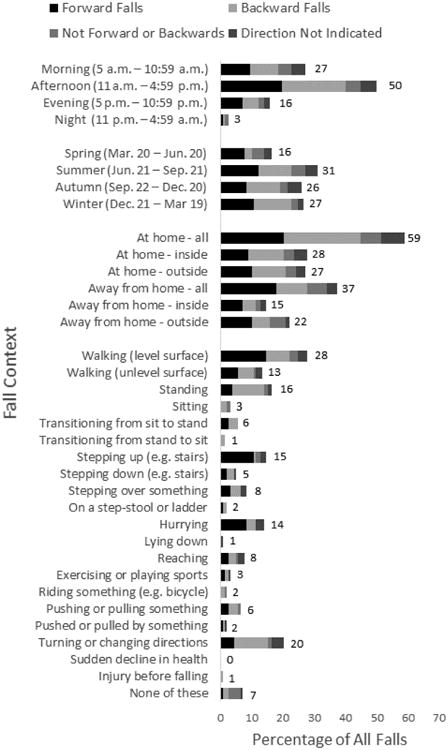
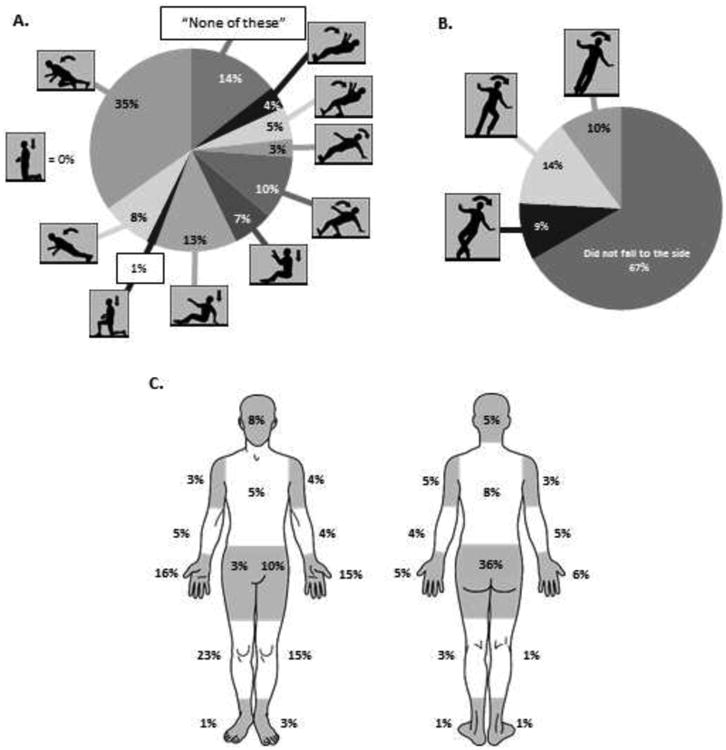
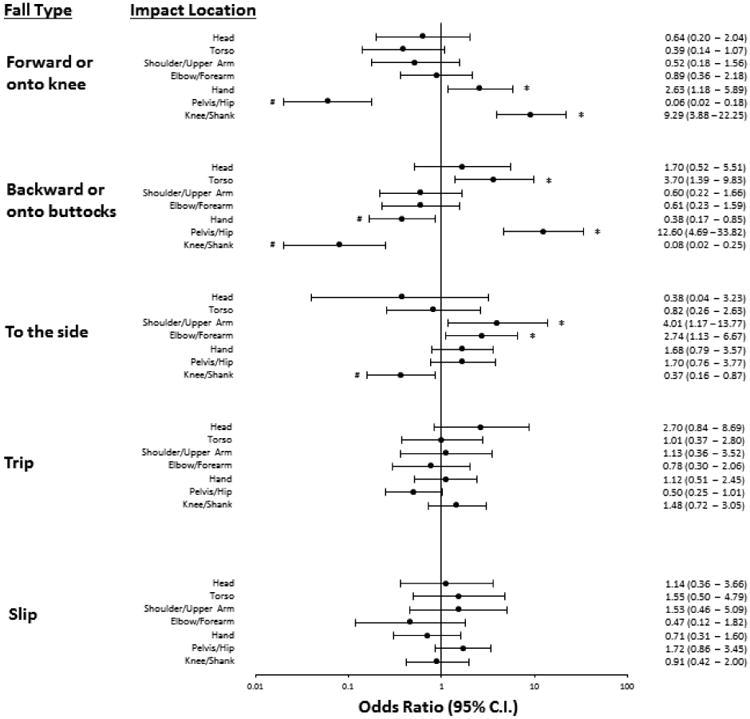
Results: More than half (59%) of participants fell, with 30% of participants falling more than once (fall rate=1.3 falls per person-year). Slips (22%) and trips (33%) accounted for the majority of falls. Approximately 44% of falls were forward in direction, while backward falls accounted for 41% of falls. About a third of all falls were reported to have lateral (sideways) motion. Subjects reported taking a protective step in response to 82% of forward falls and 37% of backward falls. Of falls reporting lateral motion, a protective step was attempted in 70% of accounts. Common impact locations included the hip/pelvis (47% of falls) and the hand/wrist (27%). Backwards falls were most commonly reported with slips and when changing direction, and increased the risk of hip/pelvis impact (OR=12.6; 95% CI: 4.7-33.8). Forward falls were most commonly reported with trips and while hurrying, and increased the risk of impact to the hand/wrist (OR=2.6; 95% CI: 1.2-5.9).
Conclusion: Falls in older ambulatory women occur more frequently than previously reported, with the fall circumstance and direction dictating impact to common fracture locations. Stepping was a common protective recovery strategy and that may serve as an appropriate focus of interventions to reduce falls in this high risk population.
Keywords: Balance; Fracture; Injury; SAFER; Slips; Trips.
Copyright © 2017 Elsevier B.V. All rights reserved.
Figures
References
-
- Ainsworth BE, Haskell WL, Leon AS, Jacobs DR, Montoye HJ, Sallis JF, Paffenbarger RS. Compendium of physical activities: classification of energy costs of human physical activities. Medicine and Science in Sports and Exercise. 1993;25(1):71–80. - PubMed
-
- Aoyagi K, Ross PD, Davis JW, Wasnich RD, Hayashi T, Takemoto TII. Falls among community-dwelling elderly in Japan. Journal of Bone and Mineral Research. 1998;13(9):1468–1474. - PubMed
-
- Berg WP, Alessio HM, Mills EM, Tong C. Circumstances and consequences of falls in independent community-dwelling older adults. Age and Ageing. 1997;26(4):261–268. - PubMed
-
- Blake AJ, Morgan K, Bendall MJ, Dallosso H, Ebrahim SBJ, Arie THD, et al. Bassey EJ. Falls by elderly people at home: Prevalence and associated factors. Age and Ageing. 1988;17(6):365–372. - PubMed
Publication types
MeSH terms
Grants and funding
LinkOut - more resources
Full Text Sources
Other Literature Sources
Medical
