


Tumour radiosensitivity is associated with immune activation in solid tumours
- PMID: 28863385
- PMCID: PMC5822441
- DOI: 10.1016/j.ejca.2017.08.001
Tumour radiosensitivity is associated with immune activation in solid tumours
Abstract
Purpose: Our goal was to determine whether tumour radiosensitivity is associated with activation of the immune system across all tumour types as measured by two gene expression signatures (GESs).
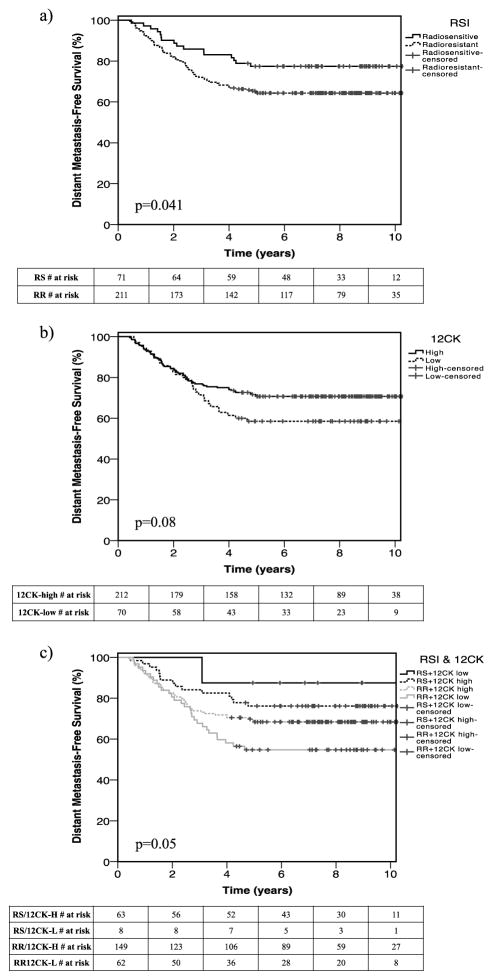
Methods: We identified 10,240 genomically profiled distinct solid primary tumours with gene expression analysis available from an institutional de-identified database. Two separate GESs were included in the analysis, the radiosensitivity index (RSI) GES (a 10-gene GES as a measure of radiosensitivity) and the 12-chemokine (12-CK) signature (a 12-gene GES as a measure of immune activation). We tested whether the RSI and 12-CK were associated with each other across all tumour samples and, in an exploratory analysis, their prognostic significance in predicting distant metastasis-free survival (DMFS) among a well-characterised, independent cohort of 282 early-stage breast cancer cases treated with surgery and post-operative radiation alone without systemic therapy. The lower the RSI score, the higher the tumour radiosensitivity; whereas, the higher the 12-CK score the higher the immune activation.
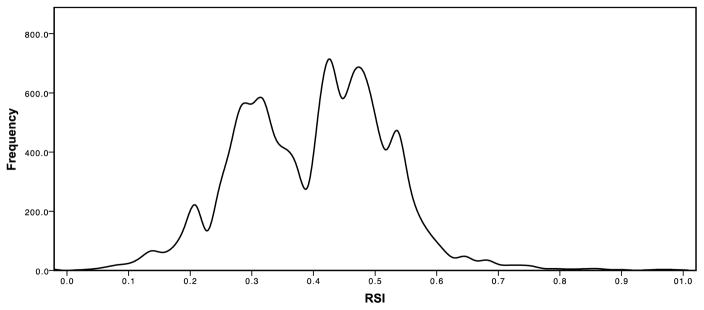
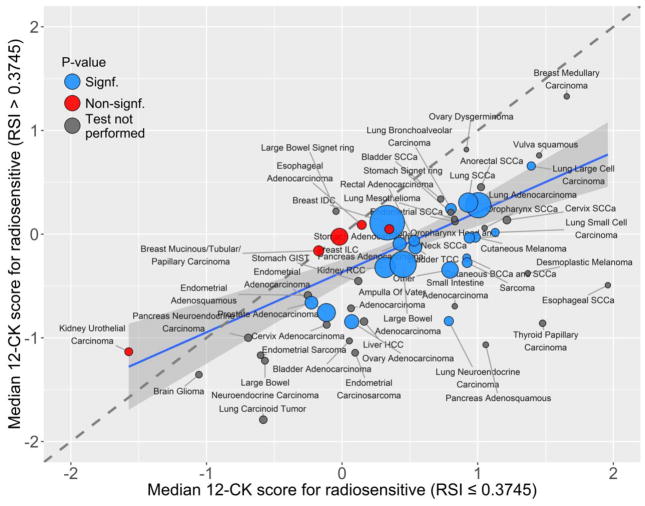
Results: Using an RSI cut-point of ≤0.3745, RSI-low tumours (n = 4,291, 41.9%) had a significantly higher median 12-CK GES value (0.54 [-0.136, 1.095]) compared with RSI-high tumours (-0.17 [-0.82, 0.42]; p < 0.001) across all tumour samples, indicating that radiosensitivity is associated with immune activation. In an exploratory analysis of early-stage breast cancer cases, a multivariable model with patient age, RSI and 12-CK provided a strong composite model for DMFS (p = 0.02), with RSI (hazard ratio [HR] 0.63 [95% confidence interval 0.36, 1.09]) and 12-CK (HR 0.66 [0.41, 1.04]) each providing comparable contributions.
Conclusions: Tumour radiosensitivity is associated with immune activation as measured by the two GESs.
Keywords: Cancer; Immune; Radiation; Radiosensitivity; Survival.
Copyright © 2017 Elsevier Ltd. All rights reserved.
Conflict of interest statement
Figures
References
-
- Tang C, Fuller CD, Garden AS, Awan MJ, Colen RR, Morrison WH, et al. Characteristics and kinetics of cervical lymph node regression after radiation therapy for human papillomavirus-associated oropharyngeal carcinoma: quantitative image analysis of post-radiotherapy response. Oral oncology. 2015;51(2):195–201. doi: 10.1016/j.oraloncology.2014.11.001. - DOI - PMC - PubMed
Publication types
MeSH terms
Substances
Grants and funding
LinkOut - more resources
Full Text Sources
Other Literature Sources
Medical
Research Materials
