Signals from the Adipose Microenvironment and the Obesity-Cancer Link-A Systematic Review
- PMID: 28864539
- PMCID: PMC5898450
- DOI: 10.1158/1940-6207.CAPR-16-0322
Signals from the Adipose Microenvironment and the Obesity-Cancer Link-A Systematic Review
Abstract
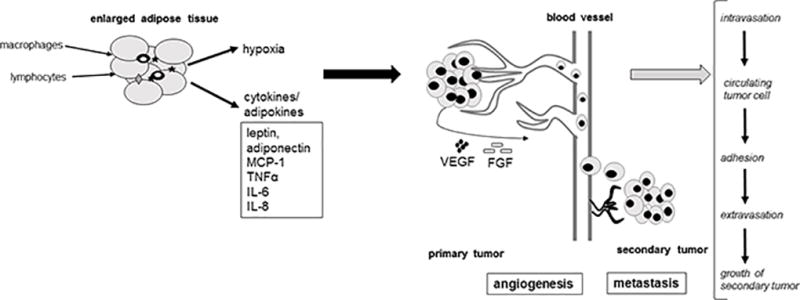
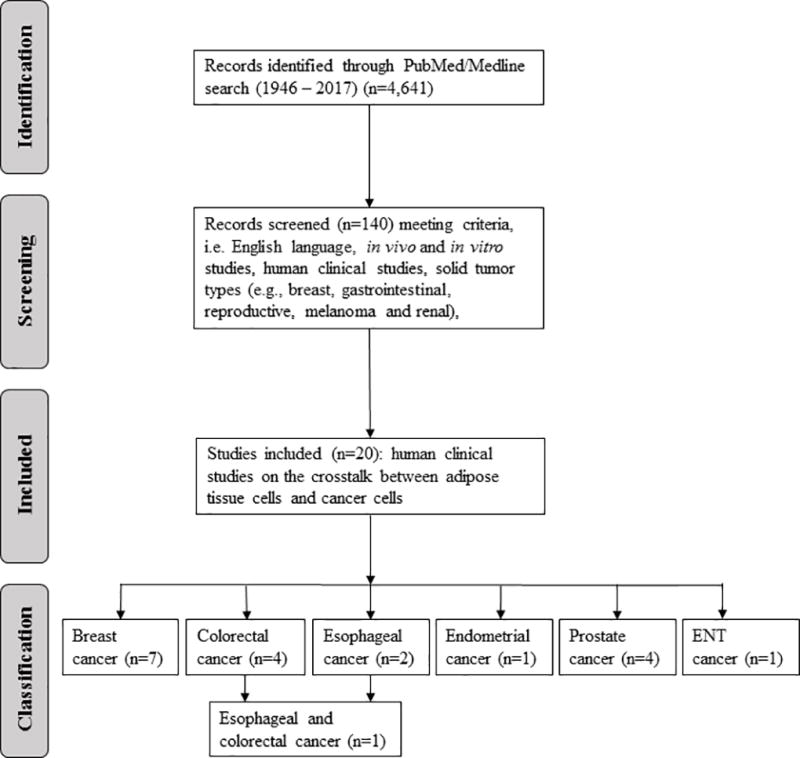
Obesity and its associated metabolic dysregulation are established risk factors for many cancers. However, the biologic mechanisms underlying this relationship remain incompletely understood. Given the rising rates of both obesity and cancer worldwide, and the challenges for many people to lose excess adipose tissue, a systematic approach to identify potential molecular and metabolic targets is needed to develop effective mechanism-based strategies for the prevention and control of obesity-driven cancer. Epidemiologic, clinical, and preclinical data suggest that within the growth-promoting, proinflammatory microenvironment accompanying obesity, crosstalk between adipose tissue (comprised of adipocytes, macrophages and other cells) and cancer-prone cells may occur via obesity-associated hormones, cytokines, and other mediators that have been linked to increased cancer risk and/or progression. We report here a systematic review on the direct "crosstalk" between adipose tissue and carcinomas in humans. We identified 4,641 articles with n = 20 human clinical studies, which are summarized as: (i) breast (n = 7); (ii) colorectal (n = 4); (iii) esophageal (n = 2); (iv) esophageal/colorectal (n = 1); (v) endometrial (n = 1); (vi) prostate (n = 4); and (vii) ear-nose-throat (ENT) cancer (n = 1). Findings from these clinical studies reinforce preclinical data and suggest organ-dependent crosstalk between adipose tissue and carcinomas via VEGF, IL6, TNFα, and other mechanisms. Moreover, visceral white adipose tissue plays a more central role, as it is more bioenergetically active and is associated with a more procancer secretome than subcutaneous adipose tissue. Efforts to eavesdrop and ultimately interfere with this cancer-enhancing crosstalk may lead to new targets and strategies for decreasing the burden of obesity-related cancers. Cancer Prev Res; 10(9); 494-506. ©2017 AACR.
©2017 American Association for Cancer Research.
Conflict of interest statement
Figures
References
-
- American Geriatrics Society Workgroup on Vitamin DSfOA. Recommendations abstracted from the American Geriatrics Society Consensus Statement on vitamin D for Prevention of Falls and Their Consequences. Journal of the American Geriatrics Society. 2014;62(1):147–52. doi: 10.1111/jgs.12631. - DOI - PubMed
Publication types
MeSH terms
Substances
Grants and funding
LinkOut - more resources
Full Text Sources
Other Literature Sources
Medical
Research Materials
Miscellaneous