


Uterine balloon tamponade as an adjunct to misoprostol for the treatment of uncontrolled postpartum haemorrhage: a randomised controlled trial in Benin and Mali
- PMID: 28864699
- PMCID: PMC5589006
- DOI: 10.1136/bmjopen-2017-016590
Uterine balloon tamponade as an adjunct to misoprostol for the treatment of uncontrolled postpartum haemorrhage: a randomised controlled trial in Benin and Mali
Abstract
Objective: To assess the effectiveness of low-cost uterine tamponade as an adjunct to misoprostol for the treatment of uncontrolled postpartum haemorrhage (PPH) in low-resource settings.
Design: Randomised controlled trial.
Setting: Seven healthcare facilities in Cotonou, Benin and Bamako, Mali.
Population: Women delivering vaginally who had clinically diagnosed PPH that was suspected to be due to uterine atony, who were unresponsive to oxytocin and who needed additional uterotonics.
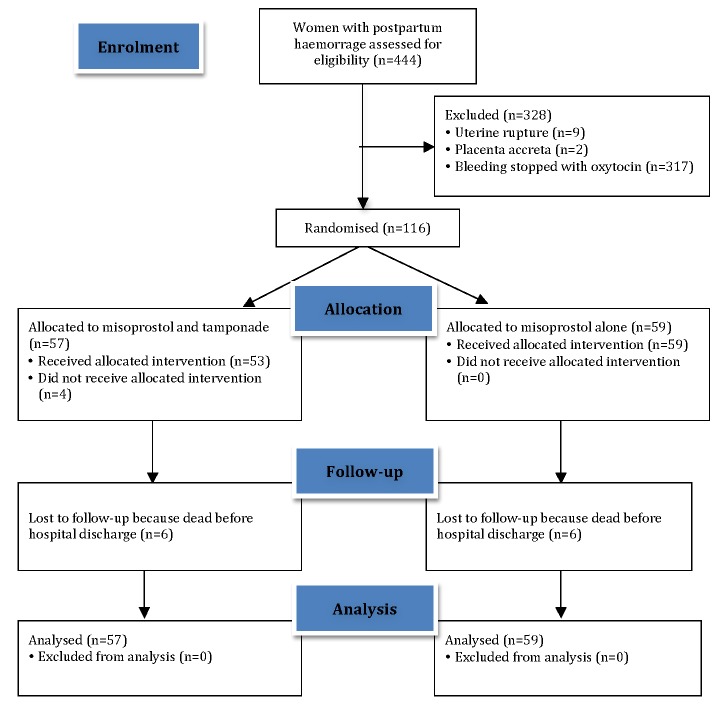
Methods: Women were randomly assigned to receive uterine balloon tamponade with a condom-catheter device or no tamponade; both groups were also given intrarectal or sublingual misoprostol.
Main outcome measure: Proportion of women with invasive surgery or who died before hospital discharge.
Results: The proportion of primary composite outcome did not differ significantly between the tamponade arm (16%; 9/57) and the standard second line treatment arm (7%; 4/59): relative risk 2.33 (95% CI 0.76 to 7.14, p=0.238). A significantly increased proportion of women with tamponade and misoprostol versus misoprostol alone had total blood loss more than 1000 mL: relative risk 1.52 (95% CI 1.15 to 2.00, p=0.01). Case fatality rate was higher in the tamponade group (10%; 6/57) than in the control group (2%; 1/59) (p=0.059).
Trial registration number: ISRCT Registry Number 01202389; Post-results.
Keywords: low resource settings; misoprostol; post-partum haemorrhage; randomized controlled trial; second line therapy; uterine balloon tamponade.
© Article author(s) (or their employer(s) unless otherwise stated in the text of the article) 2017. All rights reserved. No commercial use is permitted unless otherwise expressly granted.
Conflict of interest statement
Competing interests: All authors have completed the ICMJE uniform disclosure form at http://www.icmje.org/coi_disclosure.pdf (available on request from the corresponding author) and declare no relationships or activities that could appear to have influenced the submitted work. The head author (AD) affirms that the manuscript is an honest, accurate and transparent account of the study being reported; that no important aspects of the study have been omitted and that there are any discrepancies from the study as registered. AD has nothing to disclose.
References
-
- World Health Organization. WHO recommendations for the prevention and treatment of postpartum haemorrhage. 2012. http://apps.who.int/iris/bitstream/10665/75411/1/9789241548502_eng.pdf - PubMed
Publication types
MeSH terms
Substances
LinkOut - more resources
Full Text Sources
Other Literature Sources
