. 2017 Nov;16(11):1922-1937.
doi: 10.1074/mcp.RA117.000057. Epub 2017 Sep 1.

Quantitative Mass Spectrometry Reveals Food Intake-Induced Neuropeptide Level Changes in Rat Brain: Functional Assessment of Selected Neuropeptides as Feeding Regulators

Affiliations

Quantitative Mass Spectrometry Reveals Food Intake-Induced Neuropeptide Level Changes in Rat Brain: Functional Assessment of Selected Neuropeptides as Feeding Regulators

Hui Ye et al. Mol Cell Proteomics. 2017 Nov.

Abstract

Endogenous neuropeptides are important signaling molecules that function as regulators of food intake and body weight. Previous work has shown that neuropeptide gene expression levels in a forebrain reward site, the nucleus accumbens (NAc), were changed by feeding. To directly monitor feeding-induced changes in neuropeptide expression levels within the NAc, we employed a combination of cryostat dissection, heat stabilization, neuropeptide extraction and label-free quantitative neuropeptidomics via a liquid chromatography-high resolution mass spectrometry platform. Using this methodology, we described the first neuropeptidome in NAc and discovered that feeding caused the expression level changes of multiple neuropeptides derived from different precursors, especially proSAAS-derived peptides such as Big LEN, PEN and little SAAS. We further investigated the regulatory functions of these neuropeptides derived from the ProSAAS family by performing an intra-NAc microinjection experiment using the identified ProSAAS neuropeptides, 'Big-LEN' and 'PEN'. Big LEN significantly increased rats' food and water intake, whereas both big LEN and PEN affected other behaviors including locomotion, drinking and grooming. In addition, we quantified the feeding-induced changes of peptides from hippocampus, hypothalamus and striatum to reveal the neuropeptide interplay among different anatomical regions. In summary, our study demonstrated neuropeptidomic changes in response to food intake in the rat NAc and other key brain regions. Importantly, the microinfusion of ProSAAS peptides into NAc revealed that they are behaviorally active in this brain site, suggesting the potential use of these peptides as therapeutics for eating disorders.


Figures

Fig. 1.
Fig. 1.
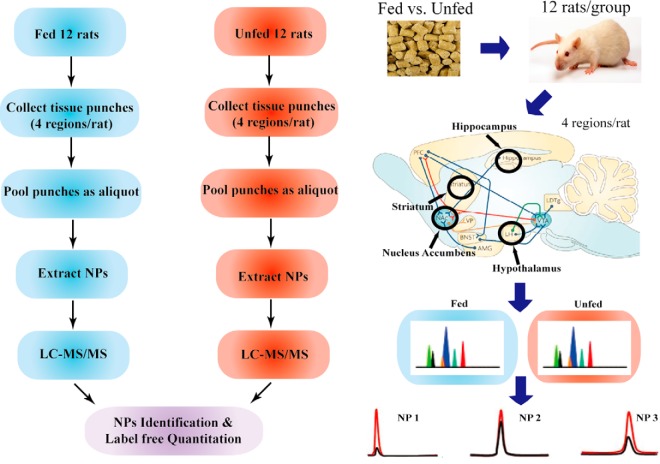
The experimental paradigm of the quantitative mass spectrometry we employed to investigate the neuropeptide level changes in response to food intake. Rats fed on a regular diet or starved were all sacrificed 2.5 h after the feeding time. Rat brains were immediately dissected following decapitation and the dorsal striatum, hippocampus, hypothalamus and nucleus accumbens regions were collected as tissue punches, followed by rapid heating by DenatorTM to minimize postmortem degradation. The tissue samples were pooled as an aliquot to minimize individual variation and increase the amount of neuropeptides contained in samples. Four punches were pooled for NAc and hippo, three punches were pooled for HT and two punches were pooled for DS as an aliquot. The sample aliquots were then processed individually, and the endogenous neuropeptides were analyzed by an Orbitrap LC-MS/MS. The high accuracy MS and MS/MS data yielded by Orbitrap were searched against database for identification, whereas peak areas calculated using the extracted ion chromatograms of each identified peptide are employed for relative quantitation. The locations of the tissue punches we collected are shown on a sagittal slice of the rat brain.
Fig. 2.
Fig. 2.
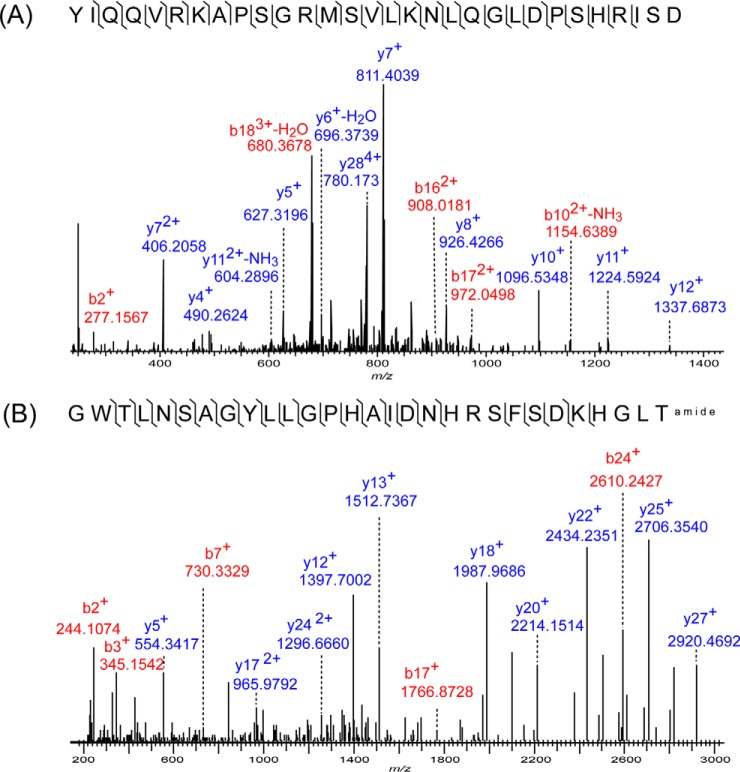
High resolution mass spectrometry enabled identification of highly and moderately charged neuropeptides with high confidence. A, The MS/MS spectra of a 5+ charged peptide ions detected at m/z 679.569 identified as YIQQVRKAPSGRMSVLKNLQGLDPSHRISD from the neuropeptide precursor cholecystokinin. B, MS/MS identification of a moderately-charged 3+ ion at m/z 1055.197 characterized as GWTLNSAGYLLGPHAIDNHRSFSDKHGLTamide (galanin).
Fig. 3.
Fig. 3.
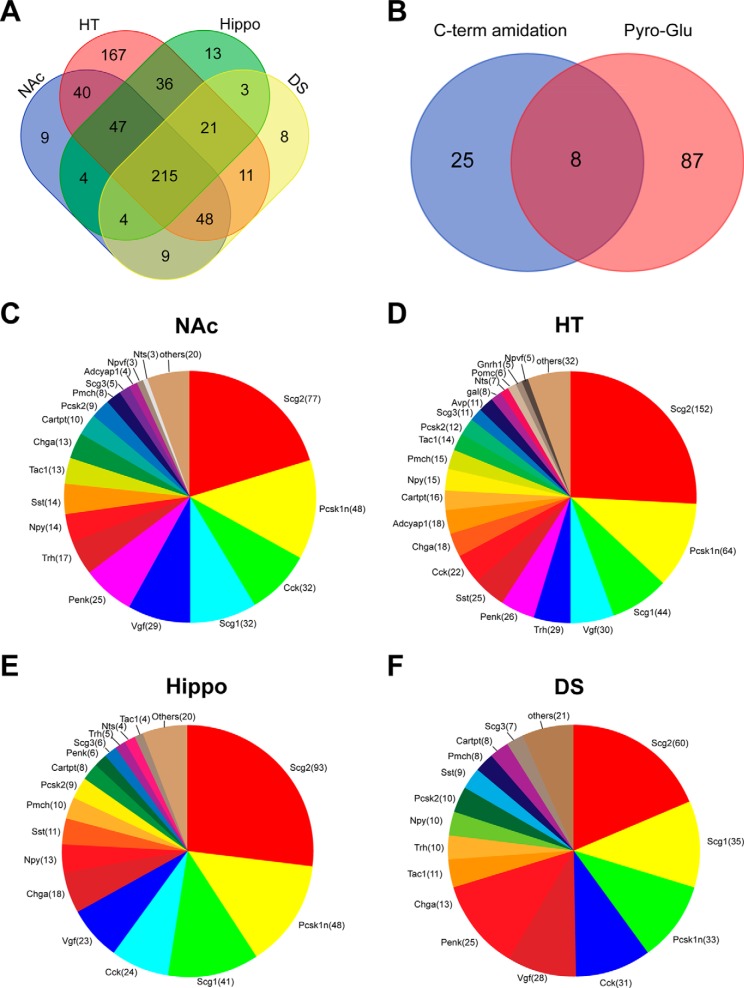
Summary of the endogenous peptides identified from rat brain. A, Overlap of unique peptides identified from hypothalamus (HT), hippocampus (hippo), nucleus accumbens (NAc), and dorsal striatum (DS). B, Overlap of peptides carrying pyro-Glu modification and C-terminal amidation. Distribution of the number of peptides per protein (shown in parenthesis) for the precursors yielding more than 5 peptides from NAc (C), HT (D), hippo (E) and DS (F).
Fig. 4.
Fig. 4.
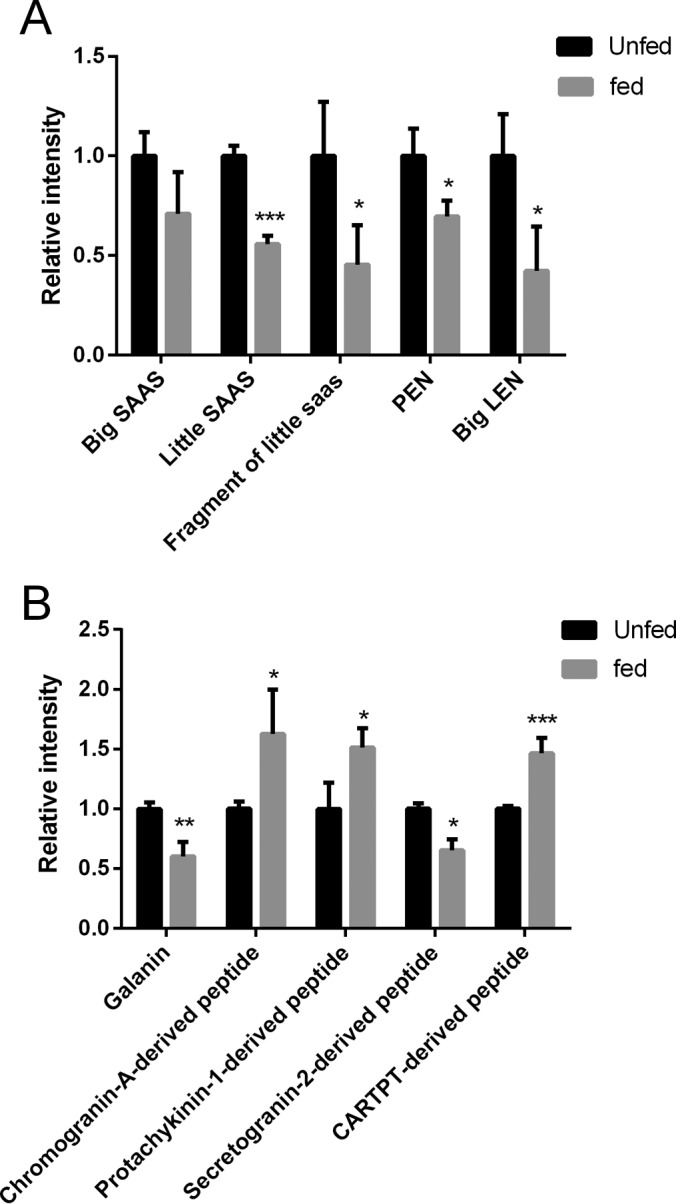
Label-free differential analysis of endogenous peptides in the nucleus accumbens (NAc). A, Relative level changes of peptides derived from the ProSAAS precursor, including big SAAS, little SAAS, a truncated little SAAS (SLSAASAPLAETSTPL), PEN and big LEN. B, Relative level changes of galanin and linker peptides derived from chromogranin-A, protachykinin-1, secretogranin-2 and CART. Four tissue punches collected from NAcs of four individual rats were pooled as an aliquot for the quantitative analysis of peptidomic changes, and three aliquots were used for each group (n = 3). Values represent means ± S.E. * denotes p < 0.05, ** denotes p < 0.01, and *** denotes p < 0.005.
Fig. 5.
Fig. 5.
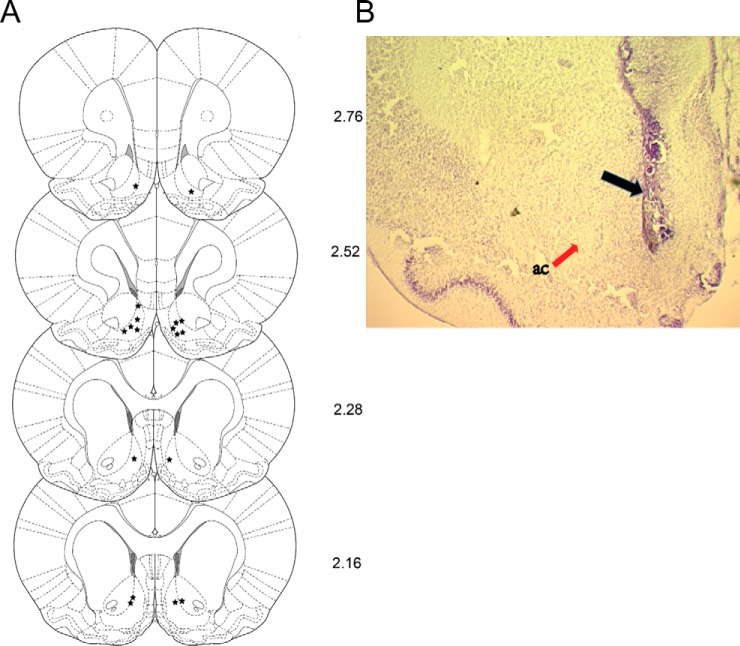
Injector placements for NAc shell-cannulated animals. A, line drawings of coronal sections, depicting the injection sites from rats with bilateral placements in NAc where the position of each section from bregma was given in mm. Each injector tip placement is represented by a star symbol. B, photomicrographs showing injector placement into NAc shell, with black arrows indicating the location of injector tips. ac, anterior commissure (red arrow). Line drawing were adapted from the atlas of Paxinos and Watson (2007), with permission.
Fig. 6.
Fig. 6.
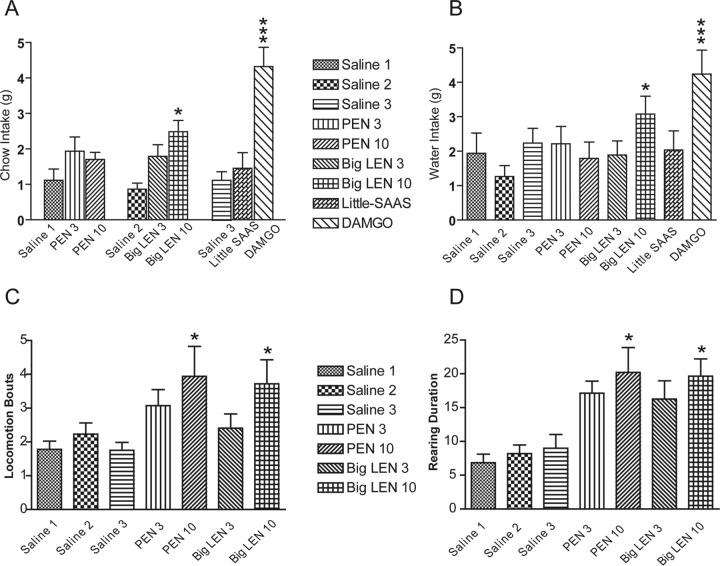
The effects of intranucleus accumbens shell infusions of ProSAAS-derived peptides in non-food-deprived rats (n = 8). A, Alteration of chow intake in grams during two hour testing session with ProSAAS-derived peptides in comparison to saline and DAMGO. The high dose (10 μg/0.5 μl) of big-LEN significantly increased chow intake. B, Alteration of water intake during two-hour testing session with ProSAAS-derived peptides in comparison to saline and DAMGO. The high dose (10 μg/0.5 μl) of big-LEN produced a significant increase in water intake. C, Both the high dose of PEN and big-LEN (10 μg/0.5 μl for each peptide) significantly elevated locomotion in satiated rats compared with saline in the first hour. D, Both the high dose of PEN and big-LEN (10 μg/0.5 μl for each peptide) significantly increased the rearing duration in satiated rats compared with saline in the first hour. Values represent means ± S.E. * denotes p < 0.05, ** denotes p < 0.01, and *** denotes p < 0.0001.
Fig. 7.
Fig. 7.
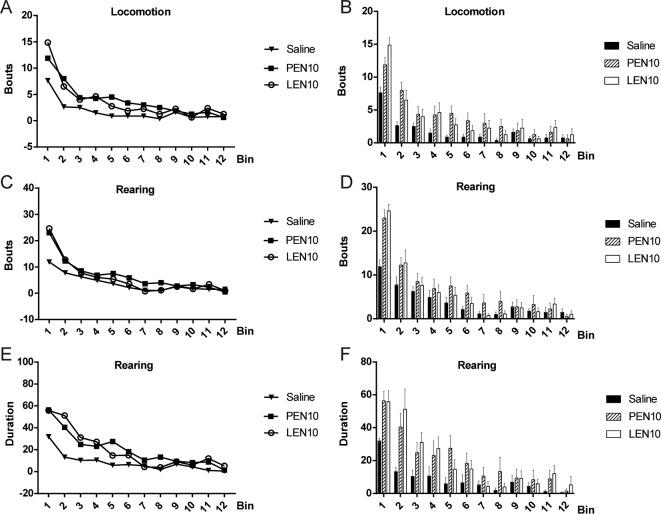
Time-course analysis of locomotion, rearing bouts and rearing duration during the first hour in rats. (A), (B) Locomotion (P). (C), (D) Rearing bouts. (E), (F) Rearing duration (p < 0.001).

References

    1. Schank J. R., Ryabinin A. E., Giardino W. J., Ciccocioppo R., and Heilig M. (2012) Stress-related neuropeptides and addictive behaviors: beyond the usual suspects. Neuron 76, 192–208 - PMC - PubMed
    1. Podvin S., Yaksh T., and Hook V. (2016) The Emerging Role of Spinal Dynorphin in Chronic Pain: A Therapeutic Perspective. Annu. Rev. Pharmacol. Toxicol. 56, 511–533 - PMC - PubMed
    1. An S., Harang R., Meeker K., Granados-Fuentes D., Tsai C. A., Mazuski C., Kim J., Doyle F. J 3rd, Petzold L. R., and Herzog E. D. (2013) A neuropeptide speeds circadian entrainment by reducing intercellular synchrony. Proc. Natl. Acad. Sci. U.S.A. 110, E4355–E4361 - PMC - PubMed
    1. Navarro V. M., and Kaiser U. B. (2013) Metabolic influences on neuroendocrine regulation of reproduction. Curr. Opin. Endocrinol. Diabetes Obes. 20, 335–341 - PMC - PubMed
    1. Gautron L., Elmquist J. K., and Williams K. W. (2015) Neural control of energy balance: translating circuits to therapies. Cell 161, 133–145 - PMC - PubMed

Publication types

LinkOut - more resources