


Temperature-dependent dynamic control of the TCA cycle increases volumetric productivity of itaconic acid production by Escherichia coli
- PMID: 28865130
- PMCID: PMC5725713
- DOI: 10.1002/bit.26446
Temperature-dependent dynamic control of the TCA cycle increases volumetric productivity of itaconic acid production by Escherichia coli
Abstract
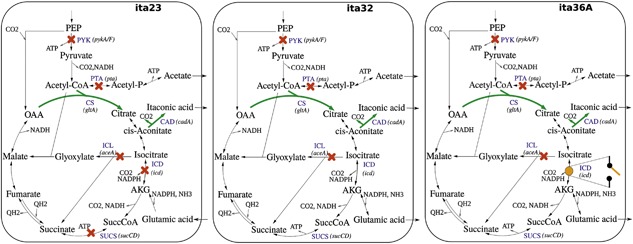
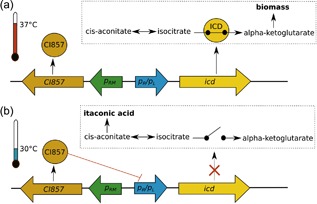
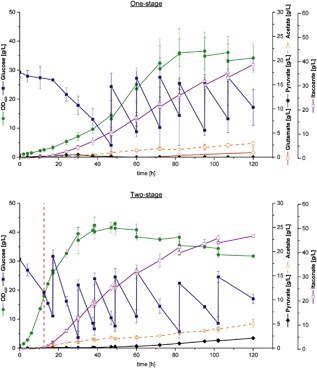
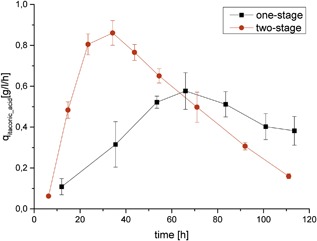
Based on the recently constructed Escherichia coli itaconic acid production strain ita23, we aimed to improve the productivity by applying a two-stage process strategy with decoupled production of biomass and itaconic acid. We constructed a strain ita32 (MG1655 ΔaceA Δpta ΔpykF ΔpykA pCadCs), which, in contrast to ita23, has an active tricarboxylic acid (TCA) cycle and a fast growth rate of 0.52 hr-1 at 37°C, thus representing an ideal phenotype for the first stage, the growth phase. Subsequently we implemented a synthetic genetic control allowing the downregulation of the TCA cycle and thus the switch from growth to itaconic acid production in the second stage. The promoter of the isocitrate dehydrogenase was replaced by the Lambda promoter (pR ) and its expression was controlled by the temperature-sensitive repressor CI857 which is active at lower temperatures (30°C). With glucose as substrate, the respective strain ita36A grew with a fast growth rate at 37°C and switched to production of itaconic acid at 28°C. To study the impact of the process strategy on productivity, we performed one-stage and two-stage bioreactor cultivations. The two-stage process enabled fast formation of biomass resulting in improved peak productivity of 0.86 g/L/hr (+48%) and volumetric productivity of 0.39 g/L/hr (+22%) in comparison to the one-stage process. With our dynamic production strain, we also resolved the glutamate auxotrophy of ita23 and increased the itaconic acid titer to 47 g/L. The temperature-dependent activation of gene expression by the Lambda promoters (pR /pL ) has been frequently used to improve protein or, in a few cases, metabolite production in two-stage processes. Here we demonstrate that the system can be as well used in the opposite direction to selectively knock-down an essential gene (icd) in E. coli to design a two-stage process for improved volumetric productivity. The control by temperature avoids expensive inducers and has the potential to be generally used to improve cell factory performance.
Keywords: Escherichia coli; dynamic metabolic control; genetic switch; itaconic acid production; two-stage process; volumetric productivity.
© 2017 The Authors. Biotechnology and Bioengineering Published by Wiley Periodicals, Inc.
Figures
References
-
- Beauprez, J. J. , De Mey, M. , & Soetaert, W. K. (2010). Microbial succinic acid production: Natural versus metabolic engineered producers. Process Biochemistry, 45, 1103–1114.
-
- Becker, J. , & Wittmann, C. (2015). Advanced biotechnology: Metabolically engineered cells for the bio‐based production of chemicals and fuels, materials, and health‐care products. Angewandte Chemie‐International Edition, 54, 3328–3350. - PubMed
-
- Burg, J. M. , Cooper, C. B. , Ye, Z. , Reed, B. R. , Moreb, E. A. , & Lynch, M. D. (2016). Large‐scale bioprocess competitiveness: The potential of dynamic metabolic control in two‐stage fermentations. Current Opinion in Chemical Engineering, 14, 121–136.
-
- Causey, T. B. , Zhou, S. , Shanmugam, K. T. , & Ingram, L. O. (2003). Engineering the metabolism of Escherichia coli W3110 for the conversion of sugar to redox‐neutral and oxidized products: Homoacetate production. Proceedings of the National Academy of Sciences of the United States of America, 100, 825–832. - PMC - PubMed
-
- Cho, H.‐S. , Seo, S. W. , Kim, Y. M. , Jung, G. Y. , & Park, J. M. (2012). Engineering glycerladehyde‐3‐phosphate dehydrogenase for switching control of glycolysis in Escherichia coli . Biotechnology and Bioengineering, 109, 2612–2619. - PubMed
MeSH terms
Substances
LinkOut - more resources
Full Text Sources
Other Literature Sources
Research Materials
