


Peroxiredoxin 6 phospholipid hydroperoxidase activity in the repair of peroxidized cell membranes
- PMID: 28865296
- PMCID: PMC5581854
- DOI: 10.1016/j.redox.2017.08.008
Peroxiredoxin 6 phospholipid hydroperoxidase activity in the repair of peroxidized cell membranes
Abstract
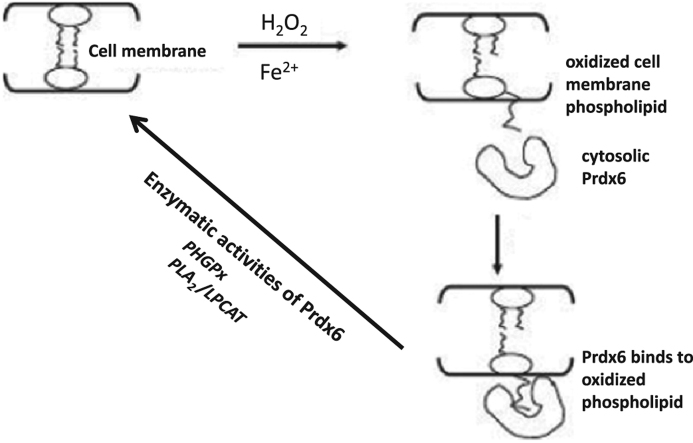
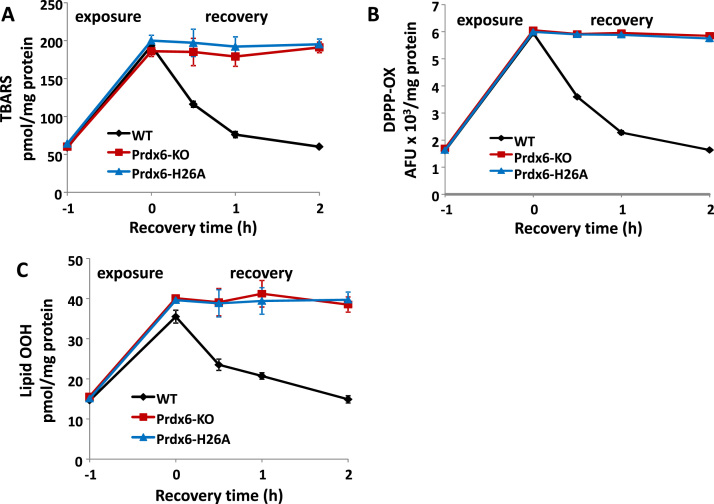
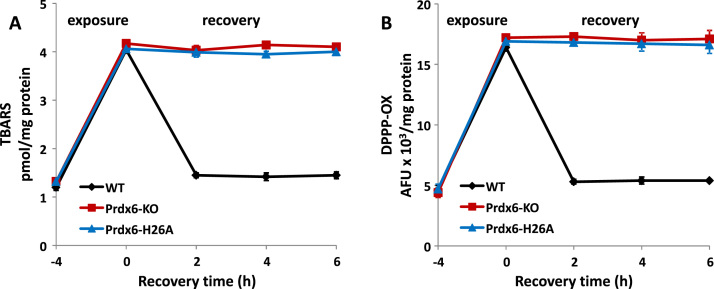
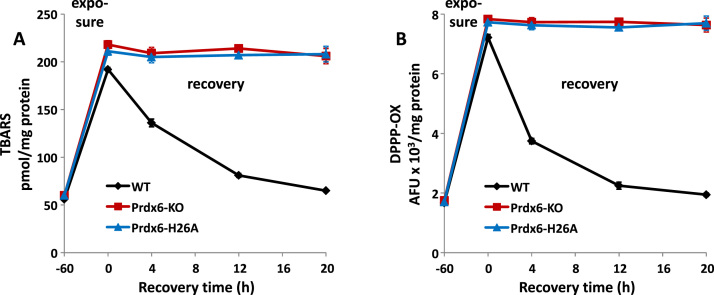
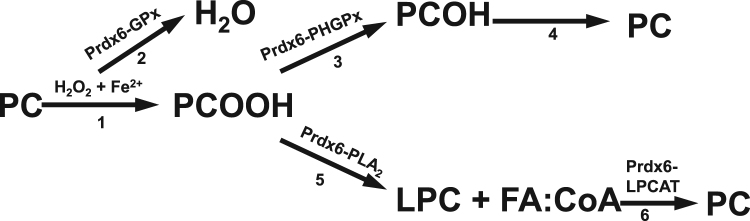
Although lipid peroxidation associated with oxidative stress can result in cellular death, sub-lethal lipid peroxidation can gradually resolve with return to the pre-exposure state. We have shown that resolution of lipid peroxidation is greatly delayed in lungs or cells that are null for peroxiredoxin 6 (Prdx6) and that both the phospholipase A2 and the GSH peroxidase activities of Prdx6 are required for a maximal rate of recovery. Like other peroxiredoxins, Prdx6 can reduce H2O2 and short chain hydroperoxides, but in addition can directly reduce phospholipid hydroperoxides. This study evaluated the relative role of these two different peroxidase activities of Prdx6 in the repair of peroxidized cell membranes. The His26 residue in Prdx6 is an important component of the binding site for phospholipids. Thus, we evaluated the lungs from H26A-Prdx6 expressing mice and generated H26A-Prdx6 expressing pulmonary microvascular endothelial cells (PMVEC) by lentiviral infection of Prdx6 null cells to compare with wild type in the repair of lipid peroxidation. Isolated lungs and PMVEC were exposed to tert-butyl hydroperoxide and mice were exposed to hyperoxia (> 95% O2). Assays for lipid peroxidation in wild type control and mutant lungs and cells showed ~4-fold increase at end-exposure. Control lungs and cells showed gradual resolution during a post-exposure recovery period. However, there was no recovery from lipid peroxidation by H26A-Prdx6 lungs or PMVEC. These studies confirm an important role for Prdx6 in recovery from membrane lipid peroxidation and indicate that reduction of H2O2 or short chain hydroperoxides does not play a role in the recovery process.
Keywords: Endothelial cells; Histidine mutation; Hyperoxia; Lipid peroxidation; Oxidant stress; Perfused lung.
Copyright © 2017 The Authors. Published by Elsevier B.V. All rights reserved.
Figures
References
-
- Girotti A.W. Lipid hydroperoxide generation, turnover, and effector action in biological systems. Lipid Res. 1998;39:1529–1542. - PubMed
-
- Sevanian A., Muakkassah-Kelly S.F., Montestruque S. The influence of phospholipase A2 and glutathione peroxidase on the elimination of membrane lipid peroxides. Arch. Biochem. Biophys. 1983;223:441–452. - PubMed
-
- Ursini F., Maiorino M., Valente M., Ferri L., Gregolin C. Purification from pig liver of a protein which protects liposomes and biomembranes from peroxidative degradation and exhibits glutathione peroxidase activity on phosphatidylcholine hydroperoxides. Biochim. Biophys. Acta. 1982;710:197–211. - PubMed
-
- Maiorino M., Conrad M., Ursini F. GPx4, lipid peroxidation, and cell death: discoveries, rediscoveries, and open issues. Antioxid. Redox Signal. 2017 - PubMed
Publication types
MeSH terms
Substances
Grants and funding
LinkOut - more resources
Full Text Sources
Other Literature Sources
Miscellaneous
