


Comparison of Readmission Rates After Acute Myocardial Infarction in 3 Patient Age Groups (18 to 44, 45 to 64, and ≥65 Years) in the United States
- PMID: 28865892
- PMCID: PMC5825232
- DOI: 10.1016/j.amjcard.2017.07.081
Comparison of Readmission Rates After Acute Myocardial Infarction in 3 Patient Age Groups (18 to 44, 45 to 64, and ≥65 Years) in the United States
Abstract
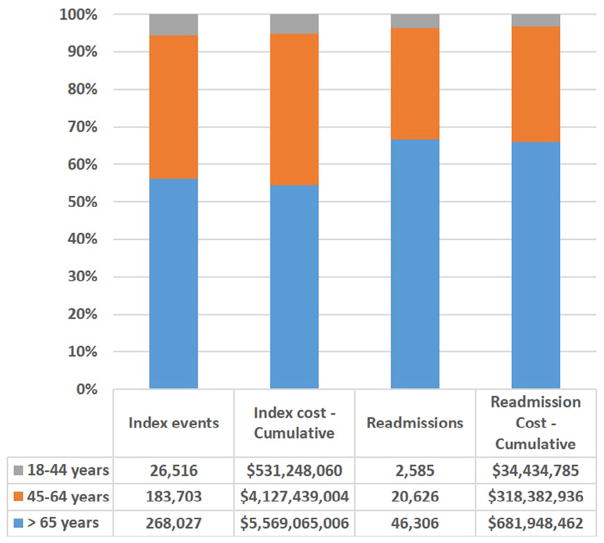
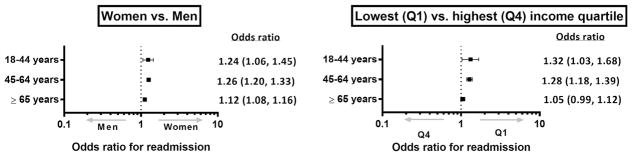
Postacute myocardial infarction (AMI) readmissions are common among Medicare beneficiaries (≥65 years) and are associated with significant resource utilization. However, patterns of AMI readmissions for younger age groups in the United States are not known. In the Nationwide Readmissions Database, a nationally representative all-payer database of inpatient hospitalizations, we identified 212,171 index AMI hospitalizations in January to November 2013, weighted to represent 478,247 hospitalizations nationally (mean age 66.9 years, 38% women, 29% low income). This included 26,516 cases in the 18 to 44 age group, 183,703 in the 45 to 64 age group, and 268,027 in the ≥65 age group. The overall 30-day readmission rate was 14.5% and varied across age groups (9.7% [18 to 44], 11.2% [45 to 64], and 17.3% [≥65]). The cumulative cost of 30-day readmissions was $1.1 billion, of which $365 million was spent on those <65 years of age. In multivariable hierarchical models, the risk of readmission was higher in women and in low-income patients, but the effect varied by age (p value for age-gender and age-income interactions <0.05) and was more prominent in the younger age groups. Further, patients in all age groups continue to have a high hospitalization burden beyond the typical 30-day readmission period, with an overall 24% post-AMI 90-day readmission rate. In conclusion, readmissions in young and middle-aged AMI survivors pose a substantial burden on patients and on U.S. health-care resources. Women and low-income patients with AMI, particularly those in younger age groups, are more frequently readmitted, and readmissions continue to burden the health-care system beyond the typical 30-day window. Future investigations would need to be targeted toward a better understanding and improvement of the rehospitalization burden for vulnerable patient groups.
Copyright © 2017 Elsevier Inc. All rights reserved.
Conflict of interest statement
The authors have no conflicts of interest to disclose.
Figures
References
-
- Medicare Payment Advisory Commission. A path to bundled payment around a rehospitalization. Report to the Congress: reforming the delivery system; Washington, DC. June. 2005; pp. 83–103.
-
- Jencks SF, Williams MV, Coleman EA. Rehospitalizations among patients in the Medicare fee-for-service program. N Engl J Med. 2009;360:1418–1428. - PubMed
-
- Krumholz HM, Merrill AR, Schone EM, Schreiner GC, Chen J, Bradley EH, Wang Y, Wang Y, Lin Z, Straube BM, Rapp MT, Normand SL, Drye EE. Patterns of hospital performance in acute myocardial infarction and heart failure 30-day mortality and readmission. Circ Cardiovasc Qual Outcomes. 2009;2:407–413. - PubMed
-
- Bongiovanni D. [Accessed August 15, 2016];Readmissions penalties: are commercial payors following Medicare’s lead? 2015 Available at: http://www.besler.com/readmissions-penalties-commercial-payors/
Publication types
MeSH terms
Grants and funding
LinkOut - more resources
Full Text Sources
Other Literature Sources
Medical
