


Targeting Inflammation to Improve Tumor Drug Delivery
- PMID: 28867166
- PMCID: PMC5614424
- DOI: 10.1016/j.trecan.2017.07.006
Targeting Inflammation to Improve Tumor Drug Delivery
Abstract
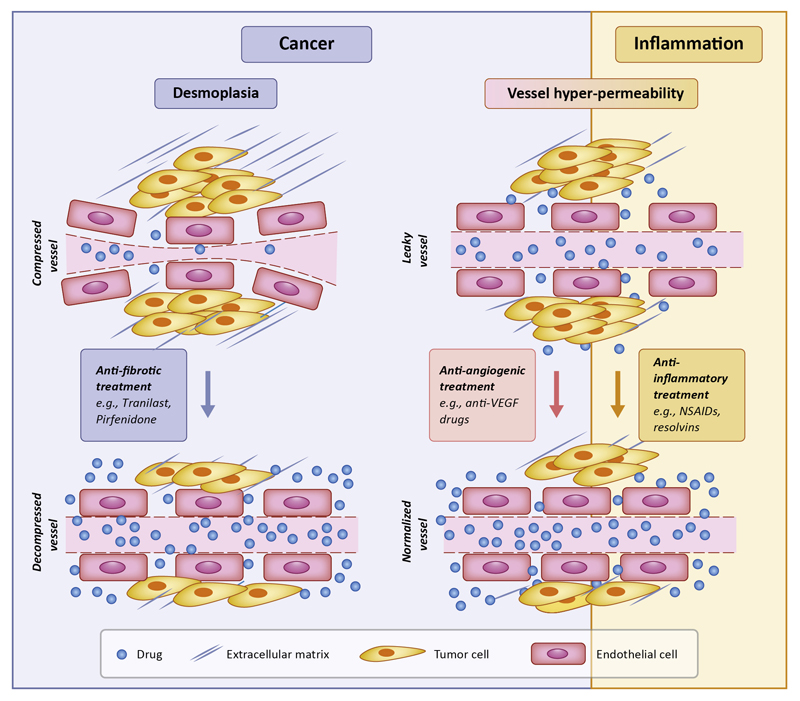
Inefficient delivery of drugs is a main cause of chemotherapy failure in hypoperfused tumors. To enhance perfusion and drug delivery in these tumors, two strategies have been developed: vascular normalization, aiming at normalizing tumor vasculature and blood vessel leakiness, and stress alleviation, aiming at decompressing tumor vessels. Vascular normalization is based on anti-angiogenic drugs, whereas stress alleviation is based on stroma-depleting agents. We present here an alternative approach to normalize tumor vasculature, taking into account that malignant tumors tend to develop at sites of chronic inflammation. Similarly to tumor vessel leakiness, inflammation is also characterized by vascular hyperpermeability. Therefore, testing the ability of anti-inflammatory agents, such as non-steroidal anti-inflammatory drugs (NSAIDs) or inflammation resolution mediators, as an alternative means to increase tumor drug delivery might prove promising.
Keywords: anti-inflammatory agents; inflammation resolution; stress alleviation; tumor perfusion; vascular normalization.
Copyright © 2017. Published by Elsevier Inc.
Figures
References
-
- Hanahan D, Weinberg RA. The hallmarks of cancer. Cell. 2000;100(1):57–70. - PubMed
-
- Hanahan D, Coussens LM. Accessories to the crime: functions of cells recruited to the tumor microenvironment. Cancer Cell. 2012;21(3):309–22. - PubMed
-
- Chauhan VP, et al. Delivery of molecular and nanoscale medicine to tumors: transport barriers and strategies. Annu Rev Chem Biomol Eng. 2011;2:281–98. - PubMed
Publication types
MeSH terms
Substances
Grants and funding
LinkOut - more resources
Full Text Sources
Other Literature Sources
