


Vitamin C Status and Cognitive Function: A Systematic Review
- PMID: 28867798
- PMCID: PMC5622720
- DOI: 10.3390/nu9090960
Vitamin C Status and Cognitive Function: A Systematic Review
Abstract
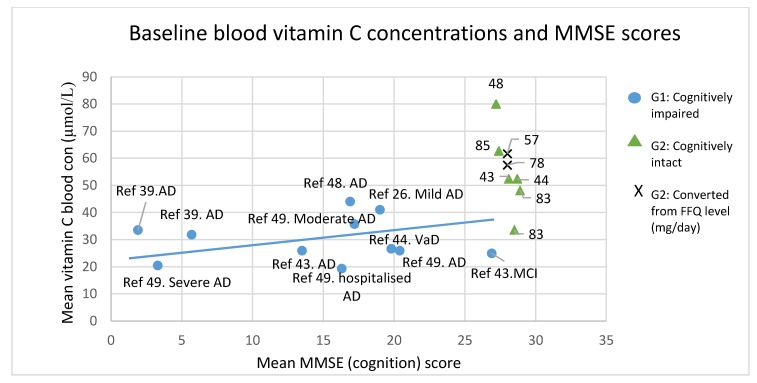
Vitamin C plays a role in neuronal differentiation, maturation, myelin formation and modulation of the cholinergic, catecholinergic, and glutaminergic systems. This review evaluates the link between vitamin C status and cognitive performance, in both cognitively intact and impaired individuals. We searched the PUBMED, SCOPUS, SciSearch and the Cochrane Library from 1980 to January 2017, finding 50 studies, with randomised controlled trials (RCTs, n = 5), prospective (n = 24), cross-sectional (n = 17) and case-control (n = 4) studies. Of these, 36 studies were conducted in healthy participants and 14 on cognitively impaired individuals (including Alzheimer's and dementia). Vitamin C status was measured using food frequency questionnaires or plasma vitamin C. Cognition was assessed using a variety of tests, mostly the Mini-Mental-State-Examination (MMSE). In summary, studies demonstrated higher mean vitamin C concentrations in the cognitively intact groups of participants compared to cognitively impaired groups. No correlation between vitamin C concentrations and MMSE cognitive function was apparent in the cognitively impaired individuals. The MMSE was not suitable to detect a variance in cognition in the healthy group. Analysis of the studies that used a variety of cognitive assessments in the cognitively intact was beyond the scope of this review; however, qualitative assessment revealed a potential association between plasma vitamin C concentrations and cognition. Due to a number of limitations in these studies, further research is needed, utilizing plasma vitamin C concentrations and sensitive cognitive assessments that are suitable for cognitively intact adults.
Keywords: Alzheimer’s; MMSE; ascorbic acid; central nervous system; cognition; dementia; vitamin C.
Conflict of interest statement
A.Sc. and A.P. have received research funding, consultancy, travel support and speaking fees from the nutrition and supplement industry. N.T., K.R., A.S. and I.H. declare no conflict of interest.
Figures

References
-
- Trout D.L. Vitamin c and cardiovascular risk factors. Am. J. Clin. Nutr. 1991;53:322S–325S. - PubMed
-
- Vojdani A., Ghoneum M. In vivo effect of ascorbic acid on enhancement of human natural killer cell activity. Nutr. Res. 1993;13:753–764. doi: 10.1016/S0271-5317(05)80799-7. - DOI
-
- Jacques P.F., Chylack L.T. Epidemiologic evidence of a role for the antioxidant vitamins and carotenoids in cataract prevention. Am. J. Clin. Nutr. 1991;53:352S–355S. - PubMed
-
- Hatch G.E. Asthma, inhaled oxidants, and dietary antioxidants. Am. J. Clin. Nutr. 1995;61:625S–630S. - PubMed
Publication types
MeSH terms
Substances
LinkOut - more resources
Full Text Sources
Other Literature Sources
Medical
