


Examining the relationship between burnout and empathy in healthcare professionals: A systematic review
- PMID: 28868237
- PMCID: PMC5534210
- DOI: 10.1016/j.burn.2017.06.003
Examining the relationship between burnout and empathy in healthcare professionals: A systematic review
Abstract
Objective: Empathy and burnout are two related yet distinct constructs that are relevant to clinical healthcare staff. The nature of their relationship is uncertain and this review aimed to complete a rigorous, systematic exploration of the literature investigating the relationship between burnout and empathy in healthcare staff.
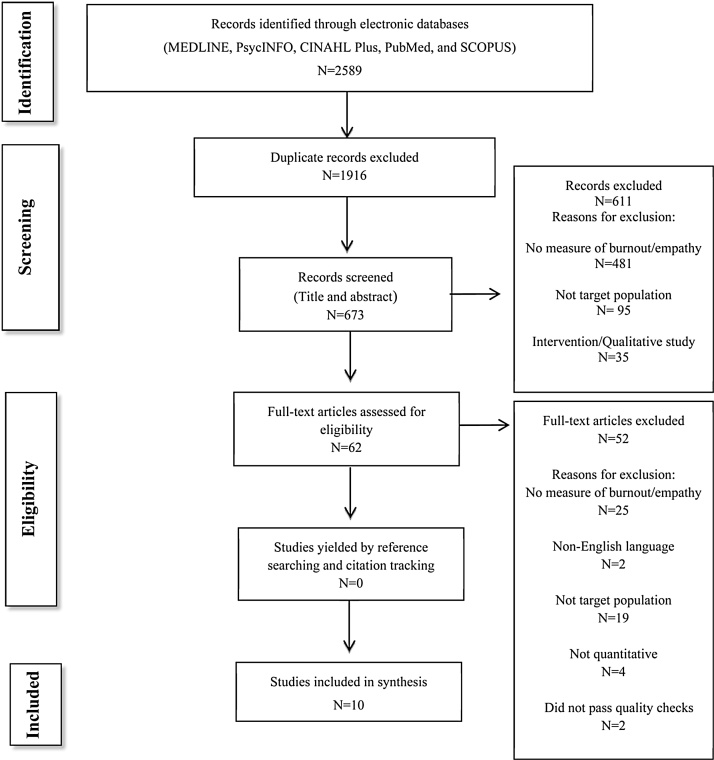
Design: A systematic review was conducted in accordance with the Preferred Reporting Items for Systematic Reviews and Meta-Analyses (PRISMA) guidance.
Data sources: Search terms (Burnout OR Burn-out OR "Burn out") AND (Empathy OR Empath*) enabled identification of studies investigating burnout and empathy in healthcare staff, using five electronic data bases (MEDLINE, PsycINFO, CINAHL Plus, PubMed, and SCOPUS). Manual searching amongst reference lists of eligible articles was also completed.
Review methods: Databases were searched for studies published in the English language, from inception to February 2017. Key inclusion criteria were: 1) participants who were nurses or medical professionals, 2) full written manuscript in English, 3) use of the Maslach Burnout Inventory to assess burnout and a standardized outcome measure for empathy, 4) quantitative methodology exclusively.
Results: Ten eligible studies were reviewed. Of those, seven were conducted in countries where English was not the first language. Eight of the studies provided empirical support for a negative relationship between empathy and burnout. One study provided support for a positive relationship between burnout and empathy. One study reported contradictory evidence with positive and negative correlations between different subscales of the empathy and burnout measures. In general, the quality of the studies was assessed to be good. However, some of the studies failed to provide information pertaining to sample size, with the reporting of data less than adequate from one study.
Conclusions: There was consistent evidence for a negative association between burnout and empathy. This review avoided a common English-speaking country bias of some areas of the literature. Given that all of the studies reviewed were cross sectional, further research is necessary to establish causality.
Keywords: Burnout; Empathy; Healthcare staff; Systematic review.
Figures
References
-
- Astrom S., Norberg A., Nilsson M., Winblad B. Tedium among personnel working with geriatric patients. Scandinavian Journal of Caring Sciences. 1987;1:125–132. - PubMed
-
- Adriaenssens J., De Gucht V., Maes S. Determinants and prevalence of burnout in emergency nurses: A systematic review of 25 years of research. International Journal of Nursing Studies. 2015;52(2):649–661. - PubMed
-
- Aiken L.H., Clarke S.P., Sloane D.M., Sochalski J., Silber J.H. Hospital nurse staffing and patient mortality, nurse burnout, and job dissatisfaction. Journal of the American Medical Association. 2002;288(16):1987–1993. - PubMed
-
- Bagnall A.M., Jones R., Akter H., Woodall J. Public Health England; London, England: 2016. Interventions to prevent burnout in high risk individuals: Evidence review.https://www.gov.uk/government/publications/interventions-to-prevent-burn... Retrieved from.
-
- Barrett-Lennard G.T. Dimensions of the therapist response as causal factors in therapeutic change. Psychological Monographs. 1962;76(43):1–36.
Publication types
LinkOut - more resources
Full Text Sources
Other Literature Sources