


Plant-like bacterial expansins play contrasting roles in two tomato vascular pathogens
- PMID: 28868644
- PMCID: PMC5835177
- DOI: 10.1111/mpp.12611
Plant-like bacterial expansins play contrasting roles in two tomato vascular pathogens
Abstract
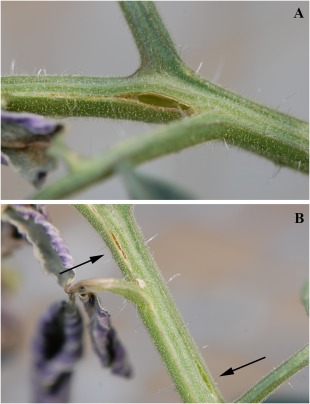
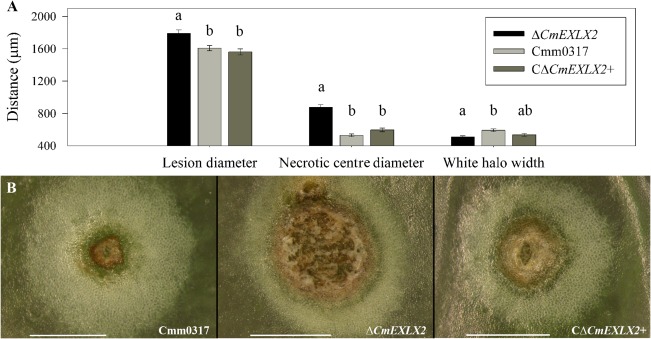
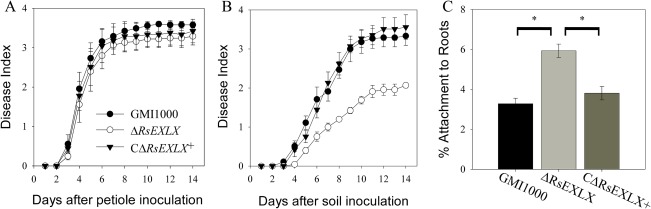
Expansin proteins, which loosen plant cell walls, play critical roles in normal plant growth and development. The horizontal acquisition of functional plant-like expansin genes in numerous xylem-colonizing phytopathogenic bacteria suggests that bacterial expansins may also contribute to virulence. To investigate the role of bacterial expansins in plant diseases, we mutated the non-chimeric expansin genes (CmEXLX2 and RsEXLX) of two xylem-inhabiting bacterial pathogens, the Actinobacterium Clavibacter michiganensis ssp. michiganensis (Cmm) and the β-proteobacterium Ralstonia solanacearum (Rs), respectively. The Cmm ΔCmEXLX2 mutant caused increased symptom development on tomato, which was characterized by more rapid wilting, greater vascular necrosis and abundant atypical lesions on distant petioles. This increased disease severity correlated with larger in planta populations of the ΔCmEXLX2 mutant, even though the strains grew as well as the wild-type in vitro. Similarly, when inoculated onto tomato fruit, ΔCmEXLX2 caused significantly larger lesions with larger necrotic centres. In contrast, the Rs ΔRsEXLX mutant showed reduced virulence on tomato following root inoculation, but not following direct petiole inoculation, suggesting that the RsEXLX expansin contributes to early virulence at the root infection stage. Consistent with this finding, ΔRsEXLX attached to tomato seedling roots better than the wild-type Rs, which may prevent mutants from invading the plant's vasculature. These contrasting results demonstrate the diverse roles of non-chimeric bacterial expansins and highlight their importance in plant-bacterial interactions.
Keywords: Clavibacter michiganensis; Ralstonia solanacearum; bacterial plant pathogenesis; expansin; horizontal gene transfer.
© 2017 BSPP AND JOHN WILEY & SONS LTD.
Figures
References
-
- Bae, C. , Han, S.W. , Song, Y.‐R. , Kim, B.‐Y. , Lee, H.‐J. , Lee, J.‐M. , Yeam, I. , Heu, S. and Oh, C.‐S. (2015) Infection processes of xylem‐colonizing pathogenic bacteria: possible explanations for the scarcity of qualitative disease resistance genes against them in crops. Theor. Appl. Genet. 128, 1219–1229. - PubMed
-
- Balaji, V. and Smart, C.D. (2012) Over‐expression of snakin‐2 and extensin‐like protein genes restricts pathogen invasiveness and enhances tolerance to Clavibacter michiganensis subsp. michiganensis in transgenic tomato (Solanum lycopersicum). Transgenic Res. 21, 23–37. - PubMed
-
- Balaji, V. , Mayrose, M. , Sherf, O. , Jacob‐Hirsch, J. , Eichenlaub, R. , Iraki, N. , Manulis‐Sasson, S. , Rechavi, G. , Barash, I. and Sessa, G. (2008) Tomato transcriptional changes in response to Clavibacter michiganensis subsp. michiganensis reveal a role for ethylene in disease development. Plant Physiol. 146, 1797–1809. - PMC - PubMed
-
- Bollard, E.G. (1960) Transport in the xylem. Annu. Rev. Plant Physiol. 11, 141–166.
-
- Boucher, C. , Barberis, P. , Trigalet, A. and Demery, D. (1985) Transposon mutagenesis of Pseudomonas solanacearum: isolation of Tn5‐induced avirulent mutants. J. Gen. Microbiol. 131, 2449–2457.
Publication types
MeSH terms
Substances
Grants and funding
LinkOut - more resources
Full Text Sources
Other Literature Sources
