


Cascading effects of attention disengagement and sensory seeking on social symptoms in a community sample of infants at-risk for a future diagnosis of autism spectrum disorder
- PMID: 28869201
- PMCID: PMC6414208
- DOI: 10.1016/j.dcn.2017.08.006
Cascading effects of attention disengagement and sensory seeking on social symptoms in a community sample of infants at-risk for a future diagnosis of autism spectrum disorder
Abstract
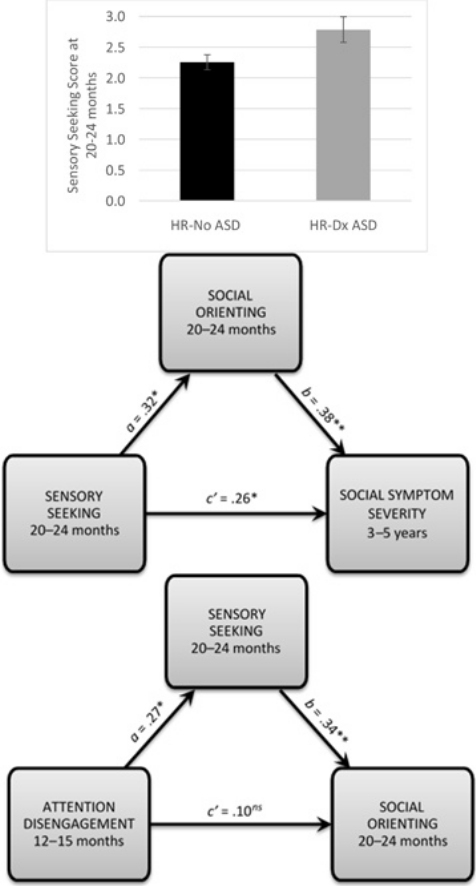
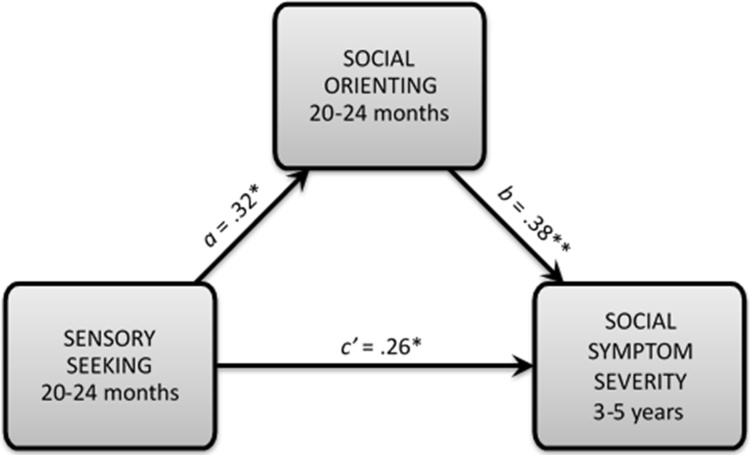
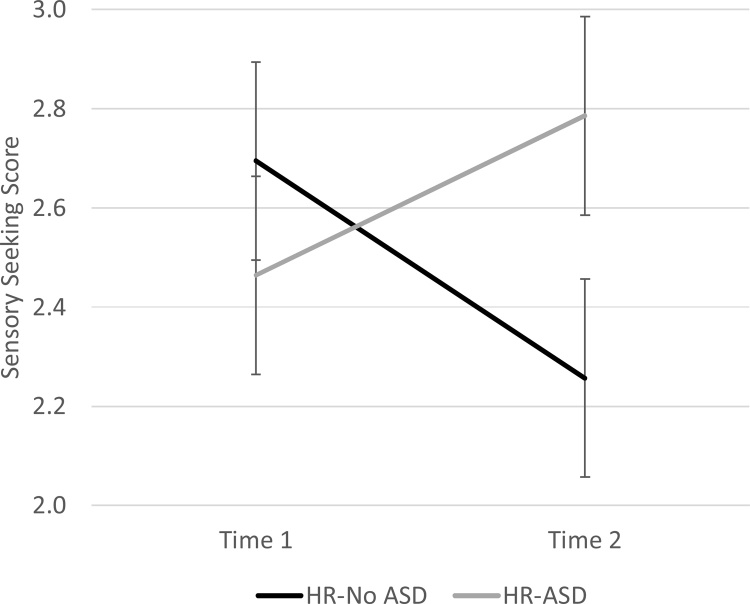
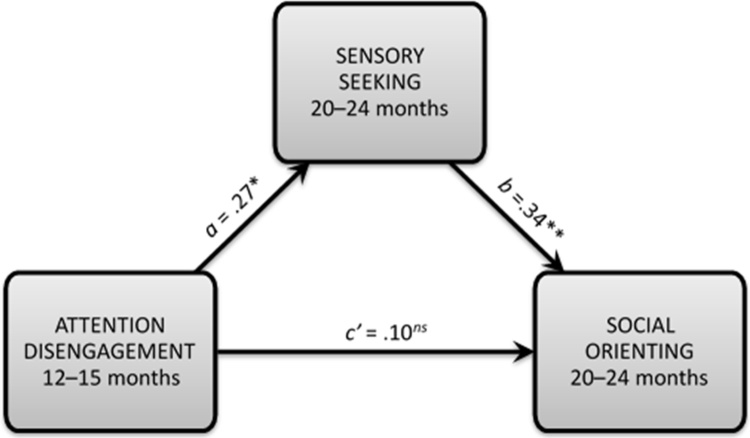
Recent work suggests sensory seeking predicts later social symptomatology through reduced social orienting in infants who are at high-risk for autism spectrum disorder (ASD) based on their status as younger siblings of children diagnosed with ASD. We drew on extant longitudinal data from a community sample of at-risk infants who were identified at 12 months using the First Year Inventory, and followed to 3-5 years. We replicate findings of Damiano et al. (in this issue) that a) high-risk infants who go on to be diagnosed with ASD show heightened sensory seeking in the second year of life relative to those who do not receive a diagnosis, and b) increased sensory seeking indirectly relates to later social symptomatology via reduced social orienting. We extend previous findings to show that sensory seeking has more clinical utility later in the second year of life (20-24 months) than earlier (13-15 months). Further, this study suggests that diminished attention disengagement at 12-15 months may precede and predict increased sensory seeking at 20-24 months. Findings add support for the notion that sensory features produce cascading effects on social development in infants at risk for ASD, and suggest that reduced attention disengagement early in life may set off this cascade.
Keywords: Attention; Autism; Infants; Longitudinal; Risk markers; Sensory features; Social.
Copyright © 2017 The Authors. Published by Elsevier Ltd.. All rights reserved.
Figures
References
-
- American Psychiatric Association . American Psychiatric Publishing; Arlington, VA: 2013. Diagnostic and Statistical Manual of Mental Disorders (DSM-5®)
-
- Asendorpf J.B. Recommendations for increasing replicability in psychology. Eur. J. Pers. 2013;27(2):108–119.
-
- Ausderau K. Sensory subtypesand associated outcomes in children with autism spectrum disorders. Autism Res. 2016;9(12):1316–1327. - PubMed
-
- Baranek G. University of North Carolina at Chapel Hill; Chapel Hill, NC: 2003. First Year Inventory (FYI) 2.0. - PubMed
Publication types
MeSH terms
Grants and funding
LinkOut - more resources
Full Text Sources
Other Literature Sources
Medical
