


Efficacy of Idebenone to Preserve Respiratory Function above Clinically Meaningful Thresholds for Forced Vital Capacity (FVC) in Patients with Duchenne Muscular Dystrophy
- PMID: 28869486
- PMCID: PMC5611828
- DOI: 10.3233/JND-170245
Efficacy of Idebenone to Preserve Respiratory Function above Clinically Meaningful Thresholds for Forced Vital Capacity (FVC) in Patients with Duchenne Muscular Dystrophy
Abstract
Background: Patients with DMD experience progressive restrictive respiratory disease and eventual respiratory failure. Standard of care guidelines command changes in disease management when forced vital capacity percent of predicted (FVC% p) falls below clinically relevant thresholds. The Phase 3 DELOS trial in patients with DMD demonstrated that idebenone reduces the loss of peak expiratory flow and FVC compared to placebo (Buyse GM, et al.; Lancet 2015; 385 : 1748-57).
Objective: Post-hoc analyses were conducted to assess whether treatment with idebenone could reduce the risk of patients dropping below clinically meaningful thresholds of FVC% p.
Methods: The DELOS trial enrolled DMD patients 10-18 years of age not using glucocorticoids to receive idebenone (N = 31) or placebo (N = 33) for 12 months. Change from baseline in FVC and FVC% p was assessed by hospital spirometry and analyzed by mixed model of repeated measures and slope analysis and proportions of patients falling below clinically meaningful thresholds of FVC% p were compared.
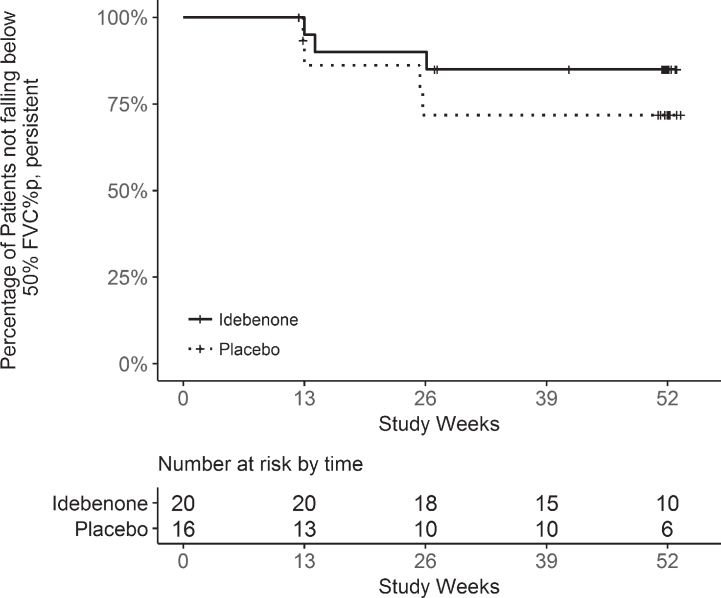
Results: The change over 1 year in FVC and FVC% p showed a consistent pattern in favor of idebenone treatment across multiple analysis methods and fewer patients in the idebenone group declined by a margin of 10% or more in FVC and FVC% p compared to placebo. There were also fewer patients in the idebenone group (15%) with a decline below FVC% p of 50% compared to the placebo group (25%) and fewer patients in the idebenone group (28%) showed a decline below FVC% p of 50% or 40% or 30% compared to the placebo group (43%).
Conclusions: These data added to the consistency and clinical meaningfulness of findings from the DELOS trial showing that idebenone can slow the loss of pulmonary function in patients with DMD.
Keywords: Duchenne muscular dystrophy; Pulmonary function; forced vital capacity; idebenone; respiration.
Figures


References
-
- Mah JK, Korngut L, Dykeman J, et al. A systematic review and meta-analysis on the epidemiology of Duchenne and Becker muscular dystrophy. Neuromuscul Disord. 2014;24:482–91. - PubMed
-
- McDonald CM, Abresch RT, Carter GT, et al. Profiles of neuromuscular diseases. Duchenne muscular dystrophy. Am J Phys Med Rehabil. 1995;74:S70–92. - PubMed
-
- Gozal D. Pulmonary manifestations of neuromuscular disease with special reference to Duchenne muscular dystrophy and spinal muscular atrophy. Pediatr Pulmonol. 2000;29:141–50. - PubMed
-
- Simonds AK. Respiratory complications of the muscular dystrophies. Semin Respir Crit Care Med. 2002;23:231–8. - PubMed
Publication types
MeSH terms
Substances
LinkOut - more resources
Full Text Sources
Other Literature Sources
Medical
