


Review
doi: 10.3390/pathogens6030041.
Listeria monocytogenes Biofilms in the Wonderland of Food Industry
Affiliations
- PMID: 28869552
- PMCID: PMC5617998
- DOI: 10.3390/pathogens6030041
Item in Clipboard
Review
Listeria monocytogenes Biofilms in the Wonderland of Food Industry
Pathogens.
.
Abstract
The foodborne pathogen Listeria monocytogenes is a concern in food safety because of its ability to form biofilm and to persist in food industry. In this mini-review, the issue represented by this pathogen and some of the latest efforts performed in order to investigate the composition of biofilms formed by L. monocytogenes are summarized.
Keywords: Listeria monocytogenes; biofilms; extracellular matrix; food industry; food safety.
Conflict of interest statement
The authors declare no conflict of interest.
Figures
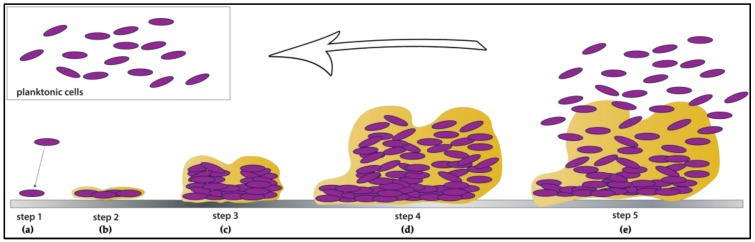
Schematic representation of the biofilm development stages. (a) The first step involves planktonic cells reversible attachment to surfaces; (b) the adhered cells begin to form a monolayer and to produce extracellular matrix; (c) the cells within the self-produced extrapolymeric matrix continue to grow and form multilayered microcolonies; (d) cells are irreversibly attached to the surface and embedded in the matrix: the biofilm is mature; (e) in the last stage of biofilm formation, cells are able to detach from the biofilm and to return in planktonic form, ready to colonize new surfaces. Adapted from [24].
References
-
- EFSA (European Food Safety Authority) Request for updating the former SCVPH opinion on Listeria monocytogenes risk related to ready-to-eat foods and scientific advice on different levels of Listeria monocytogenes in ready-to-eat foods and the related risk for human illness—Sci. EFSA J. 2008;6:599. doi: 10.2903/j.efsa.2008.599. - DOI
-
- Jofré A., Garriga M., Aymerich T., Pérez-Rodrìguez A.-V., Carrasco E., Bover-Cid S. Closing gaps for performing a risk assessment on Listeria monocytogenes in ready-to-eat (RTE) foods: Activity 1, an extensive literature search and study selection with data extraction on L. monocytogenes in a wide range of RTE food. EFSA Support. Publ. 2016 doi: 10.2903/sp.efsa.2016.EN-1141. - DOI
