


Seeing faces is necessary for face-domain formation
- PMID: 28869581
- PMCID: PMC5679243
- DOI: 10.1038/nn.4635
Seeing faces is necessary for face-domain formation
Abstract
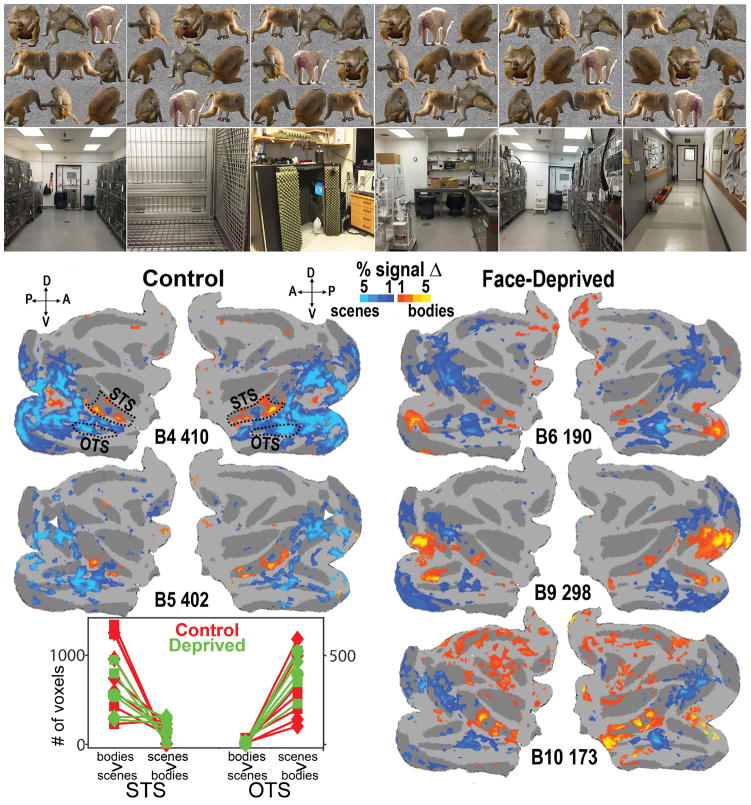
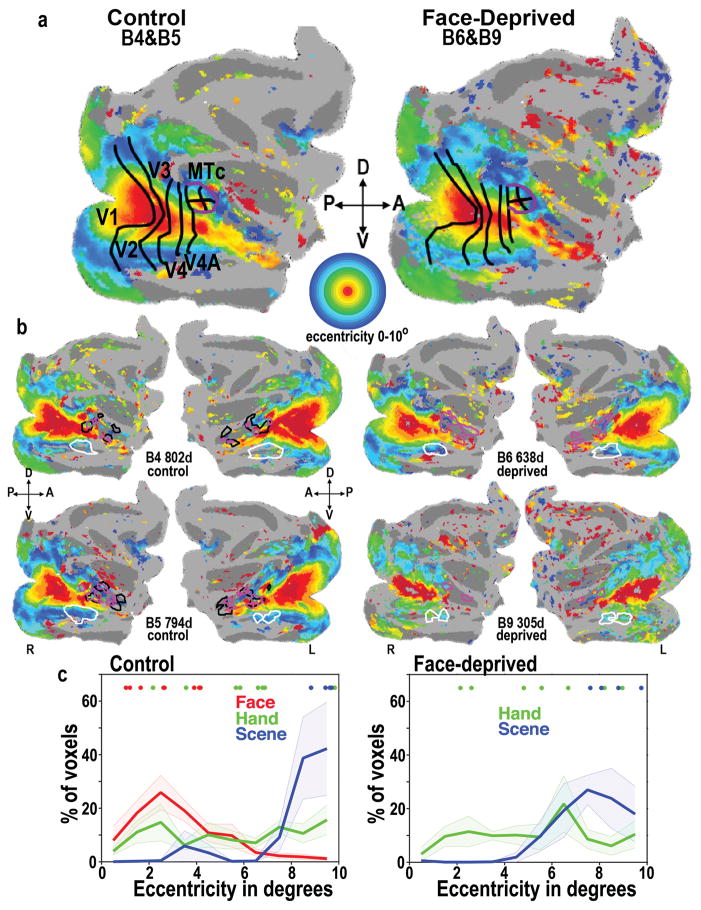
Here we report that monkeys raised without exposure to faces did not develop face domains, but did develop domains for other categories and did show normal retinotopic organization, indicating that early face deprivation leads to a highly selective cortical processing deficit. Therefore, experience must be necessary for the formation (or maintenance) of face domains. Gaze tracking revealed that control monkeys looked preferentially at faces, even at ages prior to the emergence of face domains, but face-deprived monkeys did not, indicating that face looking is not innate. A retinotopic organization is present throughout the visual system at birth, so selective early viewing behavior could bias category-specific visual responses toward particular retinotopic representations, thereby leading to domain formation in stereotyped locations in inferotemporal cortex, without requiring category-specific templates or biases. Thus, we propose that environmental importance influences viewing behavior, viewing behavior drives neuronal activity, and neuronal activity sculpts domain formation.
Conflict of interest statement
The authors declare no competing financial interests.
Figures



References
-
- McKone E, Crookes K, Jeffery L, Dilks DD. A critical review of the development of face recognition: experience is less important than previously believed. Cogn Neuropsychol. 2012;29:174–212. - PubMed
-
- McKone E, Crookes K, Kanwisher N. The cognitive and neural development of face recognition in humans. In: Gazzaniga M, editor. The Cognitive Neurosciences. 4. MIT Press; Cambridge, MA: 2009. pp. 467–482.
-
- Goren CC, Sarty M, Wu PY. Visual following and pattern discrimination of face-like stimuli by newborn infants. Pediatrics. 1975;56:544–549. - PubMed
-
- Johnson MH, Dziurawiec S, Ellis H, Morton J. Newborns’ preferential tracking of face-like stimuli and its subsequent decline. Cognition. 1991;40:1–19. - PubMed
-
- Mendelson MJ, Haith MM, Goldman-Rakic PS. Face scanning and responsiveness to social cues in infant rhesus monkeys. Developmental Psychology. 1982;18:222–228.
MeSH terms
Grants and funding
LinkOut - more resources
Full Text Sources
Other Literature Sources
Medical
