Review
. 2017 Oct:40:87-94.
doi: 10.1016/j.cbpa.2017.07.012. Epub 2017 Sep 1.

Repurposing ribosomes for synthetic biology

Affiliations
Review

Repurposing ribosomes for synthetic biology

Yi Liu et al. Curr Opin Chem Biol. 2017 Oct.

Abstract

The translation system is the cell's factory for protein biosynthesis, stitching together hundreds to thousands of amino acids into proteins, which are required for the structure, function, and regulation of living systems. The extraordinary synthetic capability of this system, which includes the ribosome and its associated factors required for polymerization, has driven extensive efforts to harness it for societal use in areas as diverse as energy, materials, and medicine. A powerful example is recombinant protein production, which has impacted the lives of patients through the synthesis of biopharmaceuticals such as insulin. In nature, however, only limited sets of monomers are utilized, thereby resulting in limited sets of biopolymers (i.e., proteins). Expanding nature's repertoire of ribosomal monomers could yield new classes of enzymes, therapeutics, materials, and chemicals with diverse, genetically encoded chemistry. Here, we discuss recent progress towards engineering ribosomes both in vivo and in vitro. These fundamental and technical breakthroughs open doors for advanced applications in biotechnology and synthetic biology.


Figures

Figure. 1
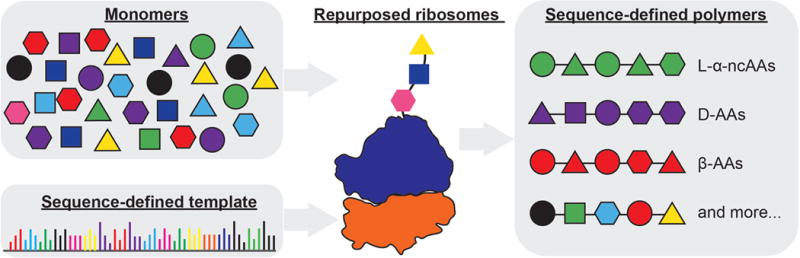
Figure. 1. Engineering the translation apparatus to manufacture sequence-defined polymers
Expanding the repertoire of ribosome substrates and functions has the potential to not only create novel biopolymers, but also open new areas of research in materials science and synthetic biology.
Figure 2
Figure 2. Approaches to orthogonal ribosomes
A. 30S orthogonality. 30S subunits (o-30S), with the anti-Shine-Dalgarno (ASD) sequence of its 16S rRNA modified to bind only to RNA message (o-mRNA) with complementary Shine-Dalgarno (SD) sequence, translate protein (o- protein) orthogonal and parallel to native translation process (gray). However, the 50S subunit is allowed to freely associate between native 30S and o-30S. B. A fully orthogonal 70S. 50S and 30S subunits are connected by a RNA tether, preventing free association of native and orthogonal species.
Figure 3
Figure 3. Integrated synthesis, assembly, and translation (iSAT) method for ribosome construction in vitro
In cell-free, ribosome-free S150 extract, reporter mRNA and rRNA are transcribed by RNA polymerase (RNA Pol) and the rRNA assembled into ribosomal subunits with added total r-proteins of the 70S (TP70). iSAT-assembled ribosomes then translate the reporter, here superfolder green fluorescent protein (sfGFP), as a measure of ribosome activity.
Figure 4
Figure 4. Adapting the ribosome to unique tRNA pools
50S subunits (o-50S) are modified in the 23S rRNA to bind only to orthogonal tRNA (o-tRNA) with a complementary sequence at the 3′ tail. This can result in two species of protein translated from one RNA message. The 30S subunit freely associates between the two 50S species.

References

    1. Bremer H, Dennis PP. Modulation of Chemical composition and other parameters of the cell by growth rate. Escherichia coli and Salmonella typhirium: Cellular and Molecular Biology. (2nd) 1996:1559. Edited by Neidhart ea.
    1. Zaher HS, Green R. Fidelity at the Molecular Level: Lessons from Protein Synthesis. Cell. 2009;136:746–762. - PMC - PubMed
    1. O’Donoghue P, Ling J, Wang Y-S, Söll D. Upgrading protein synthesis for synthetic biology. Nat Chem Biol. 2013;9:594–598. - PMC - PubMed
    1. Forster AC, Tan Z, Nalam MN, Lin H, Qu H, Cornish VW, Blacklow SC. Programming peptidomimetic syntheses by translating genetic codes designed de novo. Proc Natl Acad Sci U S A. 2003;100:6353–6357. - PMC - PubMed
    1. Davis L, Chin JW. Designer proteins: applications of genetic code expansion in cell biology. Nat Rev Mol Cell Biol. 2012;13:168–182. - PubMed

Substances