


The quality of systematic reviews about interventions for refractive error can be improved: a review of systematic reviews
- PMID: 28870179
- PMCID: PMC5584039
- DOI: 10.1186/s12886-017-0561-9
The quality of systematic reviews about interventions for refractive error can be improved: a review of systematic reviews
Abstract
Background: Systematic reviews should inform American Academy of Ophthalmology (AAO) Preferred Practice Pattern® (PPP) guidelines. The quality of systematic reviews related to the forthcoming Preferred Practice Pattern® guideline (PPP) Refractive Errors & Refractive Surgery is unknown. We sought to identify reliable systematic reviews to assist the AAO Refractive Errors & Refractive Surgery PPP.
Methods: Systematic reviews were eligible if they evaluated the effectiveness or safety of interventions included in the 2012 PPP Refractive Errors & Refractive Surgery. To identify potentially eligible systematic reviews, we searched the Cochrane Eyes and Vision United States Satellite database of systematic reviews. Two authors identified eligible reviews and abstracted information about the characteristics and quality of the reviews independently using the Systematic Review Data Repository. We classified systematic reviews as "reliable" when they (1) defined criteria for the selection of studies, (2) conducted comprehensive literature searches for eligible studies, (3) assessed the methodological quality (risk of bias) of the included studies, (4) used appropriate methods for meta-analyses (which we assessed only when meta-analyses were reported), (5) presented conclusions that were supported by the evidence provided in the review.
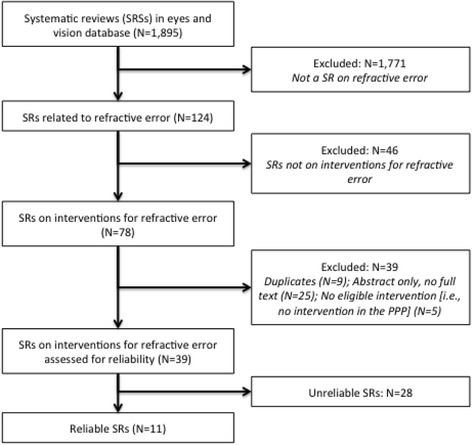
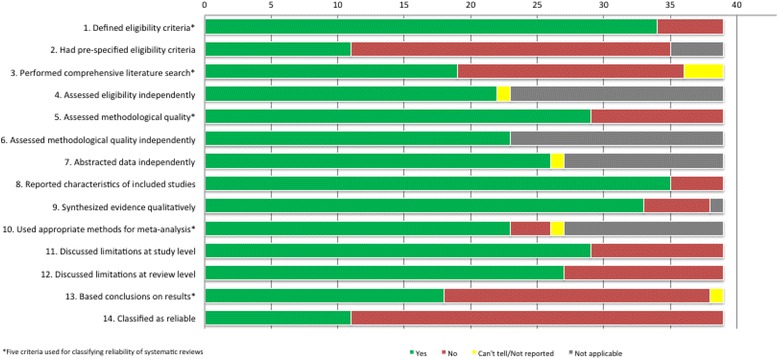
Results: We identified 124 systematic reviews related to refractive error; 39 met our eligibility criteria, of which we classified 11 to be reliable. Systematic reviews classified as unreliable did not define the criteria for selecting studies (5; 13%), did not assess methodological rigor (10; 26%), did not conduct comprehensive searches (17; 44%), or used inappropriate quantitative methods (3; 8%). The 11 reliable reviews were published between 2002 and 2016. They included 0 to 23 studies (median = 9) and analyzed 0 to 4696 participants (median = 666). Seven reliable reviews (64%) assessed surgical interventions.
Conclusions: Most systematic reviews of interventions for refractive error are low methodological quality. Following widely accepted guidance, such as Cochrane or Institute of Medicine standards for conducting systematic reviews, would contribute to improved patient care and inform future research.
Keywords: Clinical guidelines; Refractive error; Research waste; Systematic review standards.
Conflict of interest statement
Ethics approval and consent to participate
Not applicable.
Consent for publication
Not applicable.
Competing interests
EMW, SMN, TL have no financial or other interests. RSC chairs the refractive error PPP panel and is a member on the AAO PPP steering committee.
Publisher’s Note
Springer Nature remains neutral with regard to jurisdictional claims in published maps and institutional affiliations.
Figures
References
-
- Institute of Medicine . Clinical practice guidelines we can trust. Washington, DC: The National Academies Press; 2011.
-
- Li T, Vedula SS, Scherer R, Dickersin K. What comparative effectiveness research is needed? A framework for using guidelines and systematic reviews to identify evidence gaps and research priorities. Ann Intern Med. 2012;156(5):367–377. doi: 10.7326/0003-4819-156-5-201203060-00009. - DOI - PMC - PubMed
-
- Institute of Medicine . Finding what works in health care: standards for systematic reviews. Washington, DC: The National Academies Press; 2011. - PubMed
Publication types
MeSH terms
Grants and funding
LinkOut - more resources
Full Text Sources
Other Literature Sources
Medical
Miscellaneous
