


Assessing the impact of the introduction of an electronic hospital discharge system on the completeness and timeliness of discharge communication: a before and after study
- PMID: 28870188
- PMCID: PMC5584340
- DOI: 10.1186/s12913-017-2579-3
Assessing the impact of the introduction of an electronic hospital discharge system on the completeness and timeliness of discharge communication: a before and after study
Abstract
Background: Hospital discharge summaries are a key communication tool ensuring continuity of care between primary and secondary care. Incomplete or untimely communication of information increases risk of hospital readmission and associated complications. The aim of this study was to evaluate whether the introduction of a new electronic discharge system (NewEDS) was associated with improvements in the completeness and timeliness of discharge information, in Nottingham University Hospitals NHS Trust, England.
Methods: A before and after longitudinal study design was used. Data were collected using the gold standard auditing tool from the Royal College of Physicians (RCP). This tool contains a checklist of 57 items grouped into seven categories, 28 of which are classified as mandatory by RCP. Percentage completeness (out of the 28 mandatory items) was considered to be the primary outcome measure. Data from 773 patients discharged directly from the acute medical unit over eight-week long time periods (four before and four after the change to the NewEDS) from August 2010 to May 2012 were extracted and evaluated. Results were summarised by effect size on completeness before and after changeover to NewEDS respectively. The primary outcome variable was represented with percentage of completeness score and a non-parametric technique was used to compare pre-NewEDS and post-NewEDS scores.
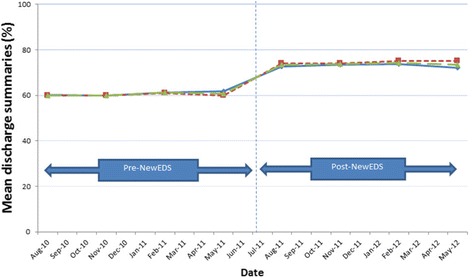
Results: The changeover to the NewEDS resulted in an increased completeness of discharge summaries from 60.7% to 75.0% (p < 0.001) and the proportion of summaries created under 24 h from discharge increased significantly from 78.0% to 93.0% (p < 0.001). Furthermore, five of the seven grouped checklist categories also showed significant improvements in levels of completeness (p < 0.001), although there were reduced levels of completeness for three items (p < 0.001).
Conclusion: The introduction of a NewEDS was associated with a significant improvement in the completeness and timeliness of hospital discharge communication.
Keywords: Completeness; Discharge summaries; Gold standard auditing tool; New electronic discharge system.
Conflict of interest statement
Ethics approval and consent to participate
This study was considered to be under the umbrella of a larger service evaluation, reference CfHEP005. The CfHEP005 was considered by the East London and The City Research Ethics Committee 1 and approval granted. Furthermore, researchers obtained Research and Development approval from Nottingham University Hospital NHS Trust and Nottinghamshire County Teaching Primary Care Trust. No patient identifiable data emanating from the study were recorded.
Consent for publication
This is not applicable.
Competing interests
The authors declare that they have no competing interests.
Publisher’s Note
Springer Nature remains neutral with regard to jurisdictional claims in published maps and institutional affiliations.
Figures

 Ward B
  Ward D57
  Combined
 Ward B
  Ward D57
  Combined
References
-
- The Health Foundation . Improving safety in primary care. London: The Health Foundation; 2011.
-
- Kripalani S, LeFevre F, Phillips CO, Williams MV, Basaviah P, Baker DW. Deficits in communication and information transfer between hospital-based and primary care physicians - implications for patient safety and continuity of care. JAMA-J Am Med Assoc. 2007;297(8):831–841. doi: 10.1001/jama.297.8.831. - DOI - PubMed
MeSH terms
LinkOut - more resources
Full Text Sources
Other Literature Sources
