


Effectiveness of a specific manual approach to the suboccipital region in patients with chronic mechanical neck pain and rotation deficit in the upper cervical spine: study protocol for a randomized controlled trial
- PMID: 28870191
- PMCID: PMC5584013
- DOI: 10.1186/s12891-017-1744-5
Effectiveness of a specific manual approach to the suboccipital region in patients with chronic mechanical neck pain and rotation deficit in the upper cervical spine: study protocol for a randomized controlled trial
Abstract
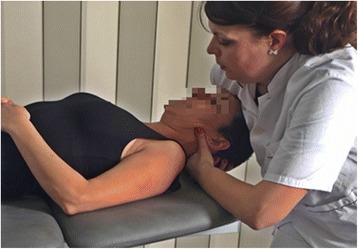
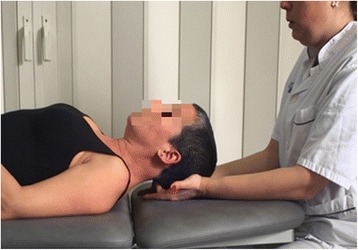
Background: Mechanical neck pain is a highly prevalent problem in primary healthcare settings. Many of these patients have restricted mobility of the cervical spine. Several manual techniques have been recommended for restoring cervical mobility, but their effectiveness in these patients is unknown. The aim of the present study is to compare the effectiveness of two types of specific techniques of the upper neck region: the pressure maintained suboccipital inhibition technique (PMSIT) and the translatory dorsal glide mobilization (TDGM) C0-C1 technique, as adjuncts to a protocolized physiotherapy treatment of the neck region in subjects with chronic mechanical neck pain and rotation deficit in the upper cervical spine.
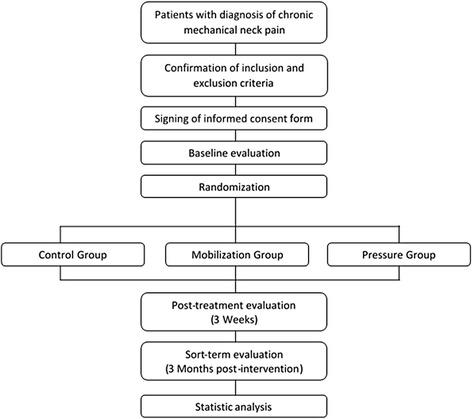
Methods: A randomized, prospective, double-blind (patient and evaluator) clinical trial. The participants (n = 78) will be randomly distributed into three groups. The Control Group will receive a protocolized treatment for 3 weeks, the Mobilization Group will receive the same protocolized treatment and 6 sessions (2 per week) of the TDGM C0-C1 technique, and the Pressure Group will receive the same protocolized treatment and 6 sessions (2 per week) of the PMSIT technique. The intensity of pain (VAS), neck disability (NDI), the cervical range of motion (CROM), headache intensity (HIT-6) and the rating of clinical change (GROC scale) will be measured. The measurements will be performed at baseline, post-treatment and 3 months after the end of treatment, by the same physiotherapist blinded to the group assigned to the subject.
Discussion: We believe that an approach including manual treatment to upper cervical dysfunction will be more effective in these patients. Furthermore, the PMSIT technique acts mostly on the musculature, while the TDGM technique acts on the joint. We expect to clarify which component is more effective in improving the upper cervical mobility.
Trial registration: ClinicalTrials.gov NCT02832232 . Registered on July 13th, 2016.
Keywords: Atlantoaxial joint; Cervical vertebrae; Range of motion; Suboccipital muscle inhibition.
Conflict of interest statement
Ethics approval and consent to participate
The study protocol has been approved by the Clinical Research Ethics Committee (CREC) of the Jordi Gol Institute of Research in Primary Healthcare (reference number P16/068) on May 25th, 2016 and has been registered at
Consent for publication
Consent was provided for images of the techniques to be included and published.
Competing interests
The authors declare that they have no competing interests.
Publisher’s Note
Springer Nature remains neutral with regard to jurisdictional claims in published maps and institutional affiliations.
Figures
References
-
- Gross AR, Aker PD, Goldsmith CH, Peloso P. Physical medicine modalities for mechanical neck disorders. Cochrane Database Syst Rev. 2000;(2):CD000961. - PubMed
-
- Gross AR, Hoving JL, Haines TA, Goldsmith CH, Kay T, Aker P. Movilización activa y pasiva para trastornos mecánicos de cuello. Oxford: En: La Cochrane Library plus en español; 2003.
-
- Fernández-de-las-Peñas C, Hernández-Barrera V, Alonso-Blanco C, Palacios-Ceña D, Carrasco-Garrido P, Jiménez-Sánchez S, et al. Prevalence of neck and low back pain in community-dwelling adults in Spain: a population-based national study. Spine. 2011;36:E 213–E 219. doi: 10.1097/BRS.0b013e3181d952c2. - DOI - PubMed
Publication types
MeSH terms
Associated data
LinkOut - more resources
Full Text Sources
Other Literature Sources
Medical
