


Tele-neurology in sub-Saharan Africa: A systematic review of the literature
- PMID: 28870567
- PMCID: PMC5678757
- DOI: 10.1016/j.jns.2017.07.037
Tele-neurology in sub-Saharan Africa: A systematic review of the literature
Abstract
Background: The rapid advancement in telecommunications on the African continent has opened up avenues for improving medical care to underserved populations. Although the greatest burden of neurological disorders is borne by Low-and-Middle Income Countries (LMICs) including sub-Saharan Africa (SSA), there is a profound paucity of neurologists to serve the population. Telemedicine presents a promising avenue for effective mobilization and utilization of the few neurologists in Africa.
Objective: To systematically review the published literature on the use of telemedicine for improved care and outcomes for patients with neurological disorders in SSA.
Methods: We searched PubMed and Cochrane library from January 1, 1980 to April 30, 2017 using the following keywords: "Telemedicine neurology Africa", "Teleneurology Africa", "Telestroke Africa", "Telerehabilitation Africa", "Telemedicine for epilepsy", "Telemedicine for Parkinson's disease Africa", "Telemedicine for dementia Africa", "Telehealth neurology Africa". Our inclusion criteria were randomized controlled trials, or case series that reported the utilization of telemedicine for care/education of individuals with neurological disorders in sub-Saharan Africa.
Results: This search yielded 6 abstracts. By consensus between two investigators, 1 publication met the criteria for inclusion and further review. The one study identified utilized telemedicine for the purpose of improving education/knowledge of 16 doctors and 17 allied health professionals in Parkinson's disease (PD) in Cameroon. The study noted feasibility and satisfaction of participants with telemedicine as well as improved knowledge base of participants after the educational course but noted access to healthcare by patients did not change. No studies have evaluated the use of telemedicine for care of patients with neurological disorders.
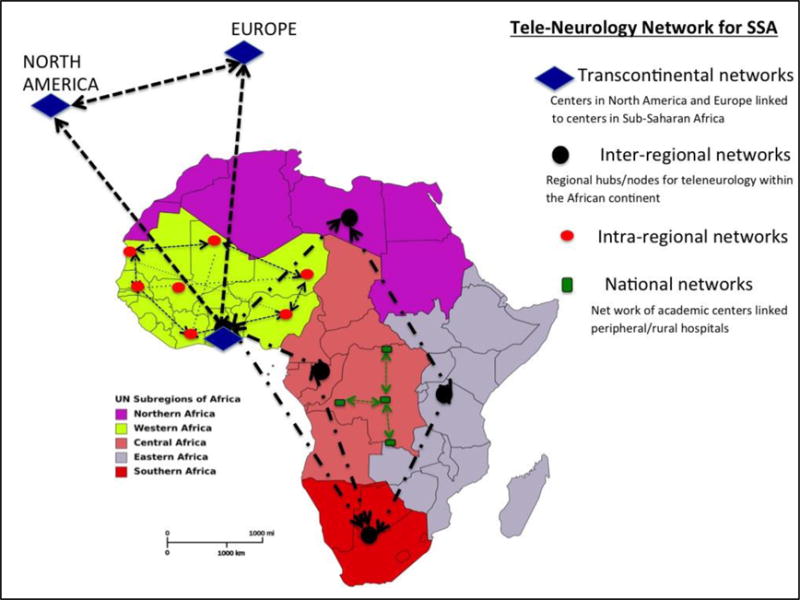
Conclusion: The indication is that teleneurology may be feasible in SSA and studies are needed to assess feasibility, acceptability, efficacy, cost-effectiveness of this promising discipline of neurology in these resource-limited settings. We propose the setting up of trans‑continental, inter-regional, intra-regional, and national networks of neurologists to utilize teleneurology platforms to improve the reach of neurology care in SSA.
Copyright © 2017 Elsevier B.V. All rights reserved.
Conflict of interest statement
Figures
References
-
- WHO. Global burden of neurological disorders: estimates and projections. http://www.who.int/mentalhealth/neurology/chapter2neurodisorderspublichc... accessed 3/07/2017.
-
- WHO. Neurology Atlas. 2004 http://www.who.int/mentalhealth/neurology/neurogyatlaslr.pdf accessed 3/07/2017.
-
- American Association of Telemedicine. What is telemedicine and telehealth? Available at http://www.americantelemed.org/files/public/abouttelemedicine/whatistele... Accessed 30/06/2017.
Publication types
MeSH terms
Grants and funding
LinkOut - more resources
Full Text Sources
Other Literature Sources
Medical
Research Materials
Miscellaneous
