. 2017 Sep 4;7(1):10141.
doi: 10.1038/s41598-017-09415-7.

Evolutionary morphology of the lizard chemosensory system

Affiliations

Evolutionary morphology of the lizard chemosensory system

Simon Baeckens et al. Sci Rep. .

Erratum in

Abstract

Foraging mode plays a pivotal role in traditional reconstructions of squamate evolution. Transitions between modes are said to spark concerted changes in the morphology, physiology, behaviour, and life history of lizards. With respect to their sensory systems, species that adopt a sit-and-wait strategy are thought to rely on visual cues primarily, while actively hunting species would predominantly use chemical information. The morphology of the tongue and the vomeronasal-organs is believed to mirror this dichotomy. Still, support for this idea of concerted evolution of the morphology of the lizard sensory system merely originates from studies comparing only a few, distantly related taxa that differ in many aspects of their biology besides foraging mode. Hence, we compared vomeronasal-lingual morphology among closely related lizard species (Lacertidae). Our findings show considerable interspecific variation indicating that the chemosensory system of lacertids has undergone substantial change over a short evolutionary time. Although our results imply independent evolution of tongue and vomeronasal-organ form, we find evidence for co-variation between sampler and sensor, hinting towards an 'optimization' for efficient chemoreception. Furthermore, our findings suggest species' degree of investment in chemical signalling, and not foraging behaviour, as a leading factor driving the diversity in vomeronasal-lingual morphology among lacertid species.


Conflict of interest statement

The authors declare that they have no competing interests.

Figures
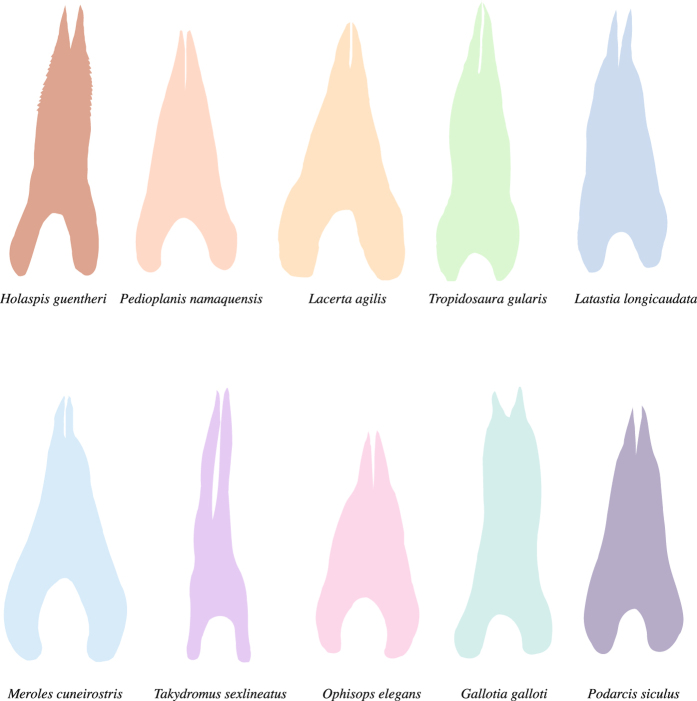
Figure 1
Figure 1
Illustration of the tongue form of ten lacertid lizards implemented in our study. All tongues are scaled to their head length (except Takydromus, which should be 43% smaller than visualized).
Figure 2
Figure 2
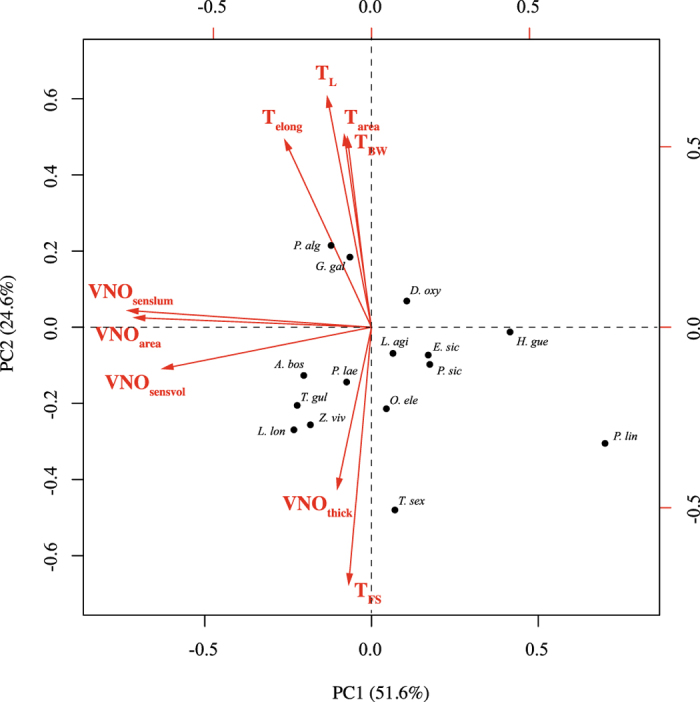
Biplot of the phylogenetic principal component analysis (pPCA) for the first two principal components (PCs) of 15 lacertid species. Red arrows indicate the PC loadings. The percentages of variance explained by the PCs are shown in the axis labels.
Figure 3
Figure 3
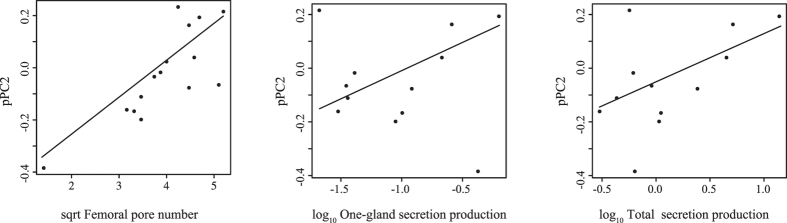
Graphs illustration the relationship (pGLS) between the morphology of the vomeronasal-lingual system (by PC2) of lacertid lizards and their investment in chemical signalling (as femoral pore number, one-gland secretion production and total secretion production).
Figure 4
Figure 4
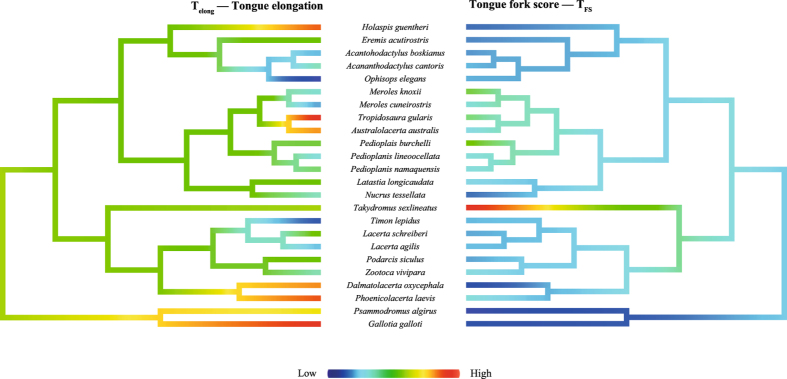
Ancestral character estimation of tongue elongation (Telong) and forkedness (TFS) along the branches and nodes of the tree for 24 lacertid lizard species. The illustration succeeds in visualizing the phylogenetic conservative character of both traits (Blomberg’s K > 1). Illustration made in R (function ‘contMap’, package ‘phytools’).
Figure 5
Figure 5
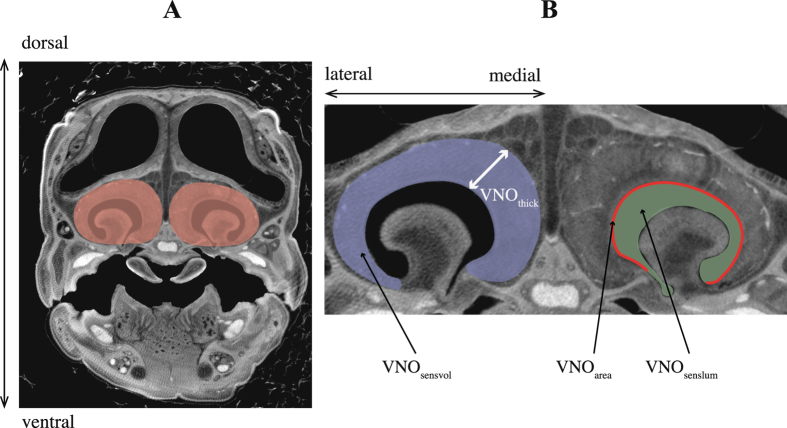
An example of reconstructed micro-CT images of a lacertid lizard head (Takydromus sexlineatus) highlighting the vomeronasal organs (VNOs). (A) transverse section of the complete head, with the VNOs in red; (B) transvers section focussing on the VNOs, with additional annotations on the measures used in this study. Abbreviations: VNOsensvol = volume of VNO sensory epithelium (blue), VNOsenslum = volume of VNO lumen (green), VNOthick = thickness of VNO sensory epithelium (white line with arrows), VNOarea = surface area of VNO sensory epithelium (red line).
Figure 6
Figure 6
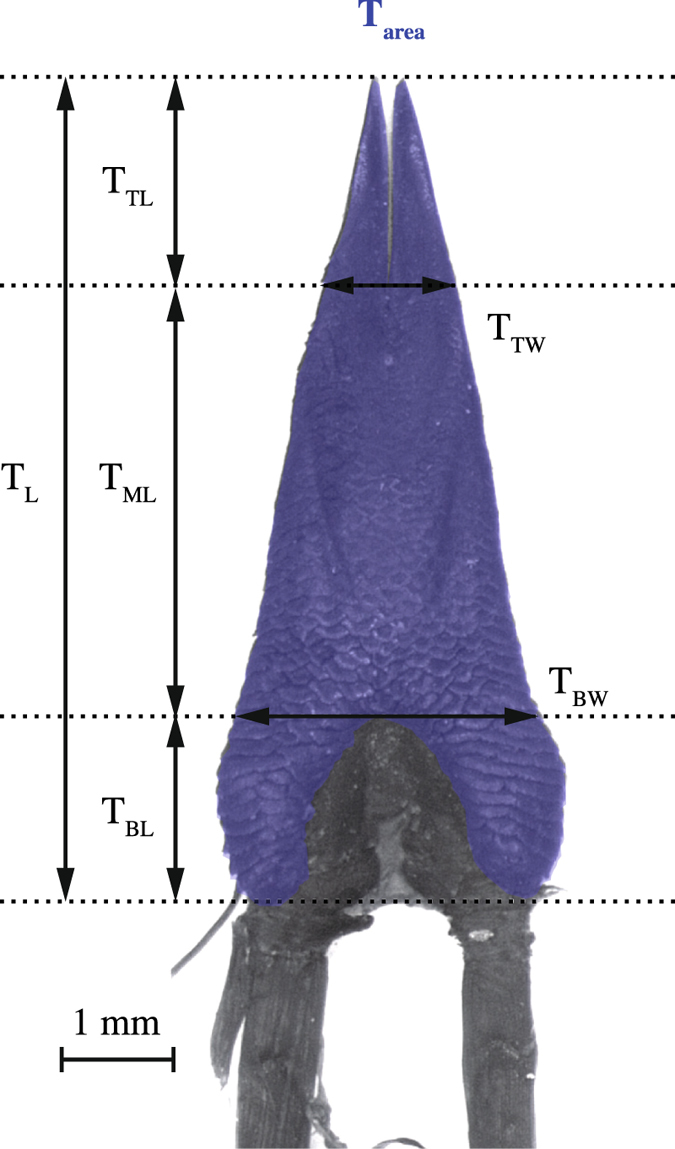
Photograph of a lacertid lizard’s tongue (dorsal view) with annotations on the morphological variables considered in this study. The surface area of the tongue is coloured. The tongue given for reference is from the species Acanthodactylus cantoris. Abbreviations: TBL = tongue base length; TBW = tongue base width; TML = tongue mid length; TTL = tongue tip length; TTW = tongue tip width; TL = tongue length; Tarea = tongue surface area.
Figure 7
Figure 7
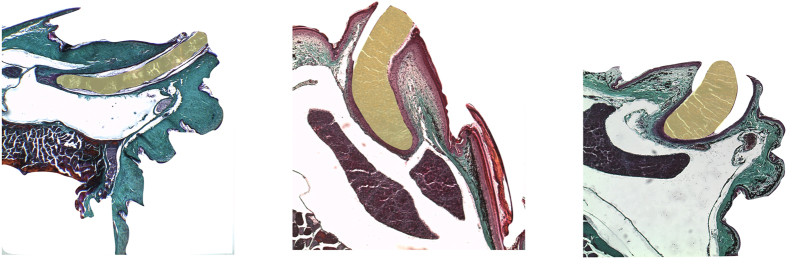
Photographs of transverse sections through the femoral glands of three lacertid lizards (from left to right: Timon lepidus, Tropidosaura gularis, Australolacerta australis). The femoral gland secretions or ‘ secretion plugs’ are coloured yellow.

References

    1. Schwenk K. The evolution of chemoreception in squamate reptiles: a phylogenetic approach. Brain. Behav. Evol. 1993;41:124–137. doi: 10.1159/000113830. - DOI - PubMed
    1. Schwenk K. Of tongues and noses: chemoreception in lizards and snakes. Trends Ecol. Evol. 1995;10:7–12. doi: 10.1016/S0169-5347(00)88953-3. - DOI - PubMed
    1. Cooper WE. Evolution and function of lingual shape in lizards, with emphasis on elongation, extensibility, and chemical sampling. J. Chem. Ecol. 1995;21:477–505. doi: 10.1007/BF02036744. - DOI - PubMed
    1. Cooper WE. Variation and evolution of forked tongues in squamate reptiles. Herpetol. Nat. Hist. 1996;4:135–150.
    1. Cooper WE. Correlated evolution of prey chemical discrimination with foraging, lingual morphology and vomeronasal chemoreceptor abundance in lizards. Behav. Ecol. Sociobiol. 1997;41:257–265. doi: 10.1007/s002650050387. - DOI

Publication types

LinkOut - more resources