


Racial and Ethnic Differences in Antibiotic Use for Viral Illness in Emergency Departments
- PMID: 28872046
- PMCID: PMC5613999
- DOI: 10.1542/peds.2017-0203
Racial and Ethnic Differences in Antibiotic Use for Viral Illness in Emergency Departments
Abstract
Background and objectives: In the primary care setting, there are racial and ethnic differences in antibiotic prescribing for acute respiratory tract infections (ARTIs). Viral ARTIs are commonly diagnosed in the pediatric emergency department (PED), in which racial and ethnic differences in antibiotic prescribing have not been previously reported. We sought to investigate whether patient race and ethnicity was associated with differences in antibiotic prescribing for viral ARTIs in the PED.
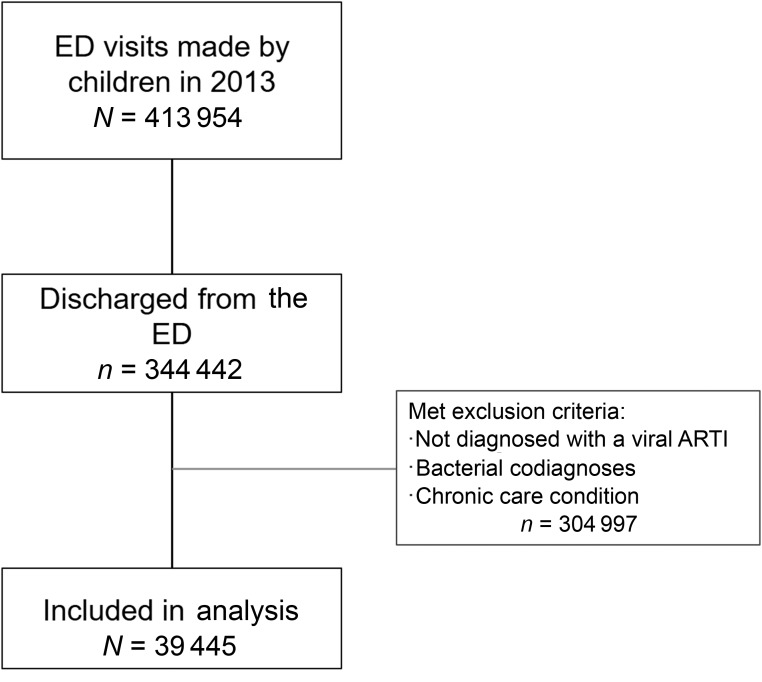
Methods: This is a retrospective cohort study of encounters at 7 PEDs in 2013, in which we used electronic health data from the Pediatric Emergency Care Applied Research Network Registry. Multivariable logistic regression was used to examine the association between patient race and ethnicity and antibiotics administered or prescribed among children discharged from the hospital with viral ARTI. Children with bacterial codiagnoses, chronic disease, or who were immunocompromised were excluded. Covariates included age, sex, insurance, triage level, provider type, emergency department type, and emergency department site.
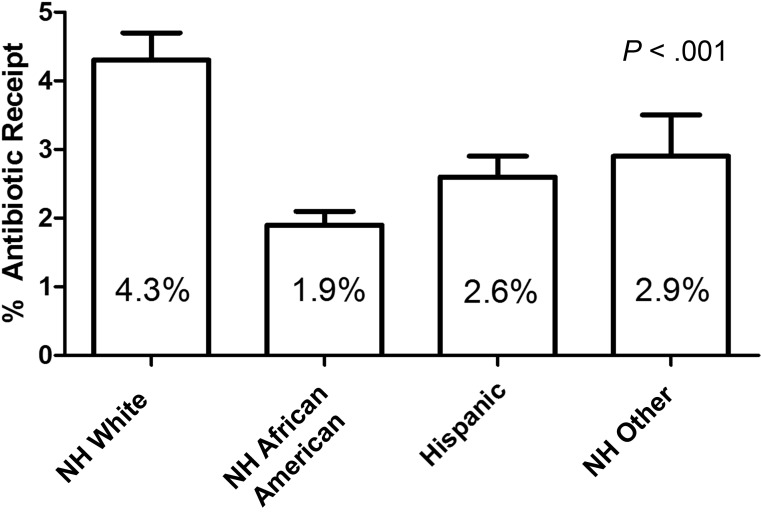
Results: Of 39 445 PED encounters for viral ARTIs that met inclusion criteria, 2.6% (95% confidence interval [CI] 2.4%-2.8%) received antibiotics, including 4.3% of non-Hispanic (NH) white, 1.9% of NH black, 2.6% of Hispanic, and 2.9% of other NH children. In multivariable analyses, NH black (adjusted odds ratio [aOR] 0.44; CI 0.36-0.53), Hispanic (aOR 0.65; CI 0.53-0.81), and other NH (aOR 0.68; CI 0.52-0.87) children remained less likely to receive antibiotics for viral ARTIs.
Conclusions: Compared with NH white children, NH black and Hispanic children were less likely to receive antibiotics for viral ARTIs in the PED. Future research should seek to understand why racial and ethnic differences in overprescribing exist, including parental expectations, provider perceptions of parental expectations, and implicit provider bias.
Copyright © 2017 by the American Academy of Pediatrics.
Conflict of interest statement
POTENTIAL CONFLICT OF INTEREST: The authors have indicated they have no potential conflicts of interest to disclose.
Figures
Comment in
-
Doing More About Health Care Disparities: Moving Past Description to Action.Pediatrics. 2017 Oct;140(4):e20172185. doi: 10.1542/peds.2017-2185. Epub 2017 Sep 5. Pediatrics. 2017. PMID: 28872047 No abstract available.
-
Re: Disparities Between Parental Expectations and Pediatric Antibiotic Prescribing.Pediatrics. 2018 Apr;141(4):e20180065. doi: 10.1542/peds.2018-0065. Pediatrics. 2018. PMID: 29602901 No abstract available.
References
-
- Alpern ER, Stanley RM, Gorelick MH, et al. ; Pediatric Emergency Care Applied Research Network . Epidemiology of a pediatric emergency medicine research network: the PECARN Core Data Project. Pediatr Emerg Care. 2006;22(10):689–699 - PubMed
-
- Wier LM, Yu H, Owens PL, Washington R. Overview of children in the emergency department, 2010: statistical brief #157 In: Healthcare Cost and Utilization Project (HCUP) Statistical Briefs. Rockville, MD: Agency for Healthcare Research and Quality; 2006 - PubMed
-
- Nyquist AC, Gonzales R, Steiner JF, Sande MA. Antibiotic prescribing for children with colds, upper respiratory tract infections, and bronchitis. JAMA. 1998;279(11):875–877 - PubMed
-
- Stone S, Gonzales R, Maselli J, Lowenstein SR. Antibiotic prescribing for patients with colds, upper respiratory tract infections, and bronchitis: a national study of hospital-based emergency departments. Ann Emerg Med. 2000;36(4):320–327 - PubMed
-
- Gaur AH, Hare ME, Shorr RI. Provider and practice characteristics associated with antibiotic use in children with presumed viral respiratory tract infections. Pediatrics. 2005;115(3):635–641 - PubMed
MeSH terms
Substances
Grants and funding
LinkOut - more resources
Full Text Sources
Other Literature Sources
Medical
Miscellaneous
