


Aberrant Signaling Pathways in T-Cell Acute Lymphoblastic Leukemia
- PMID: 28872614
- PMCID: PMC5618553
- DOI: 10.3390/ijms18091904
Aberrant Signaling Pathways in T-Cell Acute Lymphoblastic Leukemia
Abstract
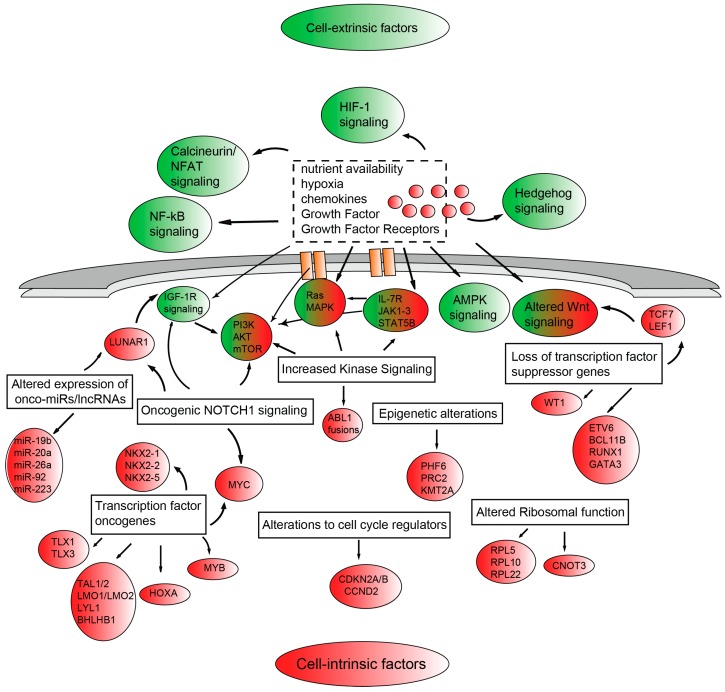
T-cell acute lymphoblastic leukemia (T-ALL) is an aggressive disease caused by the malignant transformation of immature progenitors primed towards T-cell development. Clinically, T-ALL patients present with diffuse infiltration of the bone marrow by immature T-cell blasts high blood cell counts, mediastinal involvement, and diffusion to the central nervous system. In the past decade, the genomic landscape of T-ALL has been the target of intense research. The identification of specific genomic alterations has contributed to identify strong oncogenic drivers and signaling pathways regulating leukemia growth. Notwithstanding, T-ALL patients are still treated with high-dose multiagent chemotherapy, potentially exposing these patients to considerable acute and long-term side effects. This review summarizes recent advances in our understanding of the signaling pathways relevant for the pathogenesis of T-ALL and the opportunities offered for targeted therapy.
Keywords: PI3K/AKT; acute lymphoblastic leukemia; oncogenes; targeted therapy.
Conflict of interest statement
The authors declare no conflict of interest.
Figures
References
-
- Ferrando A.A., Neuberg D.S., Staunton J., Loh M.L., Huard C., Raimondi S.C., Behm F.G., Pui C.H., Downing J.R., Gilliland D.G., et al. Gene expression signatures define novel oncogenic pathways in T cell acute lymphoblastic leukemia. Cancer Cell. 2002;1:75–87. doi: 10.1016/S1535-6108(02)00018-1. - DOI - PubMed
-
- Coustan-Smith E., Mullighan C.G., Onciu M., Behm F.G., Raimondi S.C., Pei D., Cheng C., Su X., Rubnitz J.E., Basso G., et al. Early T-cell precursor leukaemia: A subtype of very high-risk acute lymphoblastic leukaemia. Lancet Oncol. 2009;10:147–156. doi: 10.1016/S1470-2045(08)70314-0. - DOI - PMC - PubMed
-
- Inukai T., Kiyokawa N., Campana D., Coustan-Smith E., Kikuchi A., Kobayashi M., Takahashi H., Koh K., Manabe A., Kumagai M., et al. Clinical significance of early T-cell precursor acute lymphoblastic leukaemia: Results of the Tokyo children’s cancer study group study L99-15. Br. J. Haematol. 2012;156:358–365. doi: 10.1111/j.1365-2141.2011.08955.x. - DOI - PubMed
Publication types
MeSH terms
LinkOut - more resources
Full Text Sources
Other Literature Sources
Medical
Miscellaneous
